Jurisdiction -The Authority to Murder and Steal While Calling It ‘Legal’

Remember when the federal government obeyed the constitution and stayed out of our lives and affairs? Yeah, me neither. And that certainly isn’t going to change any time soon unless we put the evil Genie back into the bottle and shoot it into outer space. But we have to understand a few things in order to accomplish that goal in an expedient manner.

The federal government is conducting a massive land grab within the states of the union. They are literally using federal agencies and bureaucracies to do their dirty work for them in transferring these massive land holdings into the hands of the federal government in the interest of multi-million/billion dollar deals with private developers and investors to privately enrich those members of the United States government that are facilitating these land grabs with their unconstitutional federal laws and agencies. Case in point:

https://www.youtube.com/watch?v=IOqD19vsZEM

So, in relation to Mr. Joe Robertson’s case, we have to start by asking ourselves a question on the subject of land and control over that land. And that question is “What are the constitutional limits placed upon federal authority over land, especially land within the individual states of the union?” Well, let’s take a look:

First off, there is no such thing as “federal land” unless it is land ceded or purchased for the specific uses stated in the Constitution of the United States in Article 1, Section 8, Clause 17, which reads “To exercise exclusive Legislation in all Cases whatsoever, over such District (not exceeding ten Miles square) as may, by Cession of particular States, and the Acceptance of Congress, become the Seat of the Government of the United States, and to exercise like Authority over all Places purchased by the Consent of the Legislature of the State in which the Same shall be, for the Erection of Forts, Magazines, Arsenals, dock-Yards, and other needful Buildings;”

This tells us these specific things:

1) That the lands upon which D.C. is built as the “seat of government” is lands that are ceded or sold by the states to the “United States” for that particular use.

2) That ANY other land acquired and governed over by the “United States” MUST come to the “United States” by the same two mechanisms, cession by or purchase from the legislature of the particular state(s) in which the land is located.

3) That the only constitutionally valid uses of such land, other than that land used to create Washington D.C., is to be used for the express purposes of “which the Same shall be, for the Erection of Forts, Magazines, Arsenals, dock-Yards, and other needful Buildings.”

The language “which the Same” means “the land that was ceded or purchased from the state(s),” and the phrase “shall be” is a COMMAND that the use of that land is limited to those uses enumerated and described therein.

Outside of these enumerated uses, there are NO “federal lands” within the several states of the union, only state lands, and therefore, NO FEDERAL JURISDICTION over any such land. His attorney is the one that screwed him by never raising the lack of jurisdiction of the federal agencies and its courts to rule upon anything.

However, once he CONSENTED to be tried under federal law by failing to make such a challenge, THAT is what put the lid on the coffin. After that, any argument made as to what he did or did not do on the non-existent “federal land” was just another nail in the lid.

Jurisdiction – Do Federal Courts Actually HAVE Any?

Federal courts. We hear about them all time and all the big cases that they make decisions on. Most of them adverse to the rights of the American people and very pro-government. In many cases there is an issue of jurisdiction to be considered. Now why would you think that is?

We also hear all the time that “the courts are corrupt, especially the federal courts.” Now why would you think that is?

Perhaps, it is because it is all entirely true. These federal courts have NO jurisdiction within the states of the union, and they never have had.

I posted an earlier article about this case here. But I am adding this one so that you may have other perspectives of the significance of the case.

Take for instance, the Bundy cases in Nevada and Oregon. I have already explained in another article why the federal government’s Bureau of Land [Mis]management (BLM) had no jurisdiction on either piece of property, but consider what is currently developing in those cases and try to see why that lack of jurisdiction would also extend to the federal courts.

Also consider the true implications of that total lack of lawful authority. If the federal government, through its agents in the F.B.I., having no jurisdiction over the land in Oregon and no lawful authority to deny anyone in the state access for any reason, or to allow its occupation by a foreign entity operating under the guise of a federal agency having zero authority on that land, then there can be absolutely no question the LaVoy Finicum was murdered to cover up a massive armed robbery of the People of Oregon, the loot being the land itself.

That would also mean that all the other protestors that occupied the BLM compound were actually trying to stop an armed robbery of the People, and that they were shot at and kidnapped by a band of federally sanctioned murderers and thieves.

But the real stickler of the problem is in realizing that none of this would have been possible in either Nevada or Oregon without the knowing collusion of the higher echelons of government in both of those union states.  In other words, the People of Oregon and Nevada have traitors in their midst that are also in charge of their government.

And knowing that, do you really think that your particular state is in any less danger from the treasonous bastards that are currently in control of it?  Those same individuals that have already proven time-and-time again that they are perfectly willing to throw your individual rights and liberty under the bus of “progress” and collectivism in the name of public safety and welfare?

THINK for yourselves for once. Try to see the bigger picture for what it is and where it’s going, not just your own small little piece of it where the colors all look just right, at least, for right now.


https://supremecourtcase.wordpress.com/

Breaking! Trowbridge Forces Judge And DOJ To Abandon Federal Foreclosure Case Midstream!

https://supremecourtcase.wordpress.com/2015/10/01/sister-case-petitioner-demands-the-courts-constitutional-authority-plaintiff-and-court-go-silent-petitioner-demands-immediate-dismissal-and-costs-restitution-and-damages-of-1841451-45/

Massive Fraud in the Court – Case Reveals Breakthrough for The People

Federal Tax Case Shows Evidence the U.S. Legal System is a Fraud

http://www.truthandaction.org/landmark-case-reveals-150-years-constitutional-treason-committed-federal-courts/2/

https://supremecourtcase.wordpress.com/http://truenewsnetwork.com/2015/11/18/breaking-trowbridge-forces-judge-and-doj-to-abandon-federal-foreclosure-case-midstream/

Patrinuts – A Perfect Example of What NOT to Do.

And so it goes…

Someone on Facebook reached out to me today to take a look at a video from his first court appearance for several “transportation” related allegations that have been made against him by the State of Arkansas. This is the video of that court appearance.  Turn the volume up if necessary and listen well to the verbal exchanges that takes place between the Individual and the Judge presiding over the hearing.

https://www.youtube.com/watch?v=UXLvl3QSL1M

Which brings us to the rest of today’s lesson in how to go to court and how to make a proper challenge to said court’s presumption of jurisdiction in these sorts of matters.

The individual who posted this video has received numerous comments from the Patrinut crowd cheering him on and telling how great a job he did in addressing the court and making his challenge.  In order to understand the magnitude of the educational issues that we face in getting people properly prepared for these Ponzi schemes that are our lower courts, I have chosen to post ALL of the top level comments that were made.


Sarah Gallousis

wow, your so calm.
Like · Reply · Report · 5 hours ago

Scott Bailey

you dont have to prove jurisdiction they do
Like · 6 · Reply · Report · 5 hours ago

James Grogan

David Schwartz. This is what I’m talking about.
Like · Reply · Report · 4 hours ago

Benjamin Parker

You also need to demand a Probable Cause hearing because we all know they have none. They just arbitrarily skip that along w/ not informing you of the nature of the charges.
Edited · Like · 3 · Reply · Report · 4 minutes ago

Shawn Warren

That is the default they are now in dishonor of.
Like · 3 · Reply · Report · 4 hours ago

Kenneth Paul

ack quie essan ce
Like · 3 · Reply · Report · 4 hours ago

Heath Richards

You’re a martyr of the freedom movement, My Friend! God bless you and all that you do.
Like · 1 · Reply · Report · 3 hours ago

Kevin Freeman

When she made a plea for Shawn Warren you should have said my business here is done, and this has nothing to do with me, I am now leaving
Like · 4 · Reply · Report · 3 hours ago

Radley Bradford

I thought you had a button cam, regardless, fantastic work!
Like · 2 · Reply · Report · 3 hours ago

Benjamin Parker

Did you enter an affidavit or something similar beforehand stating that you are the man not the corporate fiction that the summons is for? Have heard its always best to enter things into the record before you go to court and say as little as possible when there.
Like · 2 · Reply · Report · 3 hours ago

Sean Westmoreland

In common law you say nothing you stand on claim ! And they have to prove jurisdiction! Which they can’t! Remember you break the law just going into their court by showing up as the corporate copyrighted name
Like · Reply · Report · 2 hours ago

Sean Westmoreland

But u did pretty good! I would never appear!
Like · Reply · Report · 2 hours ago

Sam Kelley

Those psychopaths will play their utterly childlike in mind written and spoken LEGALESE word spell and paper games all day long with you. They simply will not recognize anything but the LEGAL entity existing on a piece of paper which is PRESUMED to be SUBJECT to their corporate RULES and their privately owned and operated corporate Maritime Admiralty courts of LEGAL contracts and commerce. You’re dealing with psychopaths who have not one grain of decency, morals, empathy or intelligence. Stop going to their “courts”. Just void their bullshit LEGAL offers to contract on paper. When those utterly mindless corporate CODE enforcers hand you a TRAFFIC CITATION to sign representing the LEGAL NAME, void that shit. Write Refuse for Fraud, in the dead man LEGAL NAME box, and write your autograph in either corners of the offered contract to APPEAR to PLEA. But have the corporate CODE enforcer UNDERSTAND that you were not and or never are engaged in DRIVING, but were or do only travel. The burden of proof is on his dumbass to show evidence of you engaging in commerce on the roads for profit, gain or compensation. When he or she UNDERSTANDS, then they agree to the facts stated. So they go ahead and issue the fraudulent TRAFFIC CITATION anyway, and you get to Refuse it for Fraud and void that crap. When the “court” sends a NOTICE of a HEARING or TRIAL, then you take the copy to the prosecutor’s office and ask if they are attempting to use a fraudulent contract containing false evidence in their LEGAL proceeding. If their stupid asses say yes, then you advise them of the third degree Felony fines and imprisonment for attempting to use such false or fabricated physical evidence in a LEGAL proceeding. That should materialize into a DISMISSED. That’s if they have any fukin sense. Then tell them you will be more than happy to carry your ass on down to the Federal Court House to file those Felony charges on each and every INDIVIDUAL who participated in the fraud. Get the Feds snoopin around there and then see how they do.
Edited · Like · 2 · Reply · Report · 2 hours ago

Pat Jenn

can you post the claim?
Like · Reply · Report · 2 hours ago

Patty Brzezinski

I think you did a great job Shawn. I give you a lot of credit. Your video is a great learning tool for those that go to court after you. Cudoos.
Like · 2 · Reply · Report · 2 hours ago

David Coelho

YOU THE MAN! Keep it going you’re not alone
Like · 1 · Reply · Report · 2 hours ago

Shell Glow

Well done 😀
Like · 1 · Reply · Report · 2 hours ago

Brian O’Donnell

You did great.
Like · Reply · Report · 2 hours ago

Ricky Dean

You did very well, however you weren’t very specific on what type of jurisdiction the court lacked.
Like · Reply · Report · 1 hour ago

Michael Romero

If he has a “License” they have “Jurisdiction”, thereafter, agreed to be “Surety”.
Like · Reply · Report · 1 hour ago

Elissa Lynnie Thygesen

When they say ok, say, I object. (My 2 cents)
Like · Reply · Report · 1 hour ago

Bradley James Smith

That bailiff standing next to you is reason enough for dismissal. That was an outright act of intimidation, especially because the bailiff was not transferring records from you to the judge nor was there a reason for his interference within your space as you neither presented a risk to yourself or anyone within the court. File for dimissal due to intimidation and file a claim for emotional and psychological damages due to the trauma of that intimidation.
Like · 1 · Reply · Report · 53 minutes ago

Michael Romero

If it were a PUBLIC Court, that’s correct. The “Bailiff” being Armed makes him/her the “belligerent”. However, none of you are objecting to it.
Like · Reply · Report · 50 minutes ago

Michael Romero

Those are Private COURTS feeding on the PUBLIC ignorance, and that changes every thing.
Few will gain what I just said.
Edited · Like · 1 · Reply · Report · 49 minutes ago

Tao Lauw

I do wish all of the great legal minds providing this inherently ignorant advise would actually learn a thing or two before opening your mouth and risking SOMEONE ELSE’
HIDE with this stupidity.  (See my discussion posted below these comments).
Like · 1 · Reply · Edit · 29 minutes ago

Shane Messner

Like · Reply · Report · 24 minutes ago

Shane Messner

Great job!
Like · 2 · Reply · Report · 23 minutes ago

Randy Rebel Brown

Keep up the good fight my brother. I do similar in court. Been there 10 times. The last two they threw out…. However, I received two more pieces of paper from 2 other idiots in costumes to appear just recently. I will see how that goes. Never relent and never relinquish your inalienable rights,. You have harmed no person and no property, therefore have committed no crime. Thank you for standing up my brother
Like · 1 · Reply · Report · 6 minutes ago


So, you can plainly see that there are many in the Patrinut community that have absolutely no clue about law or how it works, much less what they are talking about in relation to all the other stuff they were commenting with. But, what they do have in abundance is way more mouth than they know what to do with when it comes to telling someone else how they should construct their own platform for legal failure. It completely amazes me how they egg each other on in their commission of legal suicide by the demonstrable ignorance and stupidity they propagate, and all because they are just too damned lazy to learn the proper methods and procedures for winning their case on appeal, or possibly even before it begins with a properly established affirmative defense and/or jurisdictional challenge.

Understand, this article isn’t for those of you that know how and why you have to make a proper record for appeal, it’s for those that haven’t a clue. Especially those Patrinuts that are under the mistaken and far more often delusional belief that they are grand champion players of these games. To actually win on appeal, it is imperative to understand how to properly make the record, because the lower courts are not designed to comply with the law or to administer any real justice of any kind. No sir/ma’am. They are there to siphon money from an unsuspecting public that has no clue how to play their legal games by the standardized rules, especially when the lower courts are not acting in compliance with those rules themselves.

After he made this post, the Individual PM’d me. This is the conversation that took place between myself and the Individual directly. Please pay attention to his comments where I used a bold and underlined font to make them more visible. Even more to the point, pay closer attention to my explanation of what to put in a proper Motion to challenge the courts jurisdictional presumptions, which will look just like this text.


  • Conversation started today
  • Tao Lauw

    2:06pm

    Tao Lauw

    What state is this in?

    Also, do you see all those comments on your post for the video? Just HOW much of that EXTREMELY bad advise did you attempt to actually use?

    Did you file anything in writing in this matter?

  • Shawn Warren

    2:26pm

    Shawn Warren

    Arkansas and I did a conditional acceptance notice

  • Tao Lauw

    2:35pm

    Tao Lauw

    I must also assume that this was your first appearance on the citations in question?

  • Shawn Warren

    2:41pm

  • Tao Lauw

    2:44pm

    Tao Lauw

    Try not to take this the wrong way, but there are some things I need to ask you up front.

  • Shawn Warren

    2:44pm

    Shawn Warren

    Sure go ahead

  • Tao Lauw

    2:45pm

    Tao Lauw

    Have you even bothered to see WHAT the subject matter is that is being regulated by the statutes you are charged under?

  • Shawn Warren

    2:46pm

    Shawn Warren

    Yes in my conditional acceptance

    They have failed to state and are in default

  • Tao Lauw

    2:51pm

    Tao Lauw

    Okay, try to understand that you NEED to forget that shit. It is a totally INCORRECT methodology for dealing with these ass-hats. If you are going to insist on listening to that crap and doing it anyway, then there is nothing that I can say that is going to make one damn bit of difference for you. And if you believe it will work, then proceed as you have and let me know how that actually turns out for you. Deal?

    Now, do you even realize that it is “TRANSPORTATION” that the statutes themselves proclaim as being the regulated subject matter over which they have jurisdiction?

    In other words, the code is regulating ONLY those engaging in the BUSINESS of transporting persons, goods, or property from one place to another FOR COMPENSATION OR HIRE as a CARRIER.

  • Shawn Warren

    2:53pm

    Shawn Warren

    Deal and yes I comprehend that. So go to trial and and have them prove I was engaging in commerce?

  • Tao Lauw

    2:55pm

    Tao Lauw

    Did I say “commerce” in this instance? NO! The term is “transportation” as THAT is the specific term being used to describe the regulated subject matter. And while they ARE related, the specific subject matter title is the issue to remain focused on.

  • Shawn Warren

    2:56pm

  • Tao Lauw

    2:58pm

    Tao Lauw

    Let me show you something here that is STRAIGHT out of your own state code that would have ended this bullshit at your first appearance if you had only NOT used that damned Patrinut crap and simply used their own bullshit regulations against them:

    2. A.C.A. § 23-2-201 (2016), Title 23 Public Utilities and Regulated Industries, Subtitle
    
    1. Public Utilities And Carriers, Chapter 2 Regulatory Commissions,
    
    Subchapter 2 -- Transportation, 23-2-201. Definitions., Arkansas Code of 1987 Annotated Official Edition © 1987-2016 by the State of Arkansas All rights reserved.
    
    (1) "Department" means the Arkansas State Highway and Transportation Department; and
    
    (2) "Transportation" means the carriage of persons and property for compensation by air, rail, water, carrier ...

    LOOK at number TWO in this text. WHAT does it say “transportation” IS?

  • Tao Lauw

    3:00pm

    Tao Lauw

    Look at the whole thing as it appears in the code:

    Title 23 Public Utilities and Regulated Industries Subtitle 1. Public Utilities And Carriers Chapter 2 Regulatory Commissions Subchapter 2 — Transportation

    A.C.A. § 23-2-201 (2016)

    23-2-201. Definitions.

    As used in this subchapter, unless the context otherwise requires:

    (1) “Department” means the Arkansas State Highway and Transportation Department; and

    (2) “Transportation” means the carriage of persons and property for compensation by air, rail, water, carrier pipelines, or motor carriers.

    HISTORY: Acts 1957, No. 132, § 1; A.S.A. 1947, § 73-151.

    http://web.lexisnexis.com/research/retrieve?_m=b580cfeb3a5a103547babc30c31aec46&docnum=2&_fmtstr=FULL&_startdoc=1&wchp=dGLbVzk-zSkAl&_md5=6a899bbc4fd63b0b3e185819c6f74e3b

    The term “carriers” as used here is PLURAL, as in applicable to EACH of those things listed, i.e. “AIR carrier,” “RAIL carrier,” “WATER carrier,” “pipelines,” or “MOTOR carrier.”  You get that?
  • Shawn Warren

    3:02pm

    Shawn Warren

    I see. So how would I use this in court?

  • Tao Lauw

    3:02pm

    Tao Lauw

    So, how about you STOP looking for magic beans and silver bullets and use their own statutory scheme to beat the shit out of them so you can sue them for malicious prosecution, false arrest/imprisonment, and constructive FRAUD!!

  • Shawn Warren

    3:02pm

    Shawn Warren

    Make them prove I was transporting ?

    • Tao Lauw

      3:31pm

      You file a WRITTEN “Motion for Discovery,” citing this statute and demanding that the prosecutor turn over ANY evidence in their possession or of which they have knowledge that shows that you were engaging in “transportation” for purposes of receiving compensation or “for hire” as a “carrier.”

      THEN, after they CAN’T provide you with that evidence, you file another WRITTEN “Motion to Dismiss for Lack of Jurisdiction,” that challenges both the subject matter and personal jurisdiction like so:

      ===========================

      The prosecution has provided no discovery showing the existence of any facts substantiated by eyewitness testimony or physical evidence that proves Respondent was engaging in any acts of “transportation” at the time of the alleged offense.
       
      Further, the prosecution has alleged no facts and provided no eyewitness testimony or physical evidence that would implicate Respondent as having ever engaged in “transportation” as that term is defined and used within A.C.A. § 23-2-201(2) in relation to the allegation(s) being made, which Respondent believes is a necessary fact element essential to the State’s claim of both subject matter and in personam (personal) jurisdiction.
       
      There is no eyewitness testimony or physical evidence that Respondent was ever being paid to transport persons, goods or property for compensation or hire as is required in order for Respondent to have been engaging in any form of “transportation” as that term is defined and used within A.C.A. § 23-2-201(2) in relation to the allegation being made.
       
      There is no eyewitness testimony or physical evidence in the form of a Bill of Lading, Passenger Manifest, Commercial Logbook, or any admission by Respondent himself or that of an eyewitness that Respondent was ever being paid to transport persons, goods or property for compensation or hire or was acting as a “carrier” for such purposes.
       
      As there is no eyewitness testimony or physical evidence that Respondent was ever engaged in “transportation” as defined in, and for the purposes stated in, A.C.A. § 23-2-201(2), then there is no evidence of the existence of subject matter jurisdiction in the instant matter.
       

      As no eyewitness testimony or physical evidence of subject matter jurisdiction over Respondent exists, the State has no standing to bring an action against Respondent in any matters relevant to “transportation,” including any alleged offenses defined thereunder within the laws and statutes of “this state.”

      Furthermore, absent subject matter jurisdiction, and absent any facts or evidence proving that Respondent was ever engaged in “transportation” as defined in, and for the purposes stated in, A.C.A. § 23-2-201(2), then there is no evidence of the existence of in personam jurisdiction over the Respondent in the instant matter.

      Therefore, this court lacks subject matter and in personam jurisdiction, the two primary elements of jurisdiction over Respondent.

      As neither subject matter nor personal jurisdiction exists over Respondent in this instant matter, and the State lacks subject matter standing to prosecute the matter, there is no justiciable issue before the court, thus depriving the court of the final element of jurisdiction.

      Whereby Respondent moves the court to immediately dismiss this matter with prejudice.

      =====================================


  • Shawn Warren

    3:34pm

    Shawn Warren

    I will do just that. Thank you very much for your help.

  • Tao Lauw

    3:36pm

    Tao Lauw

    There is one thing that you need to understand and expect; the lower court isn’t going to care about or respect the law. THAT is why you do EVERYTHING in writing, so that the higher court can see what actually happened when it goes to appeal. STOP worrying about losing at trial. The game is RIGGED to virtually ensure that you DO lose at trial in the off-chance that you can’t or won’t get your appeal done in the manner and time required.

  • Shawn Warren

    3:36pm

    Shawn Warren

    I am tired of never getting anywhere with the patrinut stuff. Want to be able to defeat them the right way and I am tired of being martryer

  • Tao Lauw

    3:37pm

    Tao Lauw

    So make damn sure to STUDY and faithfully follow the procedures for perfecting and getting your appeal. Start reading and learning about that NOW, BEFORE you actually need it. Make notes, recheck them, study them, then make sure you follow them.

  • Shawn Warren

    3:37pm

    Shawn Warren

    Yes I comprehend I will have to appeal. I will lol up the timeline houses for appeal in Arkansas

  • Tao Lauw

    3:37pm

    Tao Lauw

    Just promise one other thing if you don’t mind…?

  • Shawn Warren

    3:38pm

    Shawn Warren

    Sure what?

  • Tao Lauw

    3:39pm

    Tao Lauw

    Tell everyone else about how the Patrinut bullshit DOESN’T work, and that you CAN beat them at their own game IF you will just learn HOW. Because there simply ISN’T any shortcuts in the form of magic paperwork or legal silver bullets to getting it done.

    The ONLY silver bullet comes AFTER you have kicked their asses on the law repeatedly, THEN they will avoid you like the plague.

  • Shawn Warren

    3:40pm

    Shawn Warren

    You have my word I will.


    Cause none ice it has worked for me so far and I’ve been trying for close to 8 years

  • Tao Lauw

    3:41pm

    Tao Lauw

    The only thing that I heard you do properly and for the right reasons in that video is to begin with “I’m here by special appearance to challenge the jurisdiction of the court in the instant matter.” Everything else was wasteful and self-prejudicial bullshit.

  • Shawn Warren

    3:42pm

    Shawn Warren

    Right. I am still learning.

  • Tao Lauw

    3:42pm

    Tao Lauw

    Now, I posted the same thing I wrote here for you as a comment on that video link you sent over. Let me know how that all goes over with the Patrinut crowd that has collected there.

  • Shawn Warren

    3:43pm

    Shawn Warren

    I appriciate your straight forward not beating around the bush answers.


    I will keep you posted.

  • Tao Lauw

    3:44pm

    Tao Lauw

    Also, may I use that as a group discussion lesson on my wall, legal discussion group, and my blog? Better to use it to teach others what NOT to do as well as what TO do.

  • Shawn Warren

    3:44pm

    Shawn Warren

    Please do

  • Tao Lauw

    3:44pm

    Tao Lauw

    Your video I mean?

  • Shawn Warren

    3:44pm

    Shawn Warren

    That’s part of why I do what I do

  • Tao Lauw

    3:44pm

    Tao Lauw

    If you don’t mind, is it small enough to email or do you have it in DropBox or somewhere online that I can link directly to it?

    It isn’t easy to download one from Facebook is why I’m asking.

  • Shawn Warren

    3:45pm

    Shawn Warren

    Uploading to YouTube now I can email it to you if I can figure out how

  • Tao Lauw

    3:46pm

    Tao Lauw

    If it’s on YouTube then that is enough. Just send me the link once its up.

  • Shawn Warren

    3:46pm

    Shawn Warren

    Will do

  • Tao Lauw

    3:55pm

    Tao Lauw

    Also, would you mind if I use this chat session to show your thoughts on the matter?

  • Tao Lauw

    4:14pm

    Tao Lauw

    You need to amend one of the paragraphs to read thus:

    As no jurisdiction exists over Respondent in this instant matter, and the State lacks standing to prosecute the matter, there is no justiciable issue before the court, thus depriving the court of the final element of jurisdiction.

    Got it?

  • Shawn Warren

    4:21pm

    Shawn Warren

    Use what ever you need. And I just got the first call saying to make the judge pay the taxes on the charges. Jean Keating work.

    Got it


As you read in his own comments, for almost eight years the Patrinut crap simply hasn’t ever worked for him, and it certainly doesn’t work in the manner that its many uneducated and illiterate-in-law advocates would like you to believe it does. If it did, then they would be doing nothing but posting win after win by doing the things they do.  And they simply don’t, because it doesn’t work. It doesn’t work because it doesn’t properly address the issues being litigated. It doesn’t work because their methods simply  don’t follow LAW. Which is an issue that I’ve addressed on this blog before in another article.

So, if you aren’t willing to even read the laws and statutes that the other party is trying to use against you in these courts, just how do you ever intend to understand the allegations and fight back against them? Osmosis? It’s like playing a new board game you’ve never seen and don’t have the first clue about what the rules are, or even the point of the game. And yet, using only a plethora of magic Patrinut paper incantations and origami non-pleadings, you expect to beat all the other vastly experienced players by simply saying “I win, you lose!”  And just in case that sounds somewhat familiar, that’s because you have probably heard something similar before:


As you can see from the Arkansas statutes themselves, he already had an affirmative defense that would have served him well and most likely gotten the Judge’s attention enough that the jurisdictional challenge during his court appearance might have ended both the proceeding and the matter much more in his favor. Especially if he went to the appellate court  with a documented case of having properly made the oral objection and jurisdictional challenge in open court as well as in a properly written Motion to Dismiss for Lack of Jurisdiction.

Two things that will never help you win a court case is willful ignorance and being too damned lazy to learn how to do something properly that needs to or must be done in relation to the case being adjudicated and prepared for appeal.

Therefore, I issue a call to action! PATRINUTS UNITE!!

Then, PLEASE, hold each others clammy and pasty little hands while crossing the legal streets, and march your ill-informed and unstudied asses right down to your local law library and learn to frickin’ READ already!!

Just once, for your own sake and the sanity of those of us that have actually made the effort and sacrifices necessary to really and truly understand the fallacies of your arguments and position, TRY to comprehend how law is supposed to actually work!! Especially before you open your miseducated and unprepared mouth and provide useless disinformation to otherwise innocently ignorant individuals as if you know what the hell you’re doing!! STOP trying to make people believe that you have actually done the dumb-ass shit that you are proclaiming and that it’s legally infallible, which I would wager considerable money that none of you actually have. And if you did, then there is even better money to be made betting that it has never worked any better for you than it will the poor schmuck that is dumb enough to believe you know WTF you’re even talking about.

Doing this crap doesn’t make you look intelligent the way you think it does. Just the opposite in fact. But what it does do is literally make you a stumbling block to others in understanding the true nature and function of law as well as making you a direct danger to the legal safety, health, and welfare of your fellow man.

Attorneys – Like Mosquitoes, They Can Only Survive on the Blood of Others

A funny thing happened on the way to reading my way through a deluge of emails; I came across one that entered my inbox earlier yesterday, but which I did not actually see until the early morning hours of today.  The email reads thusly:


I’ve seen some of your videos on YouTube and wanted to tell you that you’re wrong.  You appear not to be able to distinguish the difference from the right to travel and the State’s right to regulate the operation of a dangerous mode of transportation that can harm, injure, or kill people and damage private or public property.  That State right is the doctrine of police power, which was adopted into the US Constitution by the 10th Amendment.  You should research it – plenty of SCOTUS cases in support.  How do I know?  I practiced constitutional law for over 35 years and fought govt over-reach and REAL infringement on rights.

Also, before becoming a lawyer, a group of us created the “right to travel vs driver’s license”  issue way back in 1972.  You use all of our research, court cases and tactics we developed almost 45 years ago.  We sold pamphlets, cassette tapes and gave seminars.  And it was BS then and is BS now.  I was amazed that it was still around.
You should rethink misleading people on this issue – you are perpetrating a fraud.  Not very patriotic of you.

Here then is my response to this admonition, which I reserve the right to amend over time as necessary for completeness and accuracy as time and information allows (same thing I told him in my emailed response):

Mr. Galt, you, like many before you, appear to be assuming quite a bit about what I do or do not know. And I can very well and do distinguish between a right to travel and the state police power to regulate. And there are MANY things and activities that can injure or kill that the state demonstrably has NO power whatsoever to interfere with or take away.  The fact that they use illegitimate reasoning and deadly force to get their way does NOT make them right nor their actions lawful, even though they may have legislatively or judicially declared their actions to be ‘legal.’ History documents that Adolph Hitler did the same thing if memory serves, and look how he wound up when it was all said and done. And I find no increase in your personal merit, credibility, or ability by your admission of having misunderstood and mishandled a particular subject of much legal and political debate for more than 35 years. How is an admission of perpetual misconception and/or incompetence in understanding something so simple and fundamental to the rightful free exercise and enjoyment of individual liberty and rights supposed to legitimize your position of telling me that I am “wrong” simply because you and those like you were incapable of comprehending the simplicity of thought and action relating to individual rights and liberty so as to understand this most basic of human concepts and do it right?

You also appear to be holding the mistaken belief that the various constitutions are themselves the well-spring of the rights and liberties of We the People, and that we are the ones bound by their respective provisions and principles. That is a demonstrably unsubstantiated and fundamentally unsafe foundational premise, as no constitution on this planet is now or ever has been the source of our inherent and fundamental individual rights and liberties. In that respect, its sole purpose as a grantor of any and all delegated powers and authority, and prohibitions upon the use of same, is applicable and binding only upon our servant government and its actors, regardless of branch, department, or office. The only thing a constitution does directly for the People is to provide a reminder to those in government that they are in fact, NOT the ones in charge of everything, and to preserve an actionable remedy to remove, alter, or abolish any or all parts of that government when it fails to adhere to the proper limits upon its use of that power and authority.

Now, let’s start with what I feel should be some rather simplistic facts and logic in terms of laying a foundation for this response, beginning with certain facts that we know for certain are true:

1)  It is NOT illegal for an individual to purchase an automobile or truck of any classification or type for private non-commercial use in any state of the union.

2)  There are NO laws placing any restrictions upon the number of automobiles or trucks that a private individual can purchase.

3)  There are NO laws prohibiting the free exchange of lawfully owned private automobiles or trucks between private individuals or private individuals and business’.
4)  The foundation of facts established by items 1-3 begs the conclusion that any man may purchase and own any number of automobiles or trucks as their own private property, and may do with them as he might please as to their purchase, sale, transfer, use, or destruction. After all, he lawfully and rightfully owns them, not the state, not society, and most certainly not government as it is a creature of man’s own lesser design and creation.  Only a lien-holder would have say in the matter, and neither the state nor its agents are parties to that contractual agreement as lien-holders, so they have no legitimate claim under it and no duty towards it other than ensuring that the contract does not violate properly enacted and applicable law governing such contracts or that it is not unconscionable toward either party in its terms.
However, it would appear to be your position that the state, while it has no lawful authority to say or do anything at all in relation to any of the things described in 1-4 above, can somehow still claim it has the legitimate authority to tell someone that they have no inherent or fundamental right to actually use the private property that they lawfully purchased and own for its intended and designed purpose. Thomas Jefferson would probably have first laughed in the face of any judge or attorney that would dare foment such an obviously liberty and individual rights denying concept, and then, sought their disbarment and/or impeachment, rapidly followed by criminal charges or lunatic commitment papers.   Jefferson’s thoughts on such stupidity are rather poignant, The right to use a thing comprehends a right to the means necessary to its use, and without which it would be useless.” –Thomas Jefferson to William Carmichael, 1790. ME 8:72

Jefferson had much to say on the concept and law of private property ownership and use:

Property Rights:

“The true foundation of republican government is the equal right of every citizen in his person and property and in their management.” –Thomas Jefferson to Samuel Kercheval, 1816. ME 15:36

“A right to property is founded in our natural wants, in the means with which we are endowed to satisfy these wants, and the right to what we acquire by those means without violating the similar rights of other sensible beings.” –Thomas Jefferson to Pierre Samuel Dupont de Nemours, 1816. ME 14:490

“[We in America entertain] a due sense of our equal right to… the acquisitions of our own industry.” –Thomas Jefferson: 1st Inaugural, 1801. ME 3:320

“He who is permitted by law to have no property of his own can with difficulty conceive that property is founded in anything but force.” –Thomas Jefferson to Edward Bancroft, 1788. ME 19:41

“That, on the principle of a communion of property, small societies may exist in habits of virtue, order, industry, and peace, and consequently in a state of as much happiness as Heaven has been pleased to deal out to imperfect humanity, I can readily conceive, and indeed, have seen its proofs in various small societies which have been constituted on that principle. But I do not feel authorized to conclude from these that an extended society, like that of the United States or of an individual State, could be governed happily on the same principle.” –Thomas Jefferson to Cornelius Camden Blatchly, 1822. ME 15:399

The Origin of Ownership:

“It is a moot question whether the origin of any kind of property is derived from nature at all… It is agreed by those who have seriously considered the subject that no individual has, of natural right, a separate property in an acre of land, for instance. By an universal law, indeed, whatever, whether fixed or movable, belongs to all men equally and in common is the property for the moment of him who occupies it; but when he relinquishes the occupation, the property goes with it. Stable ownership is the gift of social law, and is given late in the progress of society.” –Thomas Jefferson to Isaac McPherson, 1813. ME 13:333

“A right of property in moveable things is admitted before the establishment of government. A separate property in lands, not till after that establishment. The right to moveables is acknowledged by all the hordes of Indians surrounding us. Yet by no one of them has a separate property in lands been yielded to individuals. He who plants a field keeps possession till he has gathered the produce, after which one has as good a right as another to occupy it. Government must be established and laws provided, before lands can be separately appropriated, and their owner protected in his possession. Till then, the property is in the body of the nation, and they, or their chief as trustee, must grant them to individuals, and determine the conditions of the grant.” –Thomas Jefferson: Batture at New Orleans, 1812. ME 18:45

“The laws of civil society, indeed, for the encouragement of industry, give the property of the parent to his family on his death, and in most civilized countries permit him even to give it, by testament, to whom he pleases.” –Thomas Jefferson to Thomas Earle, 1823. ME 15:470

Every Citizen is Entitled to Own Property:

“The political institutions of America, its various soils and climates, opened a certain resource to the unfortunate and to the enterprising of every country and insured to them the acquisition and free possession of property.” –Thomas Jefferson: Declaration on Taking Up Arms, 1775. Papers 1:199

“The earth is given as a common stock for man to labor and live on. If for the encouragement of industry we allow it to be appropriated, we must take care that other employment be provided to those excluded from the appropriation. If we do not, the fundamental right to labor the earth returns to the unemployed… It is not too soon to provide by every possible means that as few as possible shall be without a little portion of land. The small landholders are the most precious part of a state.” –Thomas Jefferson to James Madison, 1785. ME 19:18, Papers 8:682

“No right [should] be stipulated for aliens to hold real property within these States, this being utterly inadmissible by their several laws and policy.” –Thomas Jefferson: Commercial Treaties Instructions, 1784.

“Whenever there is in any country uncultivated lands and unemployed poor, it is clear that the laws of property have been so far extended as to violate natural right.” –Thomas Jefferson to James Madison, 1785. ME 19:18, Papers 8:682

“[The] unequal division of property… occasions the numberless instances of wretchedness which… is to be observed all over Europe.” –Thomas Jefferson to James Madison, 1785. ME 19:17, Papers 8:681

“I am conscious that an equal division of property is impracticable. But the consequences of this enormous inequality producing so much misery to the bulk of mankind, legislators cannot invent too many devices for subdividing property, only taking care to let their subdivisions go hand in hand with the natural affections of the human mind.” –Thomas Jefferson to James Madison, 1785. ME 19:17, Papers 8:682

The Protection of Property Rights:

“[The] rights [of the people] to the exercise and fruits of their own industry can never be protected against the selfishness of rulers not subject to their control at short periods.” –Thomas Jefferson to Isaac H. Tiffany, 1816.

“I may err in my measures, but never shall deflect from the intention to fortify the public liberty by every possible means, and to put it out of the power of the few to riot on the labors of the many.” –Thomas Jefferson to John Tyler, 1804. ME 11:33

“Our wish… is that… equality of rights [be] maintained, and that state of property, equal or unequal, which results to every man from his own industry or that of his fathers.” –Thomas Jefferson: 2nd Inaugural Address, 1805. ME 3:382

“To take from one because it is thought that his own industry and that of his father’s has acquired too much, in order to spare to others, who, or whose fathers have not exercised equal industry and skill, is to violate arbitrarily the first principle of association–‘the guarantee to every one of a free exercise of his industry and the fruits acquired by it.'” –Thomas Jefferson: Note in Destutt de Tracy’s “Political Economy,” 1816. ME 14:466

“If the overgrown wealth of an individual is deemed dangerous to the State, the best corrective is the law of equal inheritance to all in equal degree; and the better, as this enforces a law of nature, while extra-taxation violates it.” –Thomas Jefferson: Note in Destutt de Tracy’s “Political Economy,” 1816. ME 14:466

Rights Associated With Ownership:

“It would be singular to admit a natural and even an hereditary right to inventors… It would be curious… if an idea, the fugitive fermentation of an individual brain, could, of natural right, be claimed in exclusive and stable property. If nature has made any one thing less susceptible than all others of exclusive property, it is the action of the thinking power called an idea, which an individual may exclusively possess as long as he keeps it to himself; but the moment it is divulged, it forces itself into the possession of every one, and the receiver cannot dispossess himself of it. Its peculiar character, too, is that no one possesses the less, because every other possesses the whole of it. He who receives an idea from me, receives instruction himself without lessening mine; as he who lights his taper at mine, receives light without darkening me. That ideas should freely spread from one to another over the globe, for the moral and mutual instruction of man, and improvement of his condition, seems to have been peculiarly and benevolently designed by nature, when she made them, like fire, expansible over all space, without lessening their density in any point, and like the air in which we breathe, move and have our physical being, incapable of confinement or exclusive appropriation. Inventions then cannot, in nature, be a subject of property. Society may give an exclusive right to the profits arising from them, as an encouragement to men to pursue ideas which may produce utility, but this may or may not be done, according to the will and convenience of the society, without claim or complaint from anybody… The exclusive right to invention [is] given not of natural right, but for the benefit of society.” –Thomas Jefferson to Isaac McPherson, 1813. ME 13:333

“By nature’s law, every man has a right to seize and retake by force his own property taken from him by another by force or fraud. Nor is this natural right among the first which is taken into the hands of regular government after it is instituted. It was long retained by our ancestors. It was a part of their common law, laid down in their books, recognized by all the authorities, and regulated as to circumstances of practice.” –Thomas Jefferson: Batture at New Orleans, 1812. ME 18:104

“Charged with the care of the general interest of the nation, and among these with the preservation of their lands from intrusion, I exercised, on their behalf, a right given by nature to all men, individual or associated, that of rescuing their own property wrongfully taken.” –Thomas Jefferson to W. C. C. Claiborne, 1810. ME 12:383

“Nothing is ours, which another may deprive us of.” –Thomas Jefferson to Maria Cosway, 1786. ME 5:440

“[If government have] a right of demanding ad libitum and of taxing us themselves to the full amount of their demand if we do not comply with it, [this would leave] us without anything we can call property.” –Thomas Jefferson: Reply to Lord North, 1775. Papers 1:233

“The first foundations of the social compact would be broken up were we definitely to refuse to its members the protection of their persons and property while in their lawful pursuits.” –Thomas Jefferson to James Maury, 1812. ME 13:145

“Persons and property make the sum of the objects of government.” –Thomas Jefferson to James Madison, 1789. ME 7:459

“The right to sell is one of the rights of property.” –Thomas Jefferson to Handsome Lake, 1802. ME 16:395

“The power of repelling invasions, and making laws necessary for carrying that power into execution seems to include that of occupying those sites which are necessary to repel an enemy, observing only the amendment to the Constitution which provides that private property shall not be taken for public use without just compensation… Where the necessary sites cannot be obtained by the joint and valid consent of parties,… provision should be made by a process of ad quod damnum, or any other more eligible means for authorizing the sites which are necessary for the public defense to be appropriated to that purpose.” –Thomas Jefferson: Message on Defence, 1808. ME 3:326

You now might better recognize this concept of yours, as it is essentially a claim that government can deny or convert to privilege the rightful and lawful use of private property against him who lawfully owns and controls it. It is a concept very much in line with that of an unlawful governmental taking or conversion of property, which is something else that SCotUS has addressed on more than one occasion, albeit with ever increasing ineptitude and leanings toward destruction of rights and usurpation of power.

Which brings me to the one question that no attorney or judge ever appears to be able to reasonably explain when asked, “how did the people go from having every right to using ANYTHING that they lawfully owned and possessed, whether that be their feet, a burrow or horse, a chariot, a sled, a litter, a wagon, or a “motor car,” to freely travel upon the roadways of their age, to suddenly having that right converted into a mere privilege due to nothing more than the advancement of time and technology coupled with the whims of other men?”

Which then, of course, begs the followup question;  “Can you name any other inherent and fundamental individual right that has been so fully and unlawfully converted into a licensed privilege simply because time and advancements in technology made changes in the manner of things and devices used to exercise it?” I certainly can’t. Nor can I fathom how any court or governmental body could have possibly come to a lawful and constitutional conclusion that they suddenly had a new power and authority that they had never previously possessed in that they could arbitrarily take away a man’s right to the use of his own private property for any and all LAWFUL (not LEGAL) purposes unless he first sought and received governmental permission to do so.

And any argument that the government has the right to deny the use of THEIR roads is patently false, because the roads are neither owned by nor belong to the government. They belong to the people. WE paid for them to be built and to be maintained. They are OURS. Government is nothing more than our elected and appointed steward for seeing to it that the roads remain fit for OUR use in pursuit of our individual private business or pleasure.

Even more to the point, just WHO could have possibly given the state legislature, or any other body of government, the authority to make that conversion of fundamental and inherent individual rights and liberties into lesser government sanctioned and licensed/permitted privileges?  Such a thing is inconceivable in a constitutional republic. If I have no personal or individual right to tell someone else that they cannot use either their private property, or our mutual property in the form of the public roads, in a lawful and peaceful manner, whether such use is done independently or simultaneously. And neither you nor anyone else has any such lawful right.  And if none of us individually have any such lawful power and authority over another man, then neither does ANY governmental agency or agent, as their just powers are derived from us. And if we don’t lawfully have it, we cannot delegate it to another, not even to our own legal creation known as government.

The collective power of government was only intended and authorized to be used against particular members within We the People that had committed unlawful acts against the person, rights or property of another individual or group. And even then, that authority was limited to the purposes of apprehending, trying, convicting, and punishing those specific individuals, not to regulate or otherwise control the rest of us individually or collectively in the just exercise of our own free will. I, like most men, am self-regulating. And I do not seek to unjustly harm the person, rights or property of any other man.

The premise for this line of thought and reasoning in relation to the limits of delegated authority derived from individual rights and liberties was proclaimed by Jefferson in these words:

 What is true of every member of the society, individually, is true of them all collectively; since the rights of the whole can be no more than the sum of the rights of the individuals.” –Thomas Jefferson to James Madison, 1789. ME 7:455, Papers 15:393 

The principles of government… [are] founded in the rights of man.” –Thomas Jefferson to John Cartwright, 1824. ME 16:51

Our rulers can have authority over such natural rights only as we have submitted to them.” –Thomas Jefferson: Notes on Virginia Q.XVII, 1782. ME 2:221

Every man, and every body of men on earth, possesses the right of self-government… This, like all other natural rights, may be abridged or modified in its exercise by their own consent, or by the law of those who depute them, if they meet in the right of others.” –Thomas Jefferson: Opinion on Residence Bill, 1790. ME 3:60

Were [a right] to be refused, or to be so shackled by regulations, not necessary for… peace and safety… as to render its use impracticable,… it would then be an injury, of which we should be entitled to demand redress.” –Thomas Jefferson: Report on Navigation of the Mississippi, 1792. ME 3:178


Furthermore, when the state enacts a law, ANY law, that is enacted for the regulation of something, anything, it must first be something that the people themselves have the power to regulate themselves either individually or by collective agreement. Why you might ask? Well, it really is a rather simple concept; one cannot give away a power or authority that s/he does not lawfully and rightfully posses. And the tired old cliche of “the people voted” is non-substantive, as the free exercise and enjoyment of inherent fundamental individual rights cannot be removed from any one or more of the people by a majority vote. Nor can a majority vote do any better when it comes to converting a right into a privilege.

This is the difference between a republic and a democracy. One protects the rights and liberties of the individual, the other is nothing more than mob rule, which the founding fathers soundly rejected.In my personal opinion, it is rather idiotic for anyone tell the people that they are born free men, and that they live in a free republic where they each have equal inherent fundamental and innumerable rights, and then, in the same breath, try to qualify or downplay that by saying “… well, … except this, … or that, … or these things here, … because we who are supposedly your servants, having been empowered by our sworn oath to protect and defend ALL of your individual rights as a prerequisite of our existence and authority, have decided without your consent to not let you claim or exercise certain one’s of them, or potentially any of them, as an individual right to be exercised without our written and purchased permission.” Tell me, just who has any lawful right whatsoever to tell another man what he can or cannot do with his own person or property when he does not use his rights to those things to intentionally or negligently cause harm to me or any other?

Now as far as the actual laws themselves go in relation to the subject of “transportation” versus “the right to travel,” let’s look at it from this perspective.

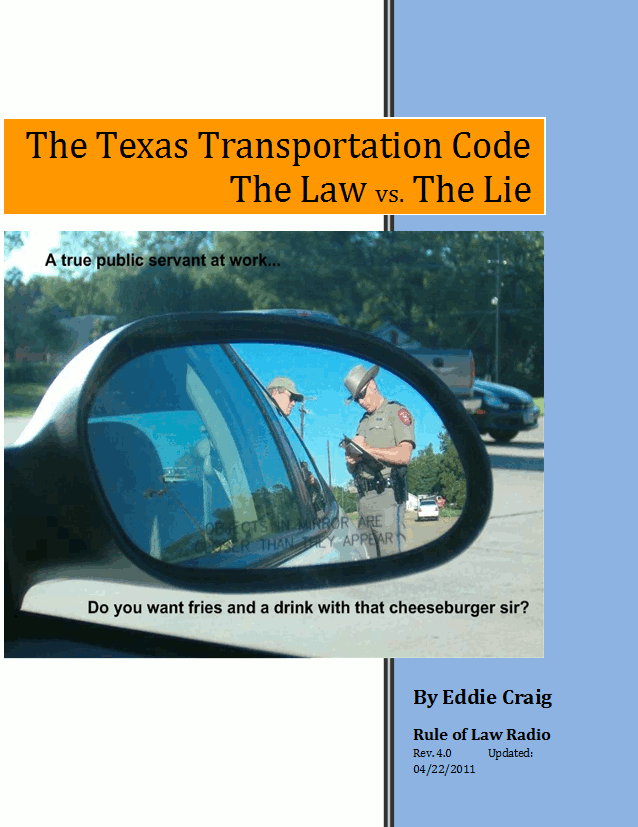
The Texas Constitution, as does most state constitutions of which I am aware, limits the subject of any legislative enactment to ONE SUBJECT. In the case of the fairly recently recodified “transportation” code, that subject just happens to be “TRANSPORTATION.” And ANYTHING that is written into that code MUST be related to that one subject. If it is not, then that portion of the code would be UNCONSTITUTIONAL as it would be a legislative Bill dealing with more than one subject.

Now, the Texas Legislature did not provide a definition of the term “transportation” in ANY law or code that exists in Texas. However, they DID create statutes that tell us precisely how to determine the meaning of those terms that they failed to define. These methods of writing, reading, and interpreting the meaning of such terms and phrases, can be found in Chapters 311 and 312 of the Texas Government Code. Within which you will find that the term “transportation” is to be defined in the same manner as other existing law or as the standard industry usage defines it, which just happens to match with the very definition that one would find in the SCotUS case law cited as the basis for that definition in Black’s Law Dictionary 6th Edition and earlier.  The same would apply to the term “carrier.”

It should be axiomatic that, in order to charge someone with a crime under the specific subject matter of “transportation,” since that is the ONLY subject to which the code and its regulatory statutes can constitutionally apply, the state MUST prove that the individual WAS engaged in “transportation” as defined by that term.  Simply being in a car on the highway isn’t enough to constitute “transportation.” And if you are willing to suggest that the state is somehow not required to prove that the regulated subject matter to which the statutes specifically apply is in any way relevant to the criminal accusations being made against the Accused by alleging offenses that are defined by and exists solely within that subject matter code, then you are admitting to the knowing and intentional denial of the right of due process as being precisely what is wrong with your particular brand of justice and the corrupt judicial and Bar system that controls it.

Furthermore, there is a HUGE difference between using the police power for regulation for public safety, such as traffic control devices meant to control traffic flow so as to prevent accidents for instance, and taxation of a privileged activity through various license and permit schemes. You are either considering them to be one and the same or are failing to recognize the distinctive differences, because SCotUS and numerous other courts have ruled over and over again that any license or permit requiring a payment of a fee in order to obtain it ARE taxes upon the exercise of the permissive privilege. The term “tax” and “license” are synonymous according to those court rulings.

However, the right to liberty through locomotion is NOT a permissive or granted privilege, but rather it is an inherent and fundamental right of liberty through locomotion, for which I do not require any man or court to recognize in order for me to know it to be absolutely true. Only a slave must ask permission and favor to move about without his chains, in whatever form those chains may be.  The Declaration of Independence makes this understanding of liberty more than  clear to someone that isn’t actually looking for some legal control mechanism by which to either conceal or deny its very existence.

To secure these [inalienable] rights [to life, liberty, and the pursuit of happiness], governments are instituted among men, deriving their just powers from the consent of the governed… Whenever any form of government becomes destructive of these ends, it is the right of the people to alter or abolish it, and to institute new government, laying its foundation on such principles, and organizing its powers in such form, as to them shall seem most likely to effect their safety and happiness.” –Thomas Jefferson: Declaration of Independence, 1776. ME 1:29, Papers 1:429
But Jefferson didn’t stop there when it came to expounding upon the only real basis and necessity for any form of organized government in the first place:

It is to secure our rights that we resort to government at all.” –Thomas Jefferson to Francois D’Ivernois, 1795. FE 7:4
[These are] the rights which God and the laws have given equally and independently to all.” –Thomas Jefferson: Rights of British America, 1774. ME 1:185, Papers 1:121


What you are saying about the police power and the government’s alleged right to regulate certain activities is not a concept created by the people OR our constitutions, but rather by the courts and those within our government that decided they knew better than us how to lead lawful and productive lives, and then proceeded to use their delegated powers to subvert and undermine the rights of everyone for the perceived [but false] benefit of a collective society, which is a concept soundly rejected as an abomination to the principles of a constitutional republic.

The idea is quite unfounded that on entering into society we give up any natural right.” –Thomas Jefferson to Francis Gilmer, 1816. ME 15:24


And you also seem to think that I and everyone else should have no opinion or argument that contradicts or refutes that which establishes the power and control sought by government through our courts. Courts which have demonstrated their complete failure in understanding even the most historically fundamental concepts of LIMITED government and inherent fundamental individual rights, which they’ve accomplished through a never-ending train of tortured reasoning and incompetent or abusive readings and interpretations of the provisions within the various constitutions to further diminish individual rights in favor of ever expanding governmental power and authority. It is the basic principle of letting the inmates run the asylum by setting and interpreting their own rules.

Your words make it appear that you want me and the rest of the American people to simply accept the baseless assertion that they, meaning the courts, attorneys like you, and governmental actors in general, are somehow more capable, qualified, and intellectually equipped to be the sole collective body uniquely empowered to be our only purveyors of truth and understanding. A concept which I find not only laughable to the point of requiring corrective surgery, but with which I heartily and vehemently disagree to the point of being willing to take up arms to defend against it. Nor am I alone in thinking so. My words to you on that point are well founded in a prior discussion involving Jefferson that long predates us both, and which soundly renounces and refutes such an assertion on your part:

You seem … to consider the judges as the ultimate arbiters of all constitutional questions; a very dangerous doctrine indeed, and one which would place us under the despotism of an oligarchy. Our judges are as honest as other men, and not more so. They have, with others, the same passions for party, for power, and the privilege of their corps…. Their power [is] the more dangerous as they are in office for life, and not responsible, as the other functionaries are, to the elective control. The Constitution has erected no such single tribunal, knowing that to whatever hands confided, with the corruptions of time and party, its members would become despots. It has more wisely made all the departments co-equal and co-sovereign within themselves.” –Thomas Jefferson to William C. Jarvis, 1820. ME 15:277

A free people [claim] their rights as derived from the laws of nature, and not as the gift of their chief magistrate.” –Thomas Jefferson: Rights of British America, 1774. ME 1:209, Papers 1:134

Some other natural rights… [have] not yet entered into any declaration of rights.” –Thomas Jefferson to John W. Eppes, 1813. ME 13:272


So, despite what you might think about the power and authority of government to do any particular thing it damn well pleases, I would consider the possibility that you, like many others before you and in office today, have failed to remember that We the People ARE the one true and primary department of government that has the power to supersede and/or do away with anything and everything that government, in whole or in part, may decide or do. The government’s willingness to resort to force of arms, and to use them without fear of accountability, does not make those doing so right. What it does make them is a group of treasonous despots that deserve to be arrested and punished with life in prison for their crimes against us all, which will be exactly what happens if they lose the battle of force.

Therefore, all I can say to you is that you may choose to believe as you wish and stay as much a slave to those beliefs in relying on a totally corrupt and broken system of law and injustice as you desire, regardless of how ill-founded or unsubstantiated such beliefs may be. But, none of your choices bind me or any other individual to you or to those choices. I have the faculties and the inherent and unalienable right to think and act for myself, to make my own choices, to self-regulate, and to engage in my own private business or pleasure using my own understanding of the proper exercise of my rights and liberties as I see fit, limited or barred only by the equal rights of others to not be intentionally or negligently harmed by me. Which would also include freedom from those same types of intrusions and harm by government actors. THAT is the true limit of government’s police powers upon the free exercise of the individual rights and property belonging to We the People as far as I am concerned.

I would rather be exposed to the inconveniences attending too much liberty than to those attending too small a degree of it.” –Thomas Jefferson to Archibald Stuart, 1791. ME 8:276

Being myself a warm zealot for the attainment and enjoyment by all mankind of as much liberty as each may exercise without injury to the equal liberty of his fellow citizens, I have lamented that… the endeavors to obtain this should have been attended with the effusion of so much blood.” –Thomas Jefferson to Jean Nicholas Demeunier, 1795. FE 7:13

Of liberty I would say that, in the whole plenitude of its extent, it is unobstructed action according to our will. But rightful liberty is unobstructed action according to our will within limits drawn around us by the equal rights of others. I do not add ‘within the limits of the law,’ because law is often but the tyrant’s will, and always so when it violates the right of an individual.” –Thomas Jefferson to Isaac H. Tiffany, 1819.

Under the law of nature, all men are born free, every one comes into the world with a right to his own person, which includes the liberty of moving and using it at his own will. This is what is called personal liberty, and is given him by the Author of nature, because necessary for his own sustenance.” –Thomas Jefferson: Legal Argument, 1770. FE 1:376

If [God] has made it a law in the nature of man to pursue his own happiness, He has left him free in the choice of place as well as mode, and we may safely call on the whole body of English jurists to produce the map on which nature has traced for each individual the geographical line which she forbids him to cross in pursuit of happiness.” –Thomas Jefferson to John Manners, 1817. ME 15:124

The evidence of [the] natural right [of expatriation], like that of our right to life, liberty, the use of our faculties, the pursuit of happiness, is not left to the feeble and sophistical investigations of reason, but is impressed on the sense of every man. We do not claim these under the charters of kings or legislators, but under the King of Kings.” –Thomas Jefferson to John Manners, 1817. ME 15:124P.S.

Thank you for your email. I will use it for the edification of others so that they may understand why attorneys should never be allowed to hold public office or other positions of power that would allow them to control and subvert the freedoms and liberties that are inherent in us all by our very birth. I will be posting your email, and my response, to my blog.

Be aware that I reserve the right to edit and amend my original response at any time and in any way that I deem necessary as time and information allows. Hopefully it will be enough to provide you with a different perspective than the one that you currently have, the most important of which being that the legal profession cannot have its cake and eat it too. When laws are used to subvert and supplant liberty and freedom with permissions and privileges, then the law itself, and those that try to justify supporting and defending it, ARE the only real problem.

Motions – Challenging Jurisdiction

Okay, let’s talk for a brief minute about Motions to Dismiss that challenge both subject matter and in personam (personal) jurisdiction and WHY you want to file BOTH in separate individual pleadings. This was a discussion I had with someone earlier today about this subject, and it’s important to note the distinctions being made in the arguments within each pleading.

Q:  Can or should a motion to dismiss for lack of in personam jurisdiction read the same (or roughly the same) as a motion to dismiss for a lack of subject matter jurisdiction?

A:  They will have similarities to the facts of the arguments, but different focuses.

Q:  For example, would in personam focus more on the officer’s authority to stop you in the first place removing the authority from the court to hear the case?

A:  It works in BOTH.

A Motion to Dismiss for Lack of Subject Matter Jurisdiction Would go Something like this:

It is an uncontested fact that the arresting officer, Officer Ima Dickhead (“Officer Dickhead“), conducted no investigation into discovering any facts or evidence that would prove Respondent was engaged in “transportation” at any time prior to or during the alleged regulatory offense.


It is an uncontested fact that Officer Dickhead‘s entire basis for making such an allegation is based entirely upon his/her own unsubstantiated personal presumptions of law rather than actual facts or evidence.


It is an uncontested fact that Officer Dickhead has no lawful authority to seize and arrest Respondent without warrant for an alleged “transportation” offense if the officer lacked any articulable facts and evidence supporting probable cause to believe that Respondent was actively engaged in “transportation.


It is an uncontested fact that, absent any facts and evidence that Respondent was engaging in “transportation,” Officer Dickhead lacked not only articulable probable cause to make a warrantless seizure and arrest of Respondent, but also any and all subject matter jurisdiction over Respondent relating to enforcement of regulatory statutes relevant to same.


It is an uncontested fact that, if Officer Dickhead never believed that Respondent was actively engaged in “transportation” at the time of the alleged offense, thus Officer Dickhead never intended to perform any investigation that would result in the discovery of any admissible facts and evidence that would prove Respondent was so engaged, then it cannot by rightfully said that Officer Dickhead was acting on any specific articulable facts or evidence supporting probable cause, but was acting instead upon an entirely unlawful and unsubstantiated legal presumption that the existing facts and evidence did not support.


It is an uncontested fact that, given the current state of tensions in this nation and this state relating to law enforcement officers brutally assaulting, injuring, and murdering individuals that are doing nothing more than asserting and exercising their fundamental and constitutionally protected rights to not be subjected to false arrests, abuses of police power, and injurious physical assaults and death at the hands of out-of-control law enforcement personnel, Officer Dickhead‘s demonstrably faulty and unsubstantiated legal presumption and callous disregard of the facts and the law created an unacceptable level of danger to the life, person, rights and property of Respondent as well as that of the general public to a degree that is shocking to the conscience.


As Officer Dickhead lacked any actual articulable facts and evidence that Respondent was actually engaged in “transportation” at the time of the warrantless seizure and arrest of Respondent, and never made any attempt whatsoever to investigate into this necessary and mandatory element of subject matter jurisdiction relating to the alleged offense, there was no legal basis creating a foundation for articulable probable cause that would serve to support Officer Dickhead‘s warrantless seizure and arrest. Therefore, the warrantless seizure and arrest of Respondent by Officer Dickhead was completely unlawful and illegal and was not based upon any probable cause supporting subject matter jurisdiction.


A Motion to Dismiss for Lack of In Personam Jurisdiction Would go Something like this:


It is an uncontested fact that the arresting officer, Officer Ima Dickhead (“Officer Dickhead”), conducted no investigation into discovering any facts or evidence that would prove Respondent was engaged in “transportation” at any time prior to or during the alleged regulatory offense.


It is an uncontested fact that Officer Dickhead‘s entire basis for making such an allegation is based entirely upon his/her own unsubstantiated personal presumptions of law rather than actual facts or evidence.


It is an uncontested fact that Officer Dickhead has no lawful authority to seize and arrest Respondent without warrant for an alleged “transportation” offense if the officer lacked any articulable facts and evidence supporting probable cause to believe that Respondent was actively engaged in “transportation.”


It is an uncontested fact that, absent any facts and evidence that Respondent was engaging in “transportation,” Officer Dickhead lacked not only articulable probable cause to make a warrantless seizure and arrest of Respondent, but also any and all in personam jurisdiction over Respondent relating to enforcement of regulatory statutes relevant to same.


It is an uncontested fact that, if Officer Dickhead never believed that Respondent was actively engaged in “transportation” at the time of the alleged offense, thus Officer Dickhead never intended to perform any investigation that would result in the discovery of any admissible facts and evidence that would prove Respondent was so engaged, then it cannot by rightfully said that Officer Dickhead was acting on any specific articulable facts or evidence supporting probable cause, but was acting instead upon an entirely unlawful and unsubstantiated legal presumption that the existing facts and evidence did not support.


It is an uncontested fact that, given the current state of tensions in this nation and this state relating to law enforcement officers brutally assaulting, injuring, and murdering individuals that are doing nothing more than asserting and exercising their fundamental and constitutionally protected rights to not be subjected to false arrests, abuses of police power, and injurious physical assaults and death at the hands of out-of-control law enforcement personnel, Officer Dickhead‘s demonstrably faulty and unsubstantiated legal presumption and callous disregard of the facts and the law created an unacceptable level of danger to the life, person, rights and property of Respondent as well as that of the general public to a degree that is shocking to the conscience.


As Officer Dickhead lacked any actual articulable facts and evidence that Respondent was actually engaged in “transportation” at the time of the warrantless seizure and arrest of Respondent, and never made any attempt whatsoever to investigate into this necessary and mandatory element of in personam jurisdiction relating to the alleged offense, there was no legal basis creating a foundation for articulable probable cause that would serve to support Officer Dickhead‘s warrantless seizure and arrest. Therefore, the warrantless seizure and arrest of Respondent by Officer Dickhead was completely unlawful and illegal and was not based upon any probable cause supporting in personam jurisdiction.


What you have to understand is, that although the facts that lead up to both challenges are essentially the same, the focus of the challenge can and would be different between a challenge to subject matter versus in personam jurisdiction. These same points of argument would serve just as well in a “Motion to Suppress” considering that, since the facts show that probable cause never existed, then the officer conducted an illegal search and seizure of the person, the conveyance, and the personal information relating to both.

Furthermore, in order for any of this information to remain admissible, the state must first PROVE that the warrantless arrest was valid by proving that probable cause DID exist, AND that the officer properly complied with Art. 38.22, Code of Criminal Procedure. The problem for the state, however, is that the officer NEVER attempted to obtain any such evidence AT THE TIME OF THE ALLEGED OFFENSE. And failing to do so would make ANYTHING they try to use thereafter, like a driving record or other official record relating to licensing, registration, inspection, financial responsibility, etc., etc., INADMISSIBLE because it is NOT relevant to the original stop and arrest and certainly not a direct result of the officer’s actions at the original stop.

Texas Muni & Justice Courts – Understanding the Due Process Consequences of Entering a Plea


Let the Games Begin.

So, you’ve been [falsely] accused[1] of committing a “transportation”[2] offense by some improperly informed, improperly educated, and improperly trained authoritarian statist funded robot that seized you at your liberty and held you in an unreasonable custodial arrest without a proper warrant of arrest or any articulable probable cause[3] just so that s/he could issue you a “[un]uniform traffic citation” that you must now deal with.

The citation tells you that you must appear on some future date and time before some particular magistrate presiding over some particular court named on the citation that allegedly has jurisdiction of the offense.[4]

Although, it should be clear to anyone that can read and comprehend constitutional language and principles that it is a direct violation of the separation of powers provision of Article 2 of the Texas Constitution and Penal Code Sec. 32.48 for a municipal or state police officer to issue an ‘order’ via a “transportation” citation that simulates a legal process such as a subpoena or summons. Sheriffs and constables, however, might potentially be excluded as being capable of committing such violations. The basis for asserting that it’s a violation of the separation of powers and the law is that both municipal and state police officers are executive branch functionaries and agents, and the issuance of a summons or subpoena having the legal force of a full-fledged judicial order requiring an individual’s compliance is entirely a judicial branch power and function, which executive officers are constitutionally forbidden to exercise. The basis for asserting that sheriffs and constables are potentially exempted from being charged with such violations is that their offices are actually established, by the Texas Constitution in Art. 5, Secs. 23 and 18 respectively, as officers of the judicial branch of government rather than the executive. But this particular issue is not the focus of this article.

The Initial Appearance Requirements and Duties of the
Magistrate/Judge.

When you eventually appear at the court named in the paperwork that accompanied the citation “on or before” the appointed date and time, as that phrase is typically printed on most of these citations, the magistrate is required by the Code of Criminal Procedure to perform the duties imposed upon him/her by Art. 15.17[5] of that code. And s/he is required to do so in simultaneous compliance with the provisions of Arts. 45.018(b), 16.01, 27.14(d), and 14.06(b) and (c) of that same code. It is imperative, however, that you make no oral response or written pleading to anything that happens in that court room without first reserving your right to special appearance by stating the phrase:

Pursuant to Art. 1.02, Code of Criminal Procedure and Rule 120a, Texas Rules of Civil Procedure, I hereby reserve my right of special appearance for the purpose of challenging the jurisdiction of this court and these proceedings, and the court should be well aware that a challenge requiring an evidentiary determination of a court’s jurisdiction is both a civil matter and proceeding.

The judge may try to tell you that, since this is presumed to be a criminal matter, a special appearance doesn’t apply. And if s/he does so, you should again state:

Objection! A challenge to a court’s jurisdiction, and any proceeding convened for the purpose of determining that jurisdiction, is a civil matter, not criminal. There is no evidence of in personam or subject matter jurisdiction on the record, and as a matter of right I am challenging the jurisdiction of this court by demanding that the state be ordered to produce its evidence on and for the record proving that the officer’s warrantless arrest of the Accused was based upon both reasonableness and articulable probable cause establishing that the Accused is a person that was engaged in and had a legal duty to perform under the regulated subject matter of “transportation” as governed by the commercial regulatory code of the same name so as to properly establish and invoke this court’s subject matter and in personam jurisdiction over the Accused.

What arrest? We Didn’t Do No Stinking Arrest!

Be aware that the prosecution will almost certainly object and attempt to claim that no arrest ever took place. However, the Texas Court of Criminals appeals ruled differently in the case of Azeez v. State, 248 S.W.3d 182, wherein the court said “We have construed this provision [Sec. 543.001, Transportation Code] to mean that, [**22] at least as a matter of state law, a restriction upon personal liberty that amounts to less than “full custodial arrest” may nevertheless constitute an ‘arrest.’” Like most federal courts, the Texas courts are notorious for making rulings that favor governmental power grabs over individual rights, the rule of law, and constitutional conformity, whether that conformity be state or federal. But this myopic analysis in Azeez that tries to make it appear that a law enforcement officer’s roadside seizure does not actually constitute a full-blown custodial arrest does not appear to harmoniously coexist with the United States Supreme Court’s idea of what constitutes a custodial arrest.

Justice Stewart’s opinion in the 1980 Mendenhall[6] case first set the current standard whereby an individual may determine if they are being held via a warrantless custodial arrest “a person has been “seized” within the meaning of the Fourth Amendment only if, in view of all of the circumstances surrounding the incident, a reasonable person would have believed that he was not free to leave, and as long as the person to whom questions are put remains free to disregard the questions and walk away, there has been no intrusion upon that person’s liberty or privacy as would require some particularized and objective justification.

The Supreme court would soon set that bar even lower in the case of California v. Hodari D.[7] when the court ruled that “To constitute a seizure of the person, just as to constitute an arrest — the quintessential “seizure of the person” under Fourth Amendment jurisprudence — there must be either the application of physical force, however slight, or, where that is absent, submission to an officer’s “show of authority” to restrain the subject’s liberty.” The second criteria constituting a “seizure of the person”, i.e. “an officer’s ‘show of authority’,” is wholly consistent with the actions associated with a common everyday traffic stop in that there is most definitely a “show of authority” initiated by the use of the officer’s MARS lighting system to pull you over as well as the resulting level of “investigative detention” intended to “restrain the subject’s liberty.” Even more so in Texas since the statute plainly states that the officer literally has arrested you and may subsequently release you from custody if you sign the citation promising to appear later in the designated court. The statute even uses the term “custody.” If you doubt that the circumstances of a traffic stop are the same as those stated by the United States supreme Court denoting an actual “seizure of the person” by the officer, then how do you propose to answer the following questions?

  • Once an officer engages the lights on their police cruiser do you believe that, as a reasonable person of at least average intelligence, that an officer doing so is displaying a “show of authority” that, by law, requires you to comply by stopping and pulling over?
  • If you were to consider not stopping once an officer’s lights have been turned on do you believe that, as a reasonable person of at least average intelligence, the consequences of refusing to stop would potentially be very dangerous and bad for you?
  • If you do stop, and then you ask the officer if you are being detained, do you, as a reasonable person of at least average intelligence, expect the officer to respond with “yes, you are being detained?”
  • Would you, as a reasonable person of at least average intelligence, consider the officer’s “no” to be a continuing “show of authority” demonstrating that you are not free to leave of your own accord and that you must comply with the officer’s demands remain in that location?
  • Lastly, if you choose to not stop and pull over in a timely and expedient manner would you, as a reasonable person of at least average intelligence, expect the officer or prosecutor to then attempt to charge you with additional crimes, such as, let’s say, felony evasion using a vehicle? 

Now, if you answered “yes” to one or more of these questions, then how is it not readily apparent that you truly are in a full-blown 4th Amendment-invoking warrantless arrest perpetrated by a government official even during a ‘traffic’ stop? And since this is obviously true according to standards established by the United States Supreme Court, why is the Texas Court of Criminal Appeals even having a discussion as to whether or not the traffic stop constitutes a warrantless custodial arrest that is fully afforded 4th and 5th Amendment protections? My only possible thought on the matter as to why is that it is because they, just like all other attorneys, both require and thrive on conflict in order to justify their existence and continuing theft of the people’s money in the form of salaries and benefits that line their own pockets and the never-ending levying and collection of innumerable fines and fees that fill the coffers of the various levels of government, that’s why.

This is why I, based upon this analysis and the supporting court opinions,  submit for your consideration that the prosecutor is either blatantly incompetent or intentionally lying to the court when s/he says that what took place on the roadside was merely an investigative detention rather than a warrantless custodial arrest. So what do you do about it? I would suggest something like this:

Objection! The prosecution appears to be misrepresenting the facts in an effort to mislead this court and deprive the Accused of the right to an examining trial for a proper determination of reasonableness and probable cause by a neutral and detached magistrate. The prosecution should be well aware of the Texas Court of Criminal Appeals case of Azeez v. State decided in 2008, wherein the court states that a traffic stop in Texas does constitute a warrantless arrest.

The prosecution should be as equally aware of the United States Supreme Court’s determinations in the cases of Mendenhall and Hodari, wherein the court ruled that a person was considered to be in a custodial arrest if they believe that they were unable to leave of their own free will because they are being subjected “to an officer’s “show of authority” to restrain the subject’s liberty,” which is precisely what occurred in this matter. The Accused specifically asked if they were free to leave and the arresting officer immediately responded that they were not free to leave.

Don’t let them try to tell you or act like there wasn’t a warrantless custodial arrest, because there absolutely was.

However, you must be forewarned that none of this will ever happen in the manner and order prescribed by common sense, law, or statute, which is supposed to proceed precisely as I’ve laid it out here according to the Texas Code of Criminal Procedure. And while you must expect that it will be either ignorantly or intentionally ignored or incorrectly done, you must not simply ignore that fact or simply allow it to happen without objection. You must be prepared to object to everything that the magistrate/judge and the prosecutor fails to do that violates constitutional protections, the law, the rules of procedure, and your inherent fundamental rights, including demanding the judge’s or prosecutor’s immediate disqualification from the case for repeatedly doing so. Be aware, however, that the disqualification of a Texas judge from a case requires a written pleading of the facts that support the disqualification, and it must be made and filed under oath, i.e. under penalty of perjury.

I Swear to Tell the Truth, Except I Don’t Really Do Either.

Isn’t it funny how you and I are required to do virtually everything “under penalty of perjury” and other threats of dire punishment for making any false writings, claims, or allegations whenever we have dealings with our public servants, but those same public servants aren’t required to verify the truth and validity of their own claims and actions “under penalty of perjury” when dealing with or moving against us? And to add insult to often serious injury resulting from any perjury they may commit, they are even more likely to simply walk away scot-free and unaccountable for doing so, even when they’ve been caught red-handed, and regardless of the harm they may have caused with their lies.

Since you are now somewhat forewarned that Texas municipal and justice courts are notorious for not playing by the rules, and very often prefer just making up their own as they go, you must learn to cope with their actions that are in violation of the law, the rules, and your rights. The best way I know of to do that is by knowing as much as possible about what their rules and procedures actually require them to do, while also being able to readily identify what they are actually doing that is in direct violation of those rules and procedures, and potentially your due process rights in the process. I am going to go into detail about several of the initial and most important violations that will almost certainly occur in your case.

One of the first of many things they do wrong is to violate your right of proper, sufficient and timely notice of the allegations against you by failing to serve you with a copy of a valid verified criminal complaint for each alleged offense, which is almost never done prior to the initial appearance proceeding you are “ordered” to appear for on the citation. That failure is a direct violation of the criminal procedures and your due process rights under the provisions of Arts. 45.018(b), 2.04, and 2.05, Code of Criminal Procedure. It is in no way proper, sufficient or timely when they serve you with the complaint on the day of a court proceeding since the code clearly states that the Accused “is entitled to” such service “no later than one day prior to any proceeding in the prosecution under that complaint.”

Which means that you must also fully understand that the phrase “is entitled to” “creates or recognizes a right,” [8] a right that the prosecution and the court just knowingly and willfully violated. It is also not in any way fair, impartial, or just, that the Accused would have been afforded absolutely no time prior to the proceeding in which to read and prepare a proper set of pleadings in relation to the jurisdiction and allegations as written into the criminal complaint(s), as it is a verifiable fact that the specific allegations and their language as written into the criminal complaint(s) is almost always vastly or completely different from that which is written on the face of the citation. This is precisely why the right to be served with a copy of the complaint(s) “no less than one day prior to any proceeding” is imperative and protected by the Code of Criminal Procedure, but entirely ignored or outright denied by the vast majority of our Texas justice and municipal courts.

The prosecutor may well stand up in court, especially if s/he is a city attorney in a large municipality, and try to say something like:

Your honor, the criminal complaints have been available to the defense by simply going to the municipal web site and downloading a copy for themselves. Since they are publicly accessible the defendant has had ample opportunity to obtain a copy. Proper notice and service of the complaint has been done under those circumstances and conditions and I would ask that the court overrule the defendant’s objections relating to improper notice.

This is where you better be listening to what you are hearing so you can properly respond to this inept and underhanded dribble from the municipal, county, or district scumbag before it’s too late. Your immediate response needs to be:

Objection! Is the prosecuting attorney seriously attempting to single-handedly rewrite the law on proper, sufficient and timely service and notice as required by Arts. 28.01, Sec. 3, Code of Criminal Procedure, which requires service to be performed by either personal service or by mail as it cannot be made in open court without violating the Accused’s protected right to have a copy (service) prior to any proceeding under 45.018(b)? I can find no statutory authority for the prosecution to provide notice by posting something on a web site, regardless of who controls it or how long it has allegedly been posted there.

Furthermore, where is the prosecution’s offer of proof that the defense was ever made aware of and given proper notice that this alleged web resource repository even existed, much less where to find it, because the defense states on and for the record that we have heard nothing of it?

Therefore, I move that the court order the prosecution to produce any evidence that the Accused was even informed about the existence of this web site or how to access it, much less provided us with any necessary information and instruction on how to obtain any specific documents or information from it relating to this matter.

We Can Use the Citation as a Complaint, (But Only if You Let Us)!!

You will also find that they very often attempt to claim that they are automatically and fully authorized by Art. 27.14(d) of the Code of Criminal Procedure to use the citation alone as the complaint against you, and that you are required to enter a plea based solely upon the existence of the citation alone. This is yet another one of their outright lies made in a blatant attempt to violate your fundamental rights and the rules of criminal procedure. Coercing the Accused into entering a plea based solely upon the citation without properly and accurately informing him/her of their rights, and which ones they may be unknowingly waiving by doing so, is a direct violation of Arts. 2.04, 2.05, 27.14(d), and Chapter 21 of the Code of Criminal Procedure, and the due process rights of the Accused under the provisions of Art. 1, Sec. 10, Texas Constitution, and Arts. 1.05 and 45.018(b), Code of Criminal Procedure.

The judge and the prosecutor are knowingly and willfully acting in concert and collusion to misinform the Accused in a such way that one can only assume is specifically intended to violate his/her rights by falsely stating how Art. 27.14(d) actually operates. Neither the prosecution nor the court is authorized to use the citation in place of a complaint unless the requirements of 27.14(d) have been fully complied with, and they most certainly have not at this point unless someone is criminally forging the signature of the Accused on the required written waiver.

In its operation as written, Art. 27.14(d) makes it absolutely mandatory that, before the court may use the citation in lieu of a properly verified criminal complaint, the Accused and the prosecutor must both agree to, and both sign, a written waiver allowing the court to accept a plea of “guilty” or “nolo contender” only, and then proceed to adjudicate and rule on that entered plea absent a verified complaint. Furthermore, Art. 27.14(d) also makes it absolutely mandatory that the aforementioned waiver must be filed in the trial record of the court prior to taking any these further actions. And none of that has happened. Thus, it is a direct violation of the rules of procedure and the right of the accused to be served with a verified copy of the complaint before even the very first proceeding in the matter, which in and of itself constitutes a knowing and willful violation of the Defendant’s right to proper, sufficient, and timely notice in accordance with due process and Texas law.

Obviously, if you haven’t ever signed such a waiver, then the court’s authority to use the citation in place of a valid verified complaint under Art. 27.14(d) must be non-existent, and therefore, a knowing and willful lie intended to deceive the Accused into unwittingly waiving their fundamental right to being served with a copy of a valid verified complaint that provides the otherwise mandatory proper, sufficient and timely notice of the allegation(s). Not to mention an underhanded due process denying attempt to cause you to waive your right to challenge the form and substance of the complaint(s) by failing to object to either issue, thus, allowing them to continue with the prosecution against you even if the complaint is faulty in form or entirely false in substance.

So, be sure to object to the prosecutor and the court trying to tag-team bully you into allowing them to use the citation as a complaint:

I object! The Accused has never seen nor signed the written waiver required by Art. 27.14(d) of the Code of Criminal Procedure. If such a waiver exists in the court record it is a fraud and I demand the court find the person or persons responsible for forging my signature and placing it there.

I have not and do not consent to the use of the citation as a verified complaint for any purposes whatsoever, and object to this obvious attempted denial and subversion of my due process rights in this matter. This is grounds for immediate judicial disqualification and prosecutorial sanctions for misconduct.

I therefore move that the judge of this court be disqualified and the prosecutor responsible for this case be sanctioned, removed, and disbarment proceedings initiated for these knowing and willful criminal acts in violation of the rights of the Accused.

Neither Citations nor Complaints Alone Can Constitutionally or Legally Invoke a Court’s Jurisdiction.

The use of the citation as the complaint also raises yet another issue, that of jurisdiction being properly invested in the court. If you read any number of Texas court cases relating to a criminal complaint as being the only charging instrument necessary to invest a justice or municipal court with jurisdiction of the offense for the purpose of trial, you will find that those cases have set the existence of such a complaint as the minimum bar by which the court may be invested with such jurisdiction. And there should be no legitimate question that a mere citation is well below that minimum bar in that it does not meet all of the statutorily mandated requirements for a valid complaint under the provisions of Art. 45.019(a), Code of Criminal Procedure.

Furthermore, these court opinions are themselves formulated in direct violation of both Art. 5, Secs. 12(b) and 17 of the Texas Constitution, as well as Arts. 2.04, and 2.05 of the Texas Code of Criminal Procedure. All of which require that an indictment and/or information be filed in conjunction with a criminal statement/affidavit and a separate criminal complaint in order to initially invest a trial court with jurisdiction of the cause.

The Texas district courts of appeals and the court of criminal appeals have all penned opinions stating that these constitutional provisions requiring a court’s jurisdiction to be invoked by the filing of a valid indictment or information are somehow irrelevant and of no legal value or authority. However, it is not any real problem at all to prove that they have knowingly and willfully erred in their logical and literal analysis of the language of these constitutional provisions.

For instance, the Texas Constitution never states that jurisdiction, once properly invested in a court by the filing of such charging instruments, is later lost if an indictment or information is quashed or otherwise found to be invalid, as it states plainly that if the indictment be quashed in the county, then the accused is not required to be discharged, but can still be held to answer the allegations in the sworn criminal affidavit. The Texas Constitution states only that the indictment and information must initially exist (and be facially and lawfully valid) for jurisdiction to be initially invested in the court. The due process benefits and protections for the rights of the Accused inherent in following this procedure should be rather obvious.

Furthermore, the Texas Constitution also alludes to the fact that a sworn statement/affidavit that was filed in conjunction with an indictment or information, which is the only thing that can lawfully provide the basis for either of those charging instruments, may continue to serve as the basis for the court to maintain its now properly invoked jurisdiction, and allows the court to continue with the necessary proceedings and any resulting trial even if the indictment or information has been quashed.

But absolutely nowhere does the Texas Constitution state or infer that a mere verified but unsworn criminal complaint alone is in any way authorized to form the basis for initially invoking any court’s jurisdiction. Nor does it state that a criminal complaint is the lawful or legal equivalent of a criminal statement/affidavit, which it legally can’t be, because a statement/affidavit is normally written and then signed by a person with competent firsthand knowledge of the facts alleged within it, and it will also contain a proper jurat declaring that it is signed under penalty of perjury. Only slightly less important is the fact that nowhere within the Texas Code of Criminal Procedure itself does it ever state that a criminal complaint alone invests a court with jurisdiction of a criminal cause. Not once, ever, anywhere. This particular rights violating idiocy directly contradicts the specific meaning and intent of the relative clauses of the Texas Constitution, and it was cooked up entirely by the courts themselves, making it 100% unconstitutional on its face.

Who Can File a Criminal Complaint?

While a statement/affidavit is only valid and admissible if the person that made it has competent firsthand knowledge of all the facts alleged in it and can both swear and testify to the validity of those facts under penalty of perjury, a criminal complaint does not require any such criteria. In fact, a criminal complaint such as is filed in most traffic cases is almost always an instrument of hearsay rather than an actual firsthand accounting of facts.

There is a very important legal difference that exists between a legally sworn criminal statement/affidavit made under penalty of perjury and an unsworn criminal complaint that is not made under penalty of perjury and is more often than not totally hearsay in its nature and content. That is why I argue that a criminal complaint and a criminal statement/affidavit are absolutely not the same instrument, and only the properly sworn criminal statement/affidavit would be constitutionally and legally valid as a proper prosecutorial instrument after the quashing of an indictment or information has occurred, not merely a verified criminal complaint alone. This is further compounded by the fact that a criminal complaint is entirely written in the form of someone’s personal beliefs that a crime may have occurred (i.e. “I have reason to believe and do believe…”), not that it is a sworn accurate firsthand accounting of the facts constituting an actual crime made by a competent fact witness.

Traffic Citations and Criminal Complaints Consist Entirely of Officer Speculation/Opinion or Hearsay and Are Not Facially Admissible as Irrefutable Fact.

In Texas you see, and probably everywhere else in the entire world, anyone can make a criminal complaint about anything that they actually believe may be a crime, whether they actually have firsthand knowledge of the crime alleged or merely believe that a crime they have only heard about from someone else has actually occurred. But, in neither case involving Class C misdemeanors is the actual criminal complaint signed under penalty of perjury, nor is it based upon a sworn criminal statement/affidavit that is. It is simply not required that the person making the criminal complaint actually have firsthand knowledge of the facts of the crime they only believe to have been committed and are reporting. Thus, potentially making the criminal complaint an accusatory instrument comprised entirely of hearsay and not actual facts, which is precisely what occurs far more often than not.

And even if the person who writes up and signs a criminal complaint actually does have firsthand knowledge of everything in it, it still contains no proper jurat requiring that the instrument be sworn to and signed “under penalty of perjury” attesting that all the facts stated in the complaint are personally known to the Affiant and are true and correct. Which means that everything written in the criminal complaint could be completely fabricated and false, but no one could legally do a thing to the individual(s) that knowingly and willfully bore false witness by making and signing a document that they knew contained nothing but a total lie.

Furthermore, to add total insult to actual injury, you cannot sue the person who made and signed the criminal complaint even when they knew that they were making a false allegation against you, as the filing of the complaint is an act protected by law. This holds true even though you could and would suffer an actual tangible harm from the false criminal complaint in the form of defamation of character, slander, and liable because that document will now exist as a matter of permanent public record that anyone can request and get a copy of.

To make these matters even worse, even when such a criminal complaint does turn out to be false, the person who signed it will most likely never be charged with falsifying a governmental record and making a false statement like they would have been if they had done the same thing in a proper criminal statement/affidavit that is required to be sworn “under penalty of perjury.” But the law says that they cannot be so charged. Which makes a verified criminal complaint the exact constitutional and legal opposite of a sworn criminal statement/affidavit which must be made under penalty of perjury and based upon the firsthand knowledge of the Affiant.

This is why I make the argument that a signed (and merely verified) criminal complaint alone, without an indictment or information that is also based upon a properly sworn criminal statement/affidavit made “under penalty of perjury,” is completely insufficient to invest any kind of court whatsoever with any form of jurisdiction, as any such criminal complaint is nothing more than an unsubstantiated accusatory instrument that may be used solely for the purpose of initiating an evidentiary investigation into a matter, but not actually prosecuting it.

Who Actually Filed the Complaint?

Now we arrive at the question of exactly who is the actual source of the criminal complaint that is filed with the court. Did it come from either the officer, prosecutor, independent person/witness, or the clerk of the court. A criminal statement/affidavit that is signed under penalty of perjury is almost always one that was written by the person that will sign it as swearing to the facts alleged in it, while the criminal complaint filed by the officer, prosecutor, or clerk of the court, is almost certainly never written by the officer or court clerk that signs it as the Affiant. This is most likely due to the fact that the officer or clerk does not know if a crime was actually committed or not, as s/he has no real clue as to what the necessary elements of the alleged offense(s) even are, much less if they all even existed at the time of the alleged offense. So someone else usually writes it up and just has the officer or clerk sign it while the prosecutor simply verifies that the officer or clerk is the one who actually signed it.

But, when the criminal complaint is both written and signed by the clerks of the very same court that is adjudicating the case, it raises yet another series of due process issues relating to the agency relationship between the clerk and the court, the then unavoidable fundamental lack of impartiality by the court, and the physical custody of the official records in relation to the case file and evidence. The potential due process dangers of this situation are egregious and unacceptable, and should be blatantly obvious, even to the morons that populate and control our so-called justice system.

Hey!! That’s A Conflict of Interest and Highly Inappropriate!!

Let’s begin with the fact that the clerks of the court, the same clerks that just acted in unison to sign and verify the criminal complaint that is being used against the Accused, actually do so as direct agents of the judge, just as they do in all other things involving and relating to that court. And that same judge is now presiding over a case in which s/he is, legally speaking, now also the actual accuser since the judge’s direct agent(s), the clerk(s), is/are the Affiant(s) and the Verifier(s) on the criminal complaint, not a single one of which has any actual personal knowledge of the facts alleged therein.

Then, in addition to those issues, the same combination of clerk(s) and judge who are now legally acting as a singular entity, and, therefore, singularly as the accuser in the matter via this agency, are also acting as both the trial judge and the official custodian of the trial record, which includes all the admitted evidence from both sides. Do you understand yet? They are doing all of this in the same legal matter that is now being adjudicated before that very same court where they also control the entire court record, including what information is to be found (or lost from) within it. There can be no bigger corrupt influence and conflict of interest or denial of due process outside of an actual extra-judicial lynching or firing squad than allowing the very person accusing you of a crime to not only preside over your trial but to also be responsible for maintaining the official records and admitted evidence for that case.

Probable Cause: Who Found It, When, Where, and How Did They Find It, and Why Was it Hiding to Begin With?

Another way the Texas courts screw the Accused in their right of due process is to refuse to provide him/her with an “examining trial” under the provisions of Art. 16.01, Code of Criminal Procedure. It is well established law that, in any case where a warrantless arrest is perpetrated, the initial presumption under the law is that the arrest is unlawful absent a valid warrant until a favorable determination of both reasonableness and probable cause have been made by a neutral and detached magistrate. However, the Accused individual is being required to raise the issue of the initial seizure and arrest being unconstitutional and illegal in order to preserve this right, and Texas law provides for only one kind of criminal proceeding for testing the reasonableness and probable cause validity of a warrantless arrest, and that is in an examining trial under Chapter 16 of the Texas Code of Criminal Procedure.

However, through one of the most myopic readings of statutes I have ever seen, the Texas courts began ruling that an examining trial, and thus, a proper probable cause determination hearing, is available only to those charged with a felony offense. You need to understand what this idiotic proclamation actually means across the board in relation to the right of due process. What these courts are really saying is that anyone accused of any alleged misdemeanor criminal offense is not to be provided with the right to any probable cause determination via the process of an examining trial, or any other process at all, because none other exists in the law. They are saying that probable cause is to simply be presumed in a misdemeanor case, and the accused individual is being made to unknowingly and unwittingly sign documents based upon intentionally false statements and omissions made by the prosecution and the court so the individual acts under the false presumption that probable cause was properly found, and thus, they are unwittingly waiving their protected right to an examining trial. While this is not actually stated in plain words upon the face of any documents being signed by the Accused, the effect remains exactly the same just as if it were.

The rulings of the Texas courts on this subject violates an already standing, and as yet not overturned, Texas Court of Criminal Appeals opinion on the examining trial being just as applicable to misdemeanor cases as it is to felonies, just as the right of due process would seem to make perfectly clear to anyone actually interested and concerned with fair and impartial proceedings for those accused of any criminal act. In the case of Ex parte Garcia, 547 S.W.2d 271, 273,274 (Crim. App. 1977), the court stated:

“[273] The record reflects that Garcia was arrested and charged by complaint and information with the offense of reckless conduct, V.T.C.A., Penal Code Sec. 22.05, a Class B misdemeanor.

The evidence introduced by the State consisted solely of the complaint and information filed against Garcia and the capias that was issued thereon. Art. 23.04, V.A.C. C.P. Garcia produced no evidence.

Appellant relies on Ex parte Wright, 138 Tex.Cr.R. 350, 136 S.W.2d 212. In that case the accused petitioner challenged the existence of probable cause for his confinement. The State showed a complaint and warrant of arrest, but nothing more. With reliance on Art. 155, C.C.P. (1925), now Art. 11.43, V.A.C.C.P., which provides that in the hearing of a habeas corpus writ, “No presumption of guilt arises from the mere fact that a criminal accusation has been made before a competent authority”, the Court in Wright found the complaint and arrest warrant insufficient to show probable cause for confinement and ordered the petitioner discharged.

… … … …

[274]  Chapters 14 through 17 of the Code of Criminal Procedure govern arrest, commitment and bail; i. e., the decision-making process pursuant to which the State takes a citizen into custody and determines what restraints should or should not be placed on him after arrest. The State performs these functions through two agents: the peace officer and the magistrate. The peace officer has some discretion, but the primary and ultimate decision to restrict the citizen’s liberty must be made by a neutral and detached magistrate. This fact is fundamental to our system of criminal justice. Whether the arrest is made with or without warrant, one of the arresting officer’s first duties after arrest is to have the arrested person taken before a magistrate (Arts. 14.06, 15.16, 15.17, V.A.C.C.P.), and the magistrate must then inform the accused of his right to an examining trial (Art. 15.17, supra).

… … … …

Chapter 16 governs the examining trial, which is a proceeding “to examine into the truth of the accusation made” (Art. 16.01, V.A.C.C.P.). It is clear from the provisions of this chapter, from those of the preceding chapter, and from the very language stating the purpose of the examining trial, that the truth of the accusation may not be based upon the accusation alone: such a conclusion, if valid, would render the examining trial a useless thing, a mere re-enactment of the earlier determination of whether the arrest warrant should issue. In contrast to this principle being an implied underpinning of the examining trial process, when probable cause for continued detention is challenged by habeas corpus, the same principle is stated expressly in Art. 11.43, supra, to-wit: “No presumption of guilt arises from the mere fact that a criminal accusation has been made before a competent [275] authority.” In habeas corpus, as at an examining trial, to allow the continued *275 commitment to rest solely upon the original accusation is to render the hearing a useless thing. The purpose of such a hearing would then be equally satisfied by merely attaching the affidavit to the respondent’s return, and dispensing with the hearing altogether. The issue would be reduced to one of whether a lawful arrest warrant had issued, rather than whether probable cause for his continued detention existed independently of the accusation (Art. 11.43, supra).

Now, while the specific issues of Ex parte Garcia relate to habeas corpus and the purpose of an examining trial in order for the state to lawfully and legitimately continue to hold someone in pretrial custody, it also goes to the point that even those charged with a Class B misdemeanor have the right to an examining trial, and it establishes the legal precept that probable cause absolutely cannot be found upon the face of a complaint or information alone, thus, it is absolutely impossible that either can be established on the face of a mere uniform traffic citation. All of which is a very big deal in and of itself since this is precisely the process that is being used in the Texas courts to deny the Accused of their right to an examining trial in misdemeanor cases. This is an issue of blatant unequal protection of the laws and due process violations of the most fundamental and essential nature within our system of jurisprudence.

In short, in any criminal allegation, especially in warrantless misdemeanor arrests, including those involving Class C misdemeanor offenses, the protection of due process rights means the court is required to perform an examining trial for the purpose of reaching two separate and distinct probable cause determinations:

  1. whether or not the warrantless arrest itself was reasonable and lawful; and
  2. whether or not enough facts and evidence actually exist to establish the necessary probable cause to lead a reasonable person of average intelligence to actually believe the Accused is most likely guilty of having committed the crime alleged.

Warrantless Arrests Require That Not One, But TWO Different Probable Cause Determinations Be Made.

Our Texas courts consistently violate the due process rights of those accused of having committed virtually any class of misdemeanor offense by denying them in their right to have both of these probable cause determinations made by a neutral and detached magistrate. The existence of reasonableness and probable cause are simply and unlawfully presumed as a matter of governmental expediency and conservation of expense in total disregard for the rights of the Accused to have such determinations made based solely upon admissible facts and evidence, rather than merely rubber-stamping the personal presumptions and opinions of the arresting officer and prosecutor based upon the allegation(s) in the complaint(s) and Information(s) alone. This is precisely why the procedure set forth in Art. 15.17 of the Texas Code of Criminal Procedure is not the same thing as the actual examining trial, and why Art. 15.17(a) alludes to the fact that the arraignment and examining trial can (and most likely should) be held at a later date.

We now come to yet another “screw you” by our courts, which is their consistent failure to inform the Accused of their rights as required by Arts. 15.17,[9] 38.22, and 38.23, Code of Criminal Procedure, and to afford them assistance of counsel as is constitutionally and statutorily protected and required in all criminal prosecutions by Art. 1, Sec. 10, Texas Constitution, and Art. 1.05, Code of Criminal Procedure.

Let it also be known that I have personally witnessed a district judge state in open court that “Texas does not recognize bifurcated representation.” Now, what this judge really meant by what he was saying is this, “The Texas courts and the National and State Bar Associations have created their own ‘law’ that forbids you to speak for yourself in any manner if you happen to have hired a bar card carrying attorney to act as your legal counsel and mouthpiece.

However, the problem with this statement, or rather, this obvious lie, is that it is a knowing and willful violation of the protected rights of the Accused under both Art. 1, Sec. 10, Texas Constitution, and Art. 1.05, Code of Criminal Procedure. In practice, this criminally inept judge’s statement in open court demonstrates a complete violation of both articles, where it is clearly stated verbatim in each that the Accused individual “… shall have the right of being heard by himself or counsel, or both… .” So, just what the hell does this district judge and those sitting in the higher Texas courts think the term “both” actually means in these clauses of the Bill of Rights and Code of Criminal Procedure? And by what authority does he or any other judge sitting in any other court act to declare those provisions void and of no effect? The courts are unconstitutionally and illegally altering the Texas Constitution, including the Bill of Rights, to suit governmental desires and expediency, not to provide justice for the people or to comply with the constitution itself, which is absolutely what their oath of office demands and requires them to do.

In other words, the district and higher level courts have declared sua sponte (in law, sua sponte (Latin: “of his, her, its or their own accord”)) that their rulings and the rules of the state bar association are to be construed as being totally superior to the Texas Constitution’s Bill of Rights and separation of powers clause, as well as the laws created by the legislature (a legislature that is also unconstitutionally and illegally populated and controlled by attorneys).

Can you not yet understand that these acts are in direct violation of existing law and our individual rights, and that this judge’s statement signifies a clear-cut case of sedition by our courts and our legislature under both the Texas and United States Constitutions? Bueller? Bueller? Anyone?

MEME - Justice & Muni Courts No Fair Trial 1920x1080

No Notice, No Due Process, No Entering of a Plea.

So, it shouldn’t surprise you that the moment will eventually arrive where the court is going to unlawfully act yet again in concert and collusion with and on the behalf of the prosecution to unlawfully coerce or deny you in each of these aforementioned due process rights that rightfully belong to you. And that moment will come when the municipal judge or justice of the peace utters the words “how do you plead?

Consider yourself forewarned, this is where a cunningly designed and placed due process “gotcha’” is lurking, hidden from obvious observation like a pool of quicksand in the open desert, but there and dangerous to your well-being nonetheless. And it begins and ends with an unlawful and unjust collusion between the prosecutor and the court to knowingly and willfully rearrange the sequencing of the criminal procedures in such a way that you are unlawfully coerced or tricked into automatically waiving and losing several very important due process rights.

The court will usually attempt to get a plea from you during the course of your initial appearance proceeding. And if you come in earlier than the date and time specified on the citation, then it is more than likely that a clerk of the court will try to get you to enter a plea with them. The clerk might even threaten you by stating that your failure to enter a plea while you are appearing now could very well result in a warrant being issued for your arrest that will falsely allege that you failed to appear as ‘required’ by the citation or some other legal instrument, all of which is highly incorrect and illegal. Be aware that Texas law was recently changed to make this last particular scenario less likely, but still not impossible. You should also be aware that the JP or municipal judge may say the same thing when you are unwilling to enter a plea at the initial appearance, and that act would be just as illegal as that of the clerk in this instance.

That said, it is imperative to the protection of your right of due process and proper procedure that you decline to do so in either of the aforementioned instances. Note that I said “decline,” not “refuse.”  You must never use the term “refuse” in relation to entering a plea, as your refusal is the specific legal mechanism that, by law, authorizes the judge to enter a plea on your behalf. So don’t engage the mechanism by doing so. See Arts. 26.12 and 45.024, Code of Criminal Procedure. I will later get into a much more detailed explanation as to why this creates a serious and unrecoverable problem with your due process rights.

Remember that neither the prosecutor nor the clerk is or can be authorized to request or accept a plea in a case, and doing so is a criminal act by them, as they are impersonating a judicial officer having the proper delegated power and authority to sit as a judge over an official ‘open court’ proceeding, and they do not. It is also an unconstitutional and illegal delegation of authority by the judge to allow either of them to do so.

It is also highly unlikely at this point that you’ve been served with a copy of any actual verified complaint, which is something you have a right to have a copy of before you even make an appearance in court for any proceeding relating to the case. It is even more likely that no complaint has yet been filed in the court record at all. This creates a immediate jurisdictional problem for the court, as there is nothing in the court record that would serve to invoke the court’s subject matter or personal jurisdiction in the matter. But that won’t stop them from trying to proceed as if they actually have such jurisdiction by illegally declaring that the accusation made on the citation is enough alone to grant them such jurisdiction (see previous court opinions on why this presumption and assertion on their part is utter criminal bullshit).

So, if the judge or anyone else does try to get you to enter a plea, especially when there is no complaint accompanied by an information or indictment, or you haven’t been properly served with copies of the complaint and information for each allegation being made against you, you have to object and state good cause as to why you are incapable of entering a plea at this time. But never ever say that you refuse to enter a plea.

Protect Your Rights, Because No One Else Here is Going To.

The problem with this statutory authorization in relation to Class C misdemeanor cases, is that it allows the court to knowingly and willfully waive several very important due process rights without either your knowledge or consent. Making it very easy for the prosecutor and the court to gain a jurisdictional advantage over you that they otherwise would be unable to achieve without first following proper procedures that normally serve to protect the Accused’s due process rights.

At our current point in time, however, the Code of Criminal Procedure literally serves to directly authorize the prosecutors and courts to commit due process rights violations at their discretion by simply entering a plea on your behalf, regardless of how many other rules or procedures they may have broken or skipped over so far, and regardless of whether you have continuously objected to their actions or not.

You must understand this. The entering of a plea by the justice or judge is an action that results in the immediate nonconsensual waiver of fundamental rights belonging to you, the Accused. Rights to which you are absolutely entitled, and which are simply being spat upon by these courts as if they never existed. What’s worse is the fact that these justices and judges can do so without fear of repercussions, culpability, or accountability, because they are allegedly doing so while acting in their “judicial” capacity, where the judicially concocted, usurped, and totally unconstitutional protection of absolute immunity exists, rather than in their magisterial capacity where no such immunity exists at all.  And all of this is done by simply changing the order in which s/he performs certain procedures while simultaneously ‘forgetting’ to properly and timely inform you of your rights.

Before we continue on with the discussion of how to object to this out-of-place rights-violating demand for a plea, consider everything you have learned from the included statutory links up to this point about the proper mandatory procedures these judges and prosecutors are required by law to follow, and exactly what you may have witnessed with your own eyes so far as to where and how they have failed or refused to do so. Because you are going to need that information to protect yourself from the highly unconstitutional and illegal shenanigans of these public serpents (not a typo).

Furthermore, you must realize that it is your duty to make the record for appeal so as to prevent them from getting away with these violations. This is not the same thing as you having to shoulder the burden of proof so as to try and prove your innocence, so don’t confuse the two. Just understand that the way that you are going to have to do this is by making both spoken and written timely legal objections to everything that is being done wrong at the same moment it is being done, and you must do it first by verbal objection, and immediately after the proceeding itself using the same grounds of objection in written form that contains greater detail and the necessary legal authorities supporting it. You can file the written objections into the court record ASAP after the fact to preserve them for the record, but, you must get them written and filed or you will lose on any appeal that may be pursued. Do not forget to include what the judge’s response to the objection was, was the objection overruled or sustained, and what legal basis was given for overruling it (assuming you were diligent and persistent enough to demand the court provide it)?

I Object! There’s No Meat on my Burger and No Justice to be Had in this Sham of a Kangaroo Court!!

You should consider yourself forewarned that the judge will most likely attempt to prevent you from making the oral record (especially if the proceeding is being recorded), even when you are making a properly formulated and stated objection. Regardless, we really have only two options for doing so:

  1. make a rather short verbal objection that superficially touches on the legal points of the objection and then later file a more detailed written objection listing all the legal points thereof; or
  2. be detailed enough in both the oral and written record so as to be fully covered in the record on appeal.

The first option is more dangerous in my opinion in that the appellate court may, whether intentionally or unintentionally, mistake the legal basis and intent of your shorter oral objection read from the trial transcript, followed by failing or refusing to read your more detailed written one from the supplemental record. Personally, I prefer doing the latter, making a more detailed oral objection of the legal points that very nearly mirrors what will also become my written one for the record, and if the judge attempts to cut me off before I have completed stating it, then I object to that as well and demand that I be heard and allowed to complete my full objection for the record.

There is one more very important point on this issue, and that is that you must make some sort of verbal objection in order to preserve your objection on and for the record. Submitting a written objection later that does not verbally appear in at least some form and semblance in a recording or transcript of the court proceeding (if it was officially recorded), means that the written objection will be totally ignored on appeal, as the issue was not preserved by actual verbal objection in the court proceeding.

Okay, the fateful moment now arrives and the judge asks “how do you plead?” Your response should automatically play out to be something very similar to the following:

You:    “Is the court willing to accept a coerced and unconscionable plea from the Accused?

Judge:  “What do you mean by “coerced and unconscionable plea?”

You:    “The prosecution has failed to provide the Accused with proper notice of the charges in the manner and time required by law under the provisions of Art. 1, Sec. 10 and Art. 5, Sec. 12(b) of the Texas Constitution, and Arts. 1.05, 2.04, 2.05, 45.018(b), and Chapter 21 of the Code of Criminal Procedure, thus depriving the Accused of sufficient opportunity to examine the complaint(s) and charging instrument(s) so as to have proper, sufficient and timely notice of the allegations being made, to prepare a proper challenge or response to same, or to know and understand the consequences of entering any plea. The Accused has never been served with a copy of the criminal complaint(s) and the aforementioned statutorily required charging instruments prior to this proceeding, which is a direct violation of the Accused’s due process rights under those same provisions of law.

Judge:  “Well, since you appear to be refusing to enter a plea yourself, the court will enter a plea of “not guilty” on your behalf.”

You:    “Objection! The court is intentionally misconstruing the statement made by the Accused as it relates to the facts of this matter, presumably to prejudicially skew the record in favor of the state and to prejudice the rights of the Accused in any subsequent appeal. At no time has the Accused refused to enter a plea. The court was specifically asked if it was willing to accept a coerced and unconscionable plea from the Accused. That question does not in any way constitute a refusal to plea by the Accused under the provisions of Art. 45.024 of the Code of Criminal Procedure. As the Accused has not been given proper notice, sufficient, and timely notice of the charges s/he cannot reasonable enter any kind of informed voluntary plea, nor be reasonably expected to do so by this court.

            Furthermore, the entering of a plea constitutes a waiver of fundamental due process rights that the Accused does not consent to having waived by the extrajudicial actions of this court at this or any other time, especially, the right to proper, sufficient, and timely notice, the right to challenge in personam jurisdiction, the right to challenge the form and substance of the criminal complaint(s) and charging instrument(s), and the right to an examining trial to make a proper determination as to the reasonableness and probable cause allegedly authorizing the otherwise illegal warrantless arrest and criminal charging of the accused by Officer Shitforbrains.

Nor does the Accused intend to allow the court to simply waive or gloss over the multitude of knowing and willful violations of law and procedure perpetrated by the prosecution and this court that are prejudicial to the rights of the Accused.

Judge:  “You are being charged with a misdemeanor. Texas law says that you only have a right to an examining trial if you are charged with a felony.”

You:    “Objection! That too is a gross mischaracterization and misstatement of the law. The Code of Criminal Procedure does not state any such thing regarding an examining trial. That is a policy created by the misrepresentations of prosecutors and the courts, not the law. The controlling Texas case on the issue of an examining trial being a mandatory requirement of due process is Ex parte Garcia, 547 S.W.2d 271, 273, 274, 275 (Crim. App. 1977), which clearly states that even a misdemeanor case requires a probable cause determination and signed order, which can only be obtained from the examining trial process according to Texas law.

The very nature of a warrantless arrest, search, or seizure requires it to be considered unlawful from the very beginning, as the police officer is the only person making both the accusation and the probable cause determination as to whether or not any law was actually being broken, who is allegedly guilty of the alleged offense, as well as whether or not his warrantless arrest, search, or seizure was lawful in and of itself. The court knows full-well that a police officer has no lawful authority whatsoever to make a determination of probable cause for the purpose of adjudication or incarceration. Only a neutral and detached magistrate may make a determination of probable cause relating to a warrantless arrest, search, or seizure pursuant Gerstein v. Pugh420 U.S. 103, 114 (1975). The court and the prosecution are both very aware of the fact that no such order attesting to any such examination and determination exists in the court record despite the Accused never waiving the right to an examining trial and vehemently demanding one from day one. The Accused has a due process right to have those determinations properly and lawfully made prior to being prosecuted in any criminal matter regardless of the Class of offense being alleged.

Judge:  “Well, your objections are overruled and the court is still entering a plea of ‘not guilty” on your behalf.”

You:    “Objection! It is now clear that you are perfectly willing to ignore the law and the rulings of the higher courts of this state and the United States Supreme Court to further your prejudicial and biased conduct and actions against the rights of the Accused and that you cannot and will not act as a fair and impartial finder of fact in this matter. On and for the record, in open court, you are willfully refusing to comply with controlling higher court precedent, the laws of this state, the rules of criminal procedure, or to act in the best interest of justice and the Accused’s protected due process rights. On those grounds, I hereby move the court for your immediate disqualification from this matter.

            Furthermore, for the purpose of legally substantiating your disqualification and removal from this matter I will be preparing and filing a written and properly sworn Motion to Disqualify in conjunction with the necessary supporting judicial conduct, professional ethics, and D.O.J. complaints relating to your actions in these proceedings.

From this point forward the only thing you say in response to any questions, statements or rulings by this same judge should be:

 “Objection! I have made a timely and proper demand for your disqualification under the provisions of Sec. 29.052, Government Code, wherein you are directed by law to cease and desist in all proceedings until the motion to disqualify has been heard and ruled upon.

I can almost hear the hemming and hawing from those of you reading this that are already familiar with the contents and subject of Subchapter 29 A-1 of the Texas Government Code, and about how those statutes don’t specifically apply to justices of the peace. But, before you get all hot and bothered by my suggestion of disqualifying a justice of the peace under statutory provisions obviously written for a municipal judge, let me lay out a little logic for you on the matter as to why I would even make such a suggestion.

While it is true that the provisions of Sec. 29.052, Government Code, are written as being specifically directed at municipal judges and not justices of the peace, the fact is that there is no other provision or procedure identified in law or statute that describes a similarly specific procedure for disqualifying a justice of the peace who illegally acts in exactly the same manner as the municipal judge may be doing. There simply is no other specifically described procedure for the disqualification of any Class C case level judge, including a justice of the peace, than is found in Subchapter 29 A-1 of the Government Code.

Furthermore, considering that both courts allegedly have the same type and level of criminal jurisdiction, logic dictates that it must be possible to disqualify a justice of the peace on any of the same legal grounds that can be used to justify the disqualification of a municipal judge when both are violating the law and the rights of the Accused in exactly the same way. And since there is only the one statutorily defined procedure for doing so, logic says that we should be reasonably able to apply that same procedure to both in the absence of any other direction on the proper process. Let the higher courts tell us later if we are wrong or if there is a different disqualification procedure for justices of the peace than there is for municipal judges. But they would also have to show us where the statutes says that’s the case, and I doubt that they can actually do so, because to my knowledge and research, it simply doesn’t exist.

There is one final but important distinction as how you go about making the record depending upon whether your trial court actually is or is not a court of record. All the phrase “court of record” means is that the court you are in is one that is required to provide the parties with an official verbatim record and transcription of any official proceedings that occur in that court, provided at least one of the parties requests that it do so. While a court of no record will have neither the capability (usually) nor any statutory requirement to provide such a record, in which case your appeal will be conducted as a “trial de novo” (meaning “from the beginning”) in the court legislatively designated to handle such cases after the initial trial, which is usually the county court or the county court-at-law (which is a statutorily created and empowered court). Think of the trial de novo as a judicial version of the ‘Mulligan’ in the game of golf.

In a court of no record, the only record that goes forward to the de novo court will be whatever pleadings and other documents were filed in the trial court record prior to the forwarding of that record for the purpose of the de novo trial. Remember, a de novo proceeding is not an appeal, although it should be, considering that the de novo court’s jurisdiction was invoked only because of the violations of rights that occurred in the lower court in order to convict you without following proper due process and the rules of procedure. The unlawful and illegal deprivations of rights perpetrated daily by the lower Texas courts of no record will virtually never be exposed and the judges held accountable, because the judicial system treats the entire de novo process and proceedings as a total “do over” of the original trial as if it actually is an original trial. Thus, nothing the lower court and prosecutor did will ever be scrutinized for what it was, a completely illegal conviction achieved by nothing other than the criminal malfeasance of the prosecution and the court.

This means, of course, that no thorough review of the lower court’s unlawful and illegal actions will ever take place in such proceedings and will be totally ignored by the real appellate courts as if they never happened at all, as they will defer instead to the proceedings of the de novo court as the only ones that actually matter. This in turn, means that the higher courts must completely ignore the fact that the de novo court’s jurisdiction could have never been invoked at all if the due process violations by the original justice or municipal court had been addressed as they should have been, and the matter dismissed in the interest of justice because of it.

You don’t have to believe me right now when I tell you that this will more or less be the actual process you will see unfold. But, if you personally find yourself being pushed through this process even once, you will not be long in coming back and apologizing to me for your having ever doubted me.

Welcome to judicial corruption, sedition, and treason… Texas judiciary style.


[1] To understand why you are being falsely accused, you must first understand what the term “transportation” actually means in relation to a regulatory code and its statutes, and why the defined subject matter activity of “transportation” does not actually apply to you and most other American’s traveling upon the highways.

[2] Nowhere in any Texas law, code or statute does the Texas Legislature define the singular term “transportation.” But, that doesn’t mean that no definition exists in law. In the case of Interstate Commerce Com’n v. Brimson, 154 U.S. 447, 14 S.Ct. 1125, 38 L.Ed. 1047, the United States Supreme Court stated that the term “transportation” means “The movement of goods or persons from one place to another, by a carrier.”

The same analysis holds true for the singular term “carrier” in that it too is not defined by the Texas legislature in any law, code or statute whatsoever. So we must once again turn to the controlling definition as found in other law, and that definition is “… any person engaged in the transportation of passengers or property by land, as a common, contract, or private carrier, or freight forwarder as those terms are used in the Interstate Commerce Act, as amended, and officers, agents and employees of such carriers.”

The Interstate Commerce Act, in 18 U.S.C.A. § 831, defines “carrier” as an “Individual or organization engaged in transporting passengers or goods for hire.”

Both definitions can be found in Black’s Law Dictionary 6th Edition.

[3] See my previous articles titled “No Articulable Probable Cause,” “Understanding the Fruit of the Poison Tree Doctrine,” and “Challenging the Complaint in a “Transportation” Related Offense.”

[4] Chapter 543, Texas “Transportation” Code.

[5] IMPORTANT** – This Word document contains a statutory breakdown of Art. 15.17 of the Code of Criminal Procedure.  Study it carefully so you can identify everything that isn’t done and that potentially deprived you of a due process right under both Texas and federal law.

[6] United States v. Mendenhall, 446 U. S. 544 (1980)

[7] California v. Hodari D., 499 U.S. 621 (1991)

[8] Texas Government Code Sec. 311.016(4).

[9] IMPORTANT** – This Word document contains a statutory breakdown and cross-reference of Art. 15.17 of the Code of Criminal Procedure.  Study it carefully so you can identify everything that isn’t done and that potentially deprived you of a due process right under both Texas and federal law.

Texas – How to Disqualify a Bad Judge

MEME - Liar Liar - Disqualify Judge 001 1920x1080


How do you go about getting rid of a bad or corrupt municipal or justice court judge?  It’s not really as hard as you think, at least not in Texas.  However, one thing that you need to be aware of is that, while the rules for disqualifying a municipal judge are laid out in writing and are pretty straightforward in Chapter 29 A-1 of the Texas Government Code, there are apparently no such written rules directly applicable to justice court judges.  But, we are necessarily going to try and use the same rules regardless. How?  By asserting the argument that there must be equal protection and application of the laws in order for us to do so.

I would also highly recommend that you spend some time devoted to reading and understanding Chapter 30 of the Texas Government Code as well. It contains several provisions that I have learned are NOT being complied with by MANY Texas municipal courts of record. And their failure to comply could possibly be grounds to challenge the validity, and thus the entirety of jurisdiction by what can only be construed as an UNLAWFULLY functioning court.

Ask yourself these questions;

  • Do we not have the SAME rights and requirements of due process in BOTH courts under either type of judge?
  • Aren’t they both bound by the same rules of procedure and judicial canons under which they claim to be acting?
  • Don’t they both violate the same rights of the Accused when they act to ignore or deny the proper application of the rules of procedure and evidence, as well as the judicial canons that require them to act fairly, impartially, and in compliance with the law?
  • And when they don’t comply with and follow those rules, don’t you have a RIGHT to seek remedy for the resulting rights violations in order to protect your right to have a fair and impartial proceeding and trial before an impartial and properly behaving judge?

The correct answer to each of these of course, is yes, and that you DO have a right to a fair and impartial judge in every proceeding and at trial. Too bad that you aren’t going to get any of that though!  At least, NOT unless you know HOW to make sure that you at least get the chance to have it.

So, the intent of this article is to show you HOW to do that.  At the bottom of this article there is linked in a complete Motion that you can use and adapt to your own case to seek the disqualification of a badly behaving judge.  BUT, be very aware that any Motion to Disqualify filed in a Texas court is REQUIRED to be signed under penalty of perjury before someone authorized by law to administer oaths.  Which means that you have to sign it in front of a Notary.

Thus, you CANNOT prepare one of these Motions in advance BEFORE going into court each time because the specific facts that each such motion must allege and have written into them supporting your right to a disqualification of a bad judge have not yet occurred, which means that you can write the Motion only AFTER the judge has misbehaved. THIS is why we MUST find a way to record the proceedings if at all possible so we can create a verbatim transcript of everything that transpired in the proceeding and gave rise to the need to disqualify.  Make sure that you do only ONE original copy of this motion (which should ALWAYS be the case for ANY original pleading or affidavit). Then, AFTER it is signed and notarized, you can make all of your extra copies for filing.

I am putting the body of the motion in this article so you can read it without having to download it first.  That way you can see if it fits your particular needs before doing so.  Just remember that the text written in the article is NOT complete as is required by an actual Motion that you would file. There is also the fact that the web SUCKS at keeping the proper document formatting that you use in the actual document.  So download and use the MS Word document instead of copying the text from the article.  Also, take note that the example Motion is an AMENDED Motion, meaning that it was a second filed version that incorporated changes from the first filed version of the pleading.  If you are filing this as your FIRST original pleading, be sure to REMOVE anything referring to the pleading being an amended version.


Respondent’s Special Appearance and Motion to Disqualify Judge AMENDED

TO THE HONORABLE 26th DISTRICT COURT JUDGE BILLY RAY STUBBLEFIELD:

COMES NOW EDDIE EUGENE CRAIG, pro se, the Respondent in this matter, who asserts as follows:

Assertion of Rights

Eddie Eugene Craig (Respondent) asserts all his/her unalienable rights, privileges and immunities at Natural Law, Common Law and Maritime Law, and all his/her commercial rights relevant to this state.

Special Appearance

Respondent asserts his/her special appearance, objecting to the trial court’s subject matter jurisdiction, personal jurisdiction, and venue.

Objection to Non-judicial Decision-making

Respondent objects to and does not consent to any assignment or any referral of this case, in any part, to any decision-maker other than a duly elected or properly appointed judicial officer exercising full authority of a municipal court judge and who has an active and current oath of office on file.  Gonzalez v. United States, 553 U.S. 242 (12 May 2008) (“If the parties consent”) (construing 28 U.S.C. § 636(b)).

Objection to use of private law

Respondent objects to the use of unpublished cases.  A cite to “WL” and “Lexis” is a reference to materials not publicly accessible.  For such references even to begin to be meaningful, a full copy of the opinion for each “WL” or “Lexis” reference must be attached.

Respondent Contact information

Contact information for Respondent Respondent is as follows:

Mailing Address:

c/o 1313 Mockingbird Ln.

Austin, Texas [78704]

Phone & Email Information:

Tel.            512-999-9999

Fax :          None

Email  myemail@somemail.com


Plaintiff Contact information

Contact information for Plaintiff City of Rockdale/ The State of Texas is as follows:

Mailing Address Regional Presiding Judge Billy Ray Stubblefield:

26th Judicial District Judge Billy Ray Stubblefield

Williamson County, Texas

P.O. Box 24

Georgetown, TX 78627

Phone & Email Information:

Tel. Phone:            (512) 943-1226

Fax:                                   (512) 943-1188

Mailing Address City of Rockdale Municipal Court:

505 W. Cameron Ave.

P.O. Box 586

Rockdale, TX. 76567

Phone & Email Information:

Tel.            (512) 446-0812

Fax :          (512) 446-6258

Mailing Address City Attorney Michelle Lehmkuhl:

505 W. Cameron Ave.

P.O. Box 586

Rockdale, TX. 76567

Phone & Email Information:

Tel.            (512) 446-2511

Fax :          (512) 446-6258


Table of Contents

Respondent’s Special Appearance and Motion to Disqualify Judge AMENDED.. 1

Assertion of Rights. 1

Special Appearance. 1

Objection to Non-judicial Decision-making. 2

Objection to use of private law.. 2

Respondent Contact information. 2

Plaintiff Contact information. 3

Table of Contents. 4

Table of Authorities. 4

Discussion. 5

Reservation of additional objections. 5

Summary of Respondent’s Arguments. 5

ISSUE:        Is the City of Rockdale Municipal Court bound by the Code of Crim. Proc. in Class C fine-only misdemeanor proceedings?. 7

ISSUE:        Did the court violate Respondent’s right of due process by ignoring specific rights codified in the Code of Crim. Proc.?. 9

ISSUE:        Did the Court violate the laws of this state and Respondent’s right of due process by requiring that a plea be entered before a court clerk rather than a proper judicial officer in a proper judicial proceeding?  13

ISSUE:        Did the Court violate Respondent’s right of due process by failing to follow the requirements of the Code of Crim. Proc. and the Code of Judicial Conduct?. 14

Request for Relief. 16

Verification. 18

Certificate of Service. 18

ORDER.. 19

Table of Authorities

Cases

Austin v. New Hampshire, 420 U.S. 656, 668 (1975) (Blackmun, J., dissent)…………………………. 1

Deposit Guaranty Nat’l Bank v. Roper, 445 U.S. 326, 344 (1980) (Powell, J., and Stewart, J., dissent)     1

Ex Parte Greenwood, 165 Tex. Crim. 349; 307 S.W.2d 586; 1957 Tex. Crim. App. LEXIS 2350 11

Gonzalez v. United States, 553 U.S. 242 (12 May 2008)………………………………………………………. 2

Williams v. Vermont, 472 U.S. 14, 28 (1985) (dissent)…………………………………………………………. 1

Rules of Criminal Procedure

Tex. Crim. Proc. Code Ann. Art. 1.05 (Thomson/West 2011)…………………………………… 10

Tex. Crim. Proc. Code Ann. ART. 2.03 (Thomson/West 2011)…………………………………… 7

Tex. Crim. Proc. Code Ann. Art. 2.04 (Thomson/West 2011)…………………………………… 10

Tex. Crim. Proc. Code Ann. Art. 2.05 (Thomson/West 2011)…………………………………… 10

Tex. Crim. Proc. Code Ann. Art.1.05 (Thomson/West 2011)………………………………. 12, 14

Tex. Crim. Proc. Code Ann. Art.1.14 (Thomson/West 2011)……………………………………. 14

Tex. Crim. Proc. Code Ann. Art.2.04 (Thomson/West 2011)……………………………………. 14

Tex. Crim. Proc. Code Ann. Art.2.05 (Thomson/West 2011)……………………………………. 14

Tex. Crim. Proc. Code Ann. Art.28.01 (Thomson/West 2011)…………………………….. 11, 12

Tex. Crim. Proc. Code Ann. Art.32.48 (Thomson/West 2011)………………………………….. 11

Tex. Crim. Proc. Code Ann. Art.45.002 (Thomson/West 2011)…………………………. 8, 9, 14

Tex. Crim. Proc. Code Ann. Art.45.018(b) (Thomson/West 2011)……………………….. 12, 14

Tex. Crim. Proc. Code Ann. Art.45.019(f) (Thomson/West 2011)……………………….. 12, 14

Tex. Crim. Proc. Code Ann. Art.45.028 (Thomson/West 2011)………………………………… 10

Tex. Crim. Proc. Code Ann. CHAPTER 45 (Thomson/West 2011)……………………………… 8


Statutes

Tex. Const. Art. 1, § 10……………………………………………………………………………………… 12, 14

Tex. Gov. Code Ann. Chapter 29-A (Thomson/West 2011)………………………………….. 5, 7

Tex. Gov. Code Ann. Sec. 29.055(c) (Thomson/West 2011)………………………………………… 6

Tex. Gov. Code Ann. Sec. 29.055(c)(1) (Thomson/West 2011)……………………………………. 6

Tex. Gov. Code Ann. Sec. 29.055(c)(2) (Thomson/West 2011)……………………………………. 6

Tex. Gov. Code Ann. Sec. 311.016(4) (Thomson/West 2011)………………………………… 12, 13


Discussion

Reservation of additional objections.

Should a “complaint” ever exist, and should STATE ever satisfy its Due Process burden by serving such “complaint,” Respondent reserves the right to supplement this motion should there be defect, error, or irregularity with such “complaint.”

Summary of Respondent’s Arguments.

Respondent originally filed this Motion to Disqualify presiding Judge Jerry Waggoner (“Judge Waggoner”) of the City of Rockdale Municipal Court (“Court”) on or about November 22, 2012. The original motion was filed pursuant Chapter 29 A-1, Gov. Code, as soon as was practicable after Respondent realized that Judge Waggoner had absolutely no intention of following the law or providing those before his court with even an appearance of fairness and impartiality or the right to fundamental due process. To date Respondent has received no response or other information as to the disposition of the original filing.

Pursuant Chapter 29 A-1, Gov. Code, Judge Waggoner was required to forward the motion to Judge Billy Ray Stubblefield for review in his capacity as regional presiding judge (see Sec. 29.055(c)(1)). From all appearances, Judge Waggoner knowingly, willingly and intentionally ignored this requirement and failed or refused to forward the original motion as required by law.

Furthermore, Judge Waggoner, pursuant Sec. 29.055(c) , Gov. Code, was required to cease and desist all further action (see Sec. 29.055(c)(2)) until such time as a ruling on his disqualification was returned by the regional presiding judge. Judge Waggoner further ignored this requirement of law and proceeded forward in this matter by the issuance of a warrant of arrest for Respondent under the guise of failure to appear for the so-called “trial.”

These acts alone prove that Judge Waggoner has no respect for the laws associated with the duties of his office, the due process rights of Respondent, or promoting even the general appearance of fairness and impartiality, therefore, his actions demand disqualification of a constitutional nature, if not actual divestment of his office and authority.

Respondent reasserts the following original points of authority and argument as the original basis for Respondent’s demand for the complete disqualification of Judge Waggoner and the dismissal of this matter.

Respondent argues that presiding Judge Waggoner is hereby disqualified ab initio pursuant Chapter 29 A-1, Gov. Code, from presiding over any proceedings in Respondent’s matter.

Respondent shows by the facts stated herein that Judge Waggoner, while acting under color of law, knowingly, willingly, and intentionally did violate specific laws relating to the duties of his office, numerous canons of the Code of Judicial Conduct and Judicial Ethics, and acted with bias and prejudice against Respondent in the preliminary proceedings held in the Court.

Furthermore, Respondent shows by the facts stated herein that Judge Waggoner’s actions under color of law have deprived Respondent of protected fundamental rights, including but not limited to, the right of due process, which deprives the Court of all personal and subject matter jurisdiction over Respondent.

Furthermore, Respondent shall show that Judge Waggoner’s actions under color of law, while absent all lawful jurisdiction, constitute criminal acts for which criminal complaints are to be filed by Respondent with the Milam County grand jury pursuant Art. 2.03, Code of Crim. Proc.

Lastly, Respondent has also filed several judicial conduct complaints (see attached) against Judge Waggoner with the State Judicial Conduct Committee for violations of multiple canons of the Code of Judicial Conduct and Judicial Ethics.

ISSUE:                 Is the City of Rockdale Municipal Court bound by the Code of Crim. Proc. in Class C fine-only misdemeanor proceedings?

If this were an actual criminal case, then, Respondent expects that Judge Waggoner and City Attorney Michelle Lehmkuhl (“Attorney Lehmkuhl”) would be required to obey the laws as codified in the Code of Crim. Proc. This is especially true considering that, while acting under color of law and in their official capacities, said law governs the duties of their respective offices relating to the prosecution of all alleged “criminal” cases.

If this were an actual “criminal” case, then, both Judge Waggoner and Attorney Lehmkuhl are specifically required and directed to follow the provisions of Chapter 45, Code of Crim. Proc., and other related provisions elsewhere within the Code of Crim. Proc., in all “criminal” cases, which the court record (or lack thereof) clearly shows they have not done, to wit:

Art. 45.002. APPLICATION OF CHAPTER.Criminal proceedings in the justice and municipal courts shall be conducted in accordance with this chapter, including any other rules of procedure specifically made applicable to those proceedings by this chapter.  If this chapter does not provide a rule of procedure governing any aspect of a case, the justice or judge shall apply the other general provisions of this code to the extent necessary to achieve the objectives of this chapter.

(Emphasis added)

Art. 45.002, Code of Crim. Proc., requires and directs that all “Criminal proceedings in the justice and municipal courts shall be conducted in accordance with this chapter, including any other rules of procedure specifically made applicable to those proceedings by this chapter.”

Furthermore, Art. 45.002, Code of Crim. Proc., clearly requires and directs that “If this chapter does not provide a rule of procedure governing any aspect of a case, the justice or judge shall apply the other general provisions of this code to the extent necessary to achieve the objectives of this chapter.”

If this were an actual “criminal” case under the provisions of Art. 45.002, Code of Crim. Proc., then, by the usage of the term “shall,” this article clearly makes mandatory the requirement that municipal and justice courts of this state comply with all the relevant provisions of Chapter 45 in general and specifically Art. 45.002, Code of Crim. Proc.

Therefore, if this were an actual “criminal” proceeding, the court record (or lack thereof) clearly proves that Judge Waggoner, while acting under color of law, knowingly, willingly, and intentionally ignored virtually all procedural due process requirements and rights belonging to Respondent, and Judge Waggoner did so in direct violation of the laws of this state and of the United States.

Therefore, Judge Waggoner and Attorney Lehmkuhl have officially declared the Code of Crim. Proc. irrelevant to these and all other criminal proceedings held in the City of Rockdale Municipal Court, both by their respective actions and failure to perform even a single item of any article therein in accordance with the plain and common language of the codes provisions during all proceedings thus far.

Thus, Respondent has good cause to believe that these facts substantiate his/her assertion and conclusion that this is not and cannot be a “criminal” proceeding, and, therefore, can only be a non-case, i.e. it is civil, and, therefore, the Court lacks jurisdiction, as does Judge Waggoner.

Therefore, by acting without jurisdiction outside of all constitutional and lawful authority, and in violation of Respondent’s fundamental protected rights, Judge Waggoner is criminally liable for his/her actions and disqualified for all purposes.

ISSUE:                 Did the court violate Respondent’s right of due process by ignoring specific rights codified in the Code of Crim. Proc.?

As addressed in Respondent’s Special Appearance and Motion to Dismiss, Respondent, by law, is entitled to proper notice, i.e. service, of a written copy of both a criminal complaint and proper charging instrument, i.e. an “information,” “not later than the day before the date of any proceeding in the prosecution…” under the provisions of Arts. 1.05, 2.04, 2.05, and 45.018(b), Code of Crim. Proc., to wit:

Code of Criminal ProcedureArt. 1.05. RIGHTS OF ACCUSED.  In all criminal prosecutions the accused shall have a speedy public trial by an impartial jury.  He shall have the right to demand the nature and cause of the accusation against him, and to have a copy thereof.  He shall not be compelled to give evidence against himself.  He shall have the right of being heard by himself, or counsel, or both;  shall be confronted with the witnesses against him, and shall have compulsory process for obtaining witnesses in his favor.  No person shall be held to answer for a felony unless on indictment of a grand jury.

Art. 2.04. [28] [34] [35] Shall draw complaints

Upon complaint being made before a district or county attorney that an offense has been committed in his district or county, he shall reduce the complaint to writing and cause the same to be signed and sworn to by the complainant, and it shall be duly attested by said attorney.

Art. 2.04 (emphasis added).

Art. 2.05. [29] [35] [36] When complaint is made

If the offense be a misdemeanor, the attorney shall forthwith prepare an information based upon such complaint and file the same in the court having jurisdiction; provided, that in counties having no county attorney, misdemeanor cases may be tried upon complaint alone, without an information, provided, however, in counties having one or more criminal district courts an information must be filed in each misdemeanor case. …

Art. 2.05 (Thomson/West 2005) (emphasis added).

Art. 45.018. COMPLAINT.

(a)  For purposes of this chapter, a complaint is a sworn allegation charging the accused with the commission of an offense.

(b) A defendant is entitled to notice of a complaint against the defendant not later than the day before the date of any proceeding in the prosecution of the defendant under the complaint.  The defendant may waive the right to notice granted by this subsection.

(Emphasis added)

Respondent filed his/her Special Appearance and Motion to Dismiss with the trial Court in a timely manner, long before his/her commanded appearance for a sham “pretrial” proceeding in which the only objective of the court and the prosecution was to coerce Respondent into either making a deal or entering a plea. Neither of these are proper purposes for commanding a pre-trial appearance before the court according to the statutes of this state codified in Art. 28.01, Code of Crim. Proc.

Without so much as reading them, Judge Waggoner dismissed Respondent’s points of law and argument relating to there being no complaint and proper charging instrument filed in the court record, and no proper, sufficient and timely notice of either instrument being served upon Respondent. Judge Waggoner refused to even acknowledging the due process violations created by proceeding in the knowing absence of a sworn complaint. As the Texas Court of Criminal Appeals has themselves set the filing of a complaint[1] as the minimum bar to investing municipal and justice courts with jurisdiction of a Class C misdemeanor cause, which Respondent believes is a constitutionally and statutorily incorrect ruling, how is it even remotely lawful for the court and the prosecutor to proceed against Respondent knowing full well that jurisdiction has never been conveyed by the filing of a proper complaint?

As no proper complaint was ever filed into the court at the time numerous pre-trial proceedings were initiated and conducted by the prosecutor and himself, Judge Waggoner, acting absent all jurisdiction in the matter, issued numerous instruments simulating legal process in violation of Sec. 32.48, Penal Code, and conducted several judicial proceedings prior to jurisdiction allegedly being obtained by the filing of a criminal complaint.

Furthermore, Judge Waggoner acted in concert and collusion with the prosecutor to deny Respondent in a fair, impartial, and speedy trial by allowing prosecutorial proceedings to commence without such a complaint having been filed, thus preventing the speedy trial “clock” from ever being started in the case. The result being that Respondent’s right to a speedy trial is directly harmed by being preliminarily processed for prosecution without benefit and protection of any passage of time being charged against the State for failure to timely commence the trial on the merits.

Additionally, it is statutorily impossible for Respondent to comply with the requirements of Art. 45.019(f), Code of Crim. Proc., by challenging the complaint until a complaint has been filed and served upon Respondent, which was never done. When a complaint is neither filed nor served upon the accused until the day of trial, it is not only statutorily impossible to challenge the complaints form and substance pursuant Art. 45.019(f), Code of Crim. Proc., it also makes it statutorily impossible for Respondent to comply with Art. 28.01, Code of Crim. Proc., by filing a Motion to Set Aside or “Quash” the complaint no less than seven days prior to any pre-trial proceeding.

To date, the requirements of Art. 45.018(b), Code of Crim. Proc., have not been complied with, thus, violating Respondent’s protected right of notice as denoted by the use of the phrase “is entitled to” pursuant Sec. 311.016(4), Gov. Code, and as recognized and protected by Art. 1.05, Code of Crim. Proc., and [Tex. Const. Art. 1, § 10], to wit:

Texas ConstitutionArt. 1, Sec. 10.  RIGHTS OF ACCUSED IN CRIMINAL PROSECUTIONS.  In all criminal prosecutions the accused shall have a speedy public trial by an impartial jury.  He shall have the right to demand the nature and cause of the accusation against him, and to have a copy thereof.  He shall not be compelled to give evidence against himself, and shall have the right of being heard by himself or counsel, or both, shall be confronted by the witnesses against him and shall have compulsory process for obtaining witnesses in his favor, except that when the witness resides out of the State and the offense charged is a violation of any of the anti-trust laws of this State, the defendant and the State shall have the right to produce and have the evidence admitted by deposition, under such rules and laws as the Legislature may hereafter provide; and no person shall be held to answer for a criminal offense, unless on an indictment of a grand jury, except in cases in which the punishment is by fine or imprisonment, otherwise than in the penitentiary, in cases of impeachment, and in cases arising in the army or navy, or in the militia, when in actual service in time of war or public danger. Government Code

Sec. 311.016. “MAY,” “SHALL,” “MUST,” ETC.  The following constructions apply unless the context in which the word or phrase appears necessarily requires a different construction or unless a different construction is expressly provided by statute:

(1)  “May” creates discretionary authority or grants permission or a power.

(2)  “Shall” imposes a duty.

(3)  “Must” creates or recognizes a condition precedent.

(4)  “Is entitled tocreates or recognizes a right.

(5)  “May not” imposes a prohibition and is synonymous with “shall not.”

(6)  “Is not entitled to” negates a right.

(7)  “Is not required to” negates a duty or condition precedent.

(Emphasis added)

By right and law Respondent is entitled to challenge the subject matter jurisdiction of the court at any time and in personam jurisdiction prior to any general appearance, and to have the response to such challenges addressed by actual points of law and evidence submitted into the record of the court. Neither the court nor the prosecution has ever met this requirement. In fact, the jurisdictional challenges posed by Respondent were simply ignored by Judge Waggoner and Attorney Lehmkuhl, while both were acting under color of law, with Judge Waggoner again proceeding sua sponte to simply declare by fiat that the court had jurisdiction, despite no legal evidence of that fact being submitted into the record by either the prosecution or the court.

ISSUE:                 Did the Court violate the laws of this state and Respondent’s right of due process by requiring that a plea be entered before a court clerk rather than a proper judicial officer in a proper judicial proceeding?

Under color of what law and authority does Judge Waggoner and Attorney Lehmkuhl act to ignore and deny the laws of this state by allegedly authorizing a mere clerk of the court, Wrenie Wheeless (Wheeless), to impersonate a judicial officer by conducting judicial proceedings for the purpose of taking and entering a plea upon the official record of the court?

ISSUE:                 Did the Court violate Respondent’s right of due process by failing to follow the requirements of the Code of Crim. Proc. and the Code of Judicial Conduct?

Respondent has procedural due process rights protected by the requirements of Arts. 1.05, 2.04, 2.05, 1.14, 45.002, 45.018(b), and 45.019(f), Code of Crim. Proc., and [Tex. Const. Art. 1, § 10]. If this were an actual “criminal” case, then, by failing to comply with these provisions of law relating to the duties of his office regarding “criminal” prosecutions, Judge Waggoner, while acting under color of law, knowingly, willingly and intentionally violated the due process rights of Respondent, thus creating the impression of bias and partiality on behalf of the prosecution.

Furthermore, Judge Waggoner, while acting under color of law, knowingly, willingly and intentionally spoke to Respondent in a condescending, belittling, and contemptuous tone and manner before other peoples currently present in the court on September 13, 2012, thus creating the impression of bias and partiality on behalf of the prosecution.

Furthermore, Judge Waggoner, while acting under color of law, knowingly, willingly and intentionally failed to act without bias and partiality by acting sua sponte on behalf of the prosecution to deny out-of-hand several written motions challenging jurisdiction of the court and other related matters of law that were never rebutted or challenged by the prosecution, and did so without holding a proper pretrial hearing of the motions for the purpose of oral argument by Respondent.

Furthermore, Judge Waggoner, while acting under color of law, knowingly, willingly and intentionally failed to act without bias and partiality by soliciting and accepting advise from Attorney Lehmkuhl to deny Respondent’s motions, despite Lehmkuhl admitting that, even though she was the prosecutor assigned to the case, she had never read them. In so doing, Judge Waggoner, while acting under color of law, and by colluding and conspiring with Attorney Lehmkuhl to deny Respondent’s due process rights under color of law, violated numerous canons of the Code of Judicial Conduct, to wit:

CANON 1 – Upholding the Integrity and Independence of the Judiciary.

CANON 2 – Avoiding Impropriety and the Appearance of Impropriety In All of the Judge’s Activities.

  1. A judge shall comply with the law and should act at all times in a manner that promotes public confidence in the integrity and impartiality of the judiciary.
  2. A judge shall not allow any relationship to influence judicial conduct or judgment A judge shall not lend the prestige of judicial office to advance the private interests of the judge or others; nor shall a judge convey or permit others to convey the impression that they are in a special position to influence the judge. A judge shall not testify voluntarily as a character witness.

CANON 3 – Performing the Duties of Judicial Office Impartially and Diligently

CANON 3A – Judicial Duties in General.  The judicial duties of a judge take precedence over all the judge’s other activities. Judicial duties include all the duties of the judge’s office prescribed by law.

CANON 3B – Adjudicative Responsibilities.

(2)     A judge should be faithful to the law and shall maintain professional competence in it. A judge shall not be swayed by partisan interests, public clamor, or fear of criticism.

(4)     A judge shall be patient, dignified and courteous to litigants, jurors, witnesses, lawyers and others with whom the judge deals in an official capacity, and should require similar conduct of lawyers, and of staff, court officials and others subject to the judge’s direction and control.

(5)     A judge shall perform judicial duties without bias or prejudice.

(6)     A judge shall not, in the performance of judicial duties, by words or conduct manifest bias or prejudice, including but not limited to bias or prejudice based upon race, sex, religion, national origin, disability, age, sexual orientation or socioeconomic status, and shall not knowingly permit staff, court officials and others subject to the judge’s direction and control to do so.


CANON 6 – Compliance with the Code of Judicial Conduct

CANON 6C – Justices of the Peace and Municipal Court Judges.

(2)     A justice of the peace or a municipal court judge, except as authorized by law, shall not directly or indirectly initiate, permit, nor consider ex parte or other communications concerning the merits of a pending judicial proceeding.

CANON 8 – Construction and Terminology of the Code

CANON 8B – Terminology.

(1)     “Shall” or “shall not” denotes binding obligations the violation of which can result in disciplinary action.

(8)     “Law” denotes court rules as well as statutes, constitutional provisions and decisional law.

Request for Relief

Therefore, Respondent requests that regional presiding judge Billy Ray Stubblefield grant his/her special appearance and enter a finding and order declaring that Judge Waggoner is disqualified for all purposes from presiding over any proceedings involving Respondent in the instant matter.

Furthermore, Respondent requests that regional presiding judge Billy Ray Stubblefield direct the Court to dismiss the false charge of failure to appear and recall the subsequent warrant of arrest issued by Judge Waggoner in direct violation of the laws of this state.

Furthermore, Respondent requests that regional presiding judge Billy Ray Stubblefield direct the Court to dismiss this case with prejudice for lack of subject matter and in personam jurisdiction.

[1] Ex Parte Greenwood, 165 Tex. Crim. 349; 307 S.W.2d 586; 1957 Tex. Crim. App. LEXIS 2350

05.0699E EC – MTDR – Disqualify or Recuse Judge (AMENDED)

Understanding the “Fruit of the Poison Tree” Doctrine

If you want to have a good understanding of the “fruit of the poison tree” doctrine, which is VERY useful in getting illegally obtained evidence suppressed, making it inadmissible, then these are the go-to cases on that subject. I would highly recommend that you adopt such a desire ASAP, because knowing this can save you a lot of time and aggravation.

What kind of evidence? ANY evidence that was obtained in ANY sort of illegal search or seizure of you or your property, or forcibly seized or compelled production of information or documentation in violation of your 4th and 5th amendment right to remain silent and NOT provide evidence or testimony against oneself.

This would actually apply to things like driver’s licenses, financial responsibility documents, or anything else that can be used against you in a court of law or that might potentially incriminate you in some way, and all of which law enforcement demands presentation of once they make contact. IF the contact is the result of an alleged “traffic stop” THEN those documents and information CAN be used against you and CAN result in additional charges, giving you a United States Constitution’s 4th and 5th Amendment, and the Texas Constitution’s Bill of Rights under Article 1, Sec. 9, right to remain silent and refuse production. No statutory scheme can lawfully make this exercise of rights into a crime, but many states have tried to do so. IF the officer uses the invocation of your rights to refuse to produce potentially incriminating documents and information to charge you with additional crimes based upon that reservation of rights, THAT is a fundamentally protected rights violation from the get-go.

I have also included a link so you can read up on the legal meaning of the phrase.

LEARN THEM! USE THEM!

http://legal-dictionary.thefreedictionary.com/Fruit+of+the+…

Silverthorne Lumber Co. v. United States, 251 U.S. 385, 40 S. Ct. 182, 64 L. Ed. 319 (1920)
https://www.law.cornell.edu/supremecourt/text/251/385

Wong Sun v. United States, 371 U.S. 471, 488
https://www.law.cornell.edu/supremecourt/text/371/471