Close

English Language Words versus Legal “Terms of Art” – The Corruption of an Entire System of Language by the Legal Profession.

Words. Can you even imagine the state of your life, or our society, if we didn’t have words? Whether spoken or written, we could not have gotten where we are today without words. We use them to describe and define so much of our world, even to sometimes provide a voice to our innermost thoughts and ideas. As humans, we use words to add dimension to our thoughts, to convey our ideas, to communicate with one another, and to further our learning and mutual understanding of so many things. At least, most of us use them for that purpose.

But, there are those among us that have always sought to use our complex language of words in ways intended to provide themselves with some advantage over those less educated in the intricacies of our language and may not fully understand the meaning of the words and phrases used to implement it. These individuals of evil or self-serving intent, a class of people we commonly refer to as “grifters,” devised methods of writing and speaking that was geared toward intentionally deceiving particular individuals, or the masses in general, when weaving and pursuing some scheme to eventually separate the targeted individual or group from their hard-earned money, the majority of which was sure to wind up in the grifter’s pocket.

The most common vernacular for such persons are “con men” or “con artists.” The tradecraft of such individuals is not difficult to understand. They are nothing more than thieves, i.e. common criminals. But, unlike robbers and thugs, they rarely use force or weapons as the preferred tool by which they ply their trade. Instead, they use charm, wit, and words to facilitate thievery upon their intended victim(s) by fraud and deception.

Despite popular opinion to the contrary, however, these types of con men haven’t disappeared, nor have they been legally wiped out. Oh no. They still exist today, and in much larger and widespread numbers than ever before, while plying their trade much more openly before the public. This should make it clear to the rest of us that they have simply gotten much better at organizing and operating more comfortably out in the open while becoming much less noticeable as a criminal element than they used to be. In fact, they have actually managed to legitimize themselves and their entire profession by turning their practice of fraud and deception into an actual socially acceptable and highly lucrative form of ‘legitimate’ business.

Who are these modern-day grifters? Well, in today’s world such deceitful and deceptive individuals are more commonly known by a far more prolific and nefarious singular name, attorneys, aka, lawyers. That makes it imperative that you fully understand that there are no bigger, better organized, and more “legal” crime syndicates on the planet than those of the National and State Bar Associations. The members of these associations have an actual license to lie, cheat, and steal in the name of “The State” and its totally corrupted form of “law” and “justice” that truly serves no one but themselves.

What you are going to see in this book is an attempt to explain precisely how this is all designed and setup to carry out the very same plan of fraud and theft that the con men of yesteryear were so well known and notorious for. Only now, those con men are in total control of the very system that was once used to protect the public by hunting them down and prosecuting them for their actions. But, those days are now long gone.  Read on and see for yourself just how true this actually is in modern America.

Dealing with a Condescending Prosecutor or Judge.

Whenever a prosecutor or judge is actually arrogant enough to make the statement “I’m not going to argue the semantics of the law with you,” consider, and remind him or her, that the law itself, including the statute(s) that s/he is trying to use against you, is actually comprised of nothing but legal semantics.

Remember, our American laws are not written in common everyday English, but, rather, they are written in a language known to a particular few as legalese. Legalese itself is not merely constructed of words and sentences, but is a particularized and meticulously crafted language unto itself. It is a language made up entirely of carefully chosen and defined terms and phrases that look and sound exactly like those with which you are normally readily familiar, but, they actually have an altered or alternative legal meaning and context. Which is to say, they are the legal semantics.  These terms and phrases are also known by another name, terms/phrases of art., which we will discuss in more detail momentarily.

The American Heritage Dictionary online defines legalese thusly:

le·gal·ese  (lē′gə-lēz´, -lēs´) [1]

n.

The specialized or technical language of the legal profession, especially when considered to be complex or abstruse.

The Collins English Dictionary online provides us with the Webster’s New World College Dictionary’s more expanded, and rather clarifying, definition of the term:

le·gal·ese  (lē′gə-lēz´, -lēs´) [2]

n.

The conventional language of legal forms, documents, etc., involving special vocabulary and formulations, often thought of as abstruse and incomprehensible to the layman.  (Emphasis added).

In this definition, you can see where legalese is both known, and intended, to be incomprehensible to the layman, i.e. the non-attorney. Thus, giving the legal profession a monopoly control, use, and understanding of its own language disguised as our common everyday English language, which that system uses to the utter detriment of all those who fail to become adequately fluent in the language themselves. Be warned, this isn’t your simplistic high school French or Spanish class we’re talking about here.

You see, the very explanation of legalese itself is an example of legal semantics in operation. For lack of a better suited and simplified explanation of the issue as to what legalese is, just remember the following; legal semantics is the process of altering the usage and meaning of commonly familiar and ordinary words and sentences by simultaneously converting them into legalese and applying an alternative and undisclosed legal meaning and context to them rather than the common everyday meaning and context even though the terms and phrases you read or hear may look, sound, and are spelled the same way that you are normally familiar with.

In which case, the only proper response to such a statement from ANY attorney would be:

I know you won’t argue with me about it, because you are legally and linguistically incompetent to do so, and would lose that debate within a matter of minutes if you tried. Therefore, I suggest that you just stand over there quietly and remember why it is better to keep your mouth closed and be thought a fool rather than to open it and remove all doubt.

Terms/Phrases of Art.

So, what exactly is a term/phrase of art, and why is it so important to recognize the difference between such terms and phrases when compared to the common English usage of similar appearing and sounding language?

The online version of the Oxford English Dictionary defines “term of art” this way:

A word or phrase that has a precise, specialized meaning within a particular field or profession. [3]      (Emphasis added).

While the online version of West’s Encyclopedia of American Law, Edition 2, defines the phrase in this way:

A word or phrase that has special meaning in a particular context. [4]   (Emphasis added).

West’s Encyclopedia of American Law then goes on to provide us with some clarity as to exactly why this differentiation of language is important to know and fully understand, as it is the precise avenue by which the perversion/corruption of our common language use and understanding  has taken place.

A term of art is a word or phrase that has a specialized meaning in relation within the context of a particular field or profession when used within the law. Terms of art abound in the written law. For example, the phrase double jeopardy can be used in common parlance to describe any situation that poses more than one risky outcome for the same person based upon the same set of facts and circumstances. However, when used in the context of constitutional protections in law double jeopardy refers specifically to an impermissible second trial of a defendant for the same offense that gave rise to the first trial where they were acquitted (found not guilty) of the alleged crime.

The classification of a word or phrase as a term of art has very real legal consequences. In Molzof v. United States, 502 U.S. 301, 112 S. Ct. 711, 116 L. Ed. 2d 731 (1992), Shirley M. Molzof brought suit against the federal government after her husband, Robert E. Molzof, suffered irreversible brain damage while under the care of government hospital workers. The federal government conceded liability, and the parties tried the issue of damages before the U.S. District Court for the Western District of Wisconsin. Molzof had brought the claim as executor of her husband’s estate under the Federal Tort Claims Act (FTCA) (28 U.S.C.A. §§ 1346(b), 2671–2680 [1988]), which prohibits the assessment of Punitive Damages against the federal government. The court granted recovery to Molzof for her husband’s injuries that resulted from the Negligence of federal employees, but it denied recovery for future medical expenses and for loss of enjoyment of life. According to the court, such damages were punitive damages, which could not be recovered against the federal government.

Upon appeal the U.S. Court of Appeals for the Seventh Circuit agreed with the trial court’s ruling, but the U.S. Supreme Court disagreed with them both. According to the Supreme Court, “punitive damages” is a legal term of art that has a widely accepted common-law meaning under state law. Congress was aware of this meaning at the time it passed the FTCA. Under traditional common-law principles, punitive damages are designed to punish a party. Since damages for future medical expenses and for loss of enjoyment of life were meant to compensate Molzof rather than punish the government, the Court reversed the decision and remanded the case to the Seventh Circuit. Both the trial court and the 7th Circuit Court of Appeals were conflating two different terms of art, “compensate” and “punish,” in order to make a finding favorable to the government over the person the government had wronged.

The legal system constantly and subversively construes our every use of language as using the legal terms of art rather than the common and ordinary meaning and usage used by laymen. The primary reason that there is any misunderstanding at all about this fact is because those professionally operating within the system are constantly telling the rest of us that, unless the law creates a specific definition for a given term or phrase, then, they too are always using the same regular English words and sentences in their everyday common and ordinary meaning and context rather than terms and phrases of art having an entirely different legal meaning and context.

However, we know, and can logically prove, that this claim is totally false. We know it is false because, unless there is an actual legal issue, they have no reason to be communicating with us at all. In other words, whenever an attorney or judge makes the statement that they are construing a term or phrase in its common and ordinary meaning and context, they actually mean its common and ordinary meaning and context in relation to law, not common English.

Therefore, whenever they communicate with us, regardless of their purported reason, they are still using legalese terms and phrases, not common English words and sentences. Which, in turn, means they are actually always communicating with us using only the common legal meaning and context as commonly defined by a particular term or phrases legal usage, not its common everyday English usage. The governmental and legal systems simply cannot communicate with us in any other way or language, as the only language and context they know and understand is that of the law itself, i.e. legalese. Which makes the terms and phrases of legalese within the law the only means by which they can communicate and interact with us at all. Pick up and start reading any written communication from any governmental office or agency, or from any law firm, and you are immediately being bombarded with legalese that uses numerous terms and phrases of art even though everything in that communication will appear to be many of the same words and phrases that you have been familiar with and using your whole adult life. However, appearances have never been more deceiving than when they come from government or those in the legal profession.

For those people that want to fight every single court battle as if it were a contractual agreement and obligation involving waiver and mutual consent, this understanding is paramount to achieving any level of actual success in resolving whatever issue(s) they are bringing to your door. Why do I say this is true and necessary? Well, consider this example:

How do you enter into a contractual negotiation with someone else, and how exactly do you define and satisfy the necessary terms of that contract as far as offer, acceptance, and meeting of the minds?

How do you know exactly what is being offered and exchanged, and contractually required, if not by the terms of the contract itself?

How do you know what the other party is promising to offer, do, or deliver to you in return for your consideration, and what must that consideration be comprised of, federal reserve notes, gold or silver, or a bushel of potatoes every week for ten years?

Now, what if none of the parties attempting to enter into this contract spoke the same language, and couldn’t communicate in any way so as to directly understand one-another? Before you could move forward with establishing the contract, you would need either an interpreter, or, one or both of you would need to learn the other’s language to the point of fluency, correct?

So, if you are going to argue that the system is trying to ‘contract’ with you during every interaction with its offices or agents, don’t you think it more than just a little beneficial to be able to understand the language of this ‘contract’ so as to comprehend precisely what the offer is, as well as the potential penalty for either party if they fail to fulfill their individual part(s) of the agreement? Wouldn’t that same understanding also be useful in exposing and renegotiating or refusing the unfavorable or unacceptable terms or unconscionability of the agreement as offered?

Personally, I think it would be tantamount, as compulsory contracts are nothing new when it comes to governmental coercion and corruption of the rule of law. But, unless they want to start an outright civil war, they are not quite ready and willing to abandon any and all semblance of complying with certain rules and requirements of certain contractual agreements as they relate to substantive and procedural due process.

Be aware, I am not saying that contractual arguments are the arguments to make in many of these cases that we are forcibly compelled to endure and get through, but, it is a good example of how to think about what is actually happening in relation to lawful and legal process and procedural requirements, as they are also specific contractually obligating terms already agreed upon by the very construct of government and the creation of the laws that contain them. This is what makes a violation of those laws by those within the system a very big deal, even though it may not look or feel like it at the time.

[1] The American Heritage® Dictionary of the English Language, Fifth Edition. Retrieved February 4 2017 from https://ahdictionary.com/word/search.html?q=legalese.

[2] Webster’s New World College Dictionary, 4th Edition. Copyright © 2010. Retrieved February 4 2017 from https://www.collinsdictionary.com/us/dictionary/english/legalese.

[3] Oxford Living Dictionaries, English  “Term of Art.” Retrieved February 4 2017 from https://en.oxforddictionaries.com/definition/term_of_art.

[4] West’s Encyclopedia of American Law, edition 2. S.v. “Term of Art.” Retrieved February 4 2017 from http://legal-dictionary.thefreedictionary.com/Term+of+Art.

How to Control [and Legally Embarrass] a Bad Judge – Episode 1

When you have a prosecutor and a judge conspiring and acting to further a case despite a lack of jurisdiction, especially when that lack of jurisdiction is based upon an insufficient complaint and charging instrument or lack of admissible evidence by which to prove ALL of the necessary elements of the alleged offense(s), just how are you supposed to deal with it?

Such little circus sideshows are usually played out by the judge and prosecutor in a tag-team performance during the motions hearing, which is where the judge will most certainly attempt to deny your motions without ANY legal basis or rebuttal relevant to a single thing in your motion(s). What the judge is failing to provide in this denial is what we call the necessary “findings of fact and conclusions of law” that provide the supporting legal grounds for the denial. Neither of which they actually ever have in such cases.  This is why you should ALWAYS file a supporting “Motion to Reconsider,” or, in certain circumstances, a “Motion for Findings of Fact and Conclusions of Law,” with any other actual motion that you file that results in an appealable negative order, ruling, or judgement.  DO NOT put either of these motion requests into the same motion that initiated the action order, as they will be automatically denied when the actual motion itself is denied.

Now, once you make ANY form of argument that the statutes are being legally misapplied to you and your private activities, you are most likely going to prompt the prosecutor or judge to say something like “Are you saying the code/ statutes/ laws don’t apply to you?” At this point the prosecution is going to chime in and supply some totally irrelevant and idiotic example claiming that some five-to-ten year-old child will suddenly be able to take off in mommy and daddy’s car any time they want because licenses aren’t really required. An example which is not only moronically stupid on its face, but also has absolutely NOTHING to do with the facts and evidence of the case before the court.

The prosecutor’s little forays into fantasy land, along with their side trip to ridiculous park, will be fully sanctioned by the judge if you fail to object properly. However, these little stories are NOT testimony per se, as this is only a motions hearing, but they ARE completely ludicrous fabrications and are not at all relevant to the facts and case before the court. So, when you object to this moronic commentary DON’T say stupid Patrinut shit like “I object, s/he’s testifying and misstating the facts judge!” Instead, stick to the commentaries total lack of relevance and the prosecutor’s dumb-assery for having made it as your basis for making the objection:

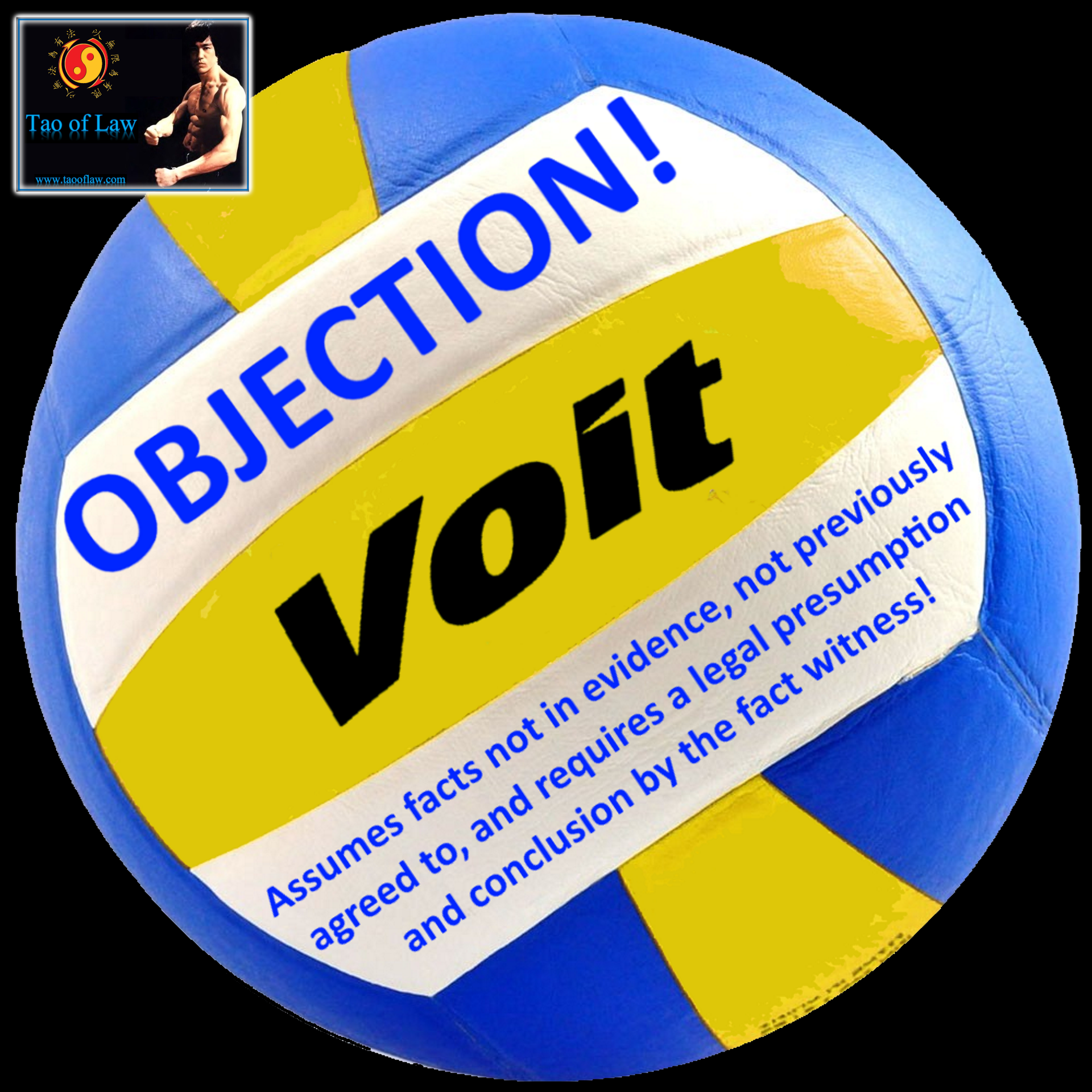
OBJECTION!  How badly the prosecutor would allow their child to behave if these statutes never actually applied to the Accused or the general public is completely irrelevant to the matter before the court, and serves no legitimate purpose other than demonstrating that the prosecutor should probably be sterilized and not allowed to care for children in general. That idiotic example of coulda’ shoulda’ woulda’ is not the law, it cannot be substituted for the law, and it has nothing to do with the actual law and facts before this court.  Therefore, I move that if the prosecutor wishes to engage in the fabrication of delusional and irrelevant fantasies that s/he resign and either write fiction books or run for public office in the legislature. Otherwise, I move that the prosecutor be instructed to stick exclusively to the facts and evidence relevant to this matter rather than their red herring theories on ‘possibility’.

Take note, as there was no actual admissible and countermanding evidence and/or any legal brief(s) filed by the prosecution alleging any opposing statutes, facts, or law that serve to rebut those contained in your own motion(s), the judge and the prosecutor have no legal leg to stand on for denying them, especially with the judge acting biasedly for the prosecution by simply denying them without legal grounds. Their imaginary “what if” example scenarios are NOT the law, nor are they the basis of the law. Just as they are NOT evidence of anything whatsoever, other than as an example of a vivid and totally irrelevant imagination.

So, one possible response to a judge that makes such an obviously prejudicial and biased statement of this nature would be:

Judge, I believe the burden of proving that the specific regulatory statutes at issue in this matter actually DO apply to the Accused rests upon the Prosecution, rather than upon the Accused to prove that they do not. It’s called “the presumption of innocence.” I would move the court to look it up in the Code of Criminal Procedure under Arts. 2.01, 2.03(b), 11.43, 35.17.2, and 38.03.

Furthermore, the prosecution has failed to allege even a single fact in the complaint and/or charging instrument that the Accused was actively engaging in some form of commercial “transportation” activity upon the highway, which is the ONLY way that these specific regulatory statutes legally CAN apply. On these grounds I move that the court take judicial notice of Article 38.03 of the Code of Criminal Procedure, which reads:

Art. 38.03. PRESUMPTION OF INNOCENCE.

All persons are presumed to be innocent and no person may be convicted of an offense unless each element of the offense is proved beyond a reasonable doubt.  The fact that he has been arrested, confined, or indicted for, or otherwise charged with, the offense gives rise to no inference of guilt at his trial.

Further still, SB 971 as enacted by the 74th Legislature in 1995, which is the enactment that created the entire “transportation” code in its current recodified form, including the various statutes at issue in this matter, regulates a specific type of business or business related activity, that of “transportation.” An activity in which the Accused was NOT and never has been engaged, the allegation and proof of which is an essential  required fact element that the prosecution cannot presume to be true or legally prove due to a lack of admissible evidence relating to and proving said activity.

The prosecution is duty-bound to set forth EVERY element that is required to be proven at trial IN the complaint AND the charging instrument, AND must prove EVERY element at trial with ADMISSIBLE EVIDENCE, not hypothetical and overly ridiculous red herring arguments and contrived situations that have no relevance or bearing upon the facts of the case.

Finally, neither this court nor the prosecution may simply presume ANY required fact element of an alleged offense to be true, as that subverts the right of the Accused to the presumption of innocence of EVERY element of an alleged offense, which is fatal error, being a clear violation of the Accused’s right of due process and all. There can be no reasonable legal debate as to whether or not the act of “transportation” is a necessary fact element of the alleged offense considering that it is the specifically stated subject matter of the very legislation that created the recodified “transportation” code and the statutes therein.

There is no such fact element alleged in the complaint and charging instrument, and the state has no admissible evidence that would serve as proof of that necessary element. This lack of admissible evidence also proves that the arresting officer could not possibly have had any articulable facts or evidence supporting reasonable suspicion or probable cause, thus making the warrantless detention, seizure and arrest of the Accused completely unlawful in the first instance. Which, in turn, makes it more than clear that the state is attempting to unlawfully apply the “transportation” code and its regulatory statutes to a completely unrelated subject matter activity to which it simply and legally does NOT and CANNOT apply as said activity is entirely OUTSIDE of the code’s subject matter jurisdiction and application.

Therefore, the state has no case, as the prosecution simply cannot prove that these statutes apply without first proving that the Accused was engaged in the regulated activity of “transportation.” Which is legally impossible to do using only a law enforcement officer’s personal or professional opinion during testimony absent other admissible substantive evidence supporting that conclusion, as the officer is not qualified to make such legal determinations and conclusions and then offer them as factual opinion and evidence through testimony at trial.

Whereby, on these legal and constitutional grounds, I move for your immediate disqualification for bias, prejudice, judicial incompetence, and multiple violations of state law, the rules of procedure, the rules of evidence, the rules of judicial and professional conduct, and criminal offenses constituting felony violations of Abuse of Official Capacity and Official Oppression under Sections 39.02 and 39.03 Penal Code.

In other words, ‘judge,’ fuck you, fuck the prosecutor, and fuck the rest of the dirty wharf rats whose asses and nut sacks you both kiss every day to hold onto your corrupt lying-ass jobs.

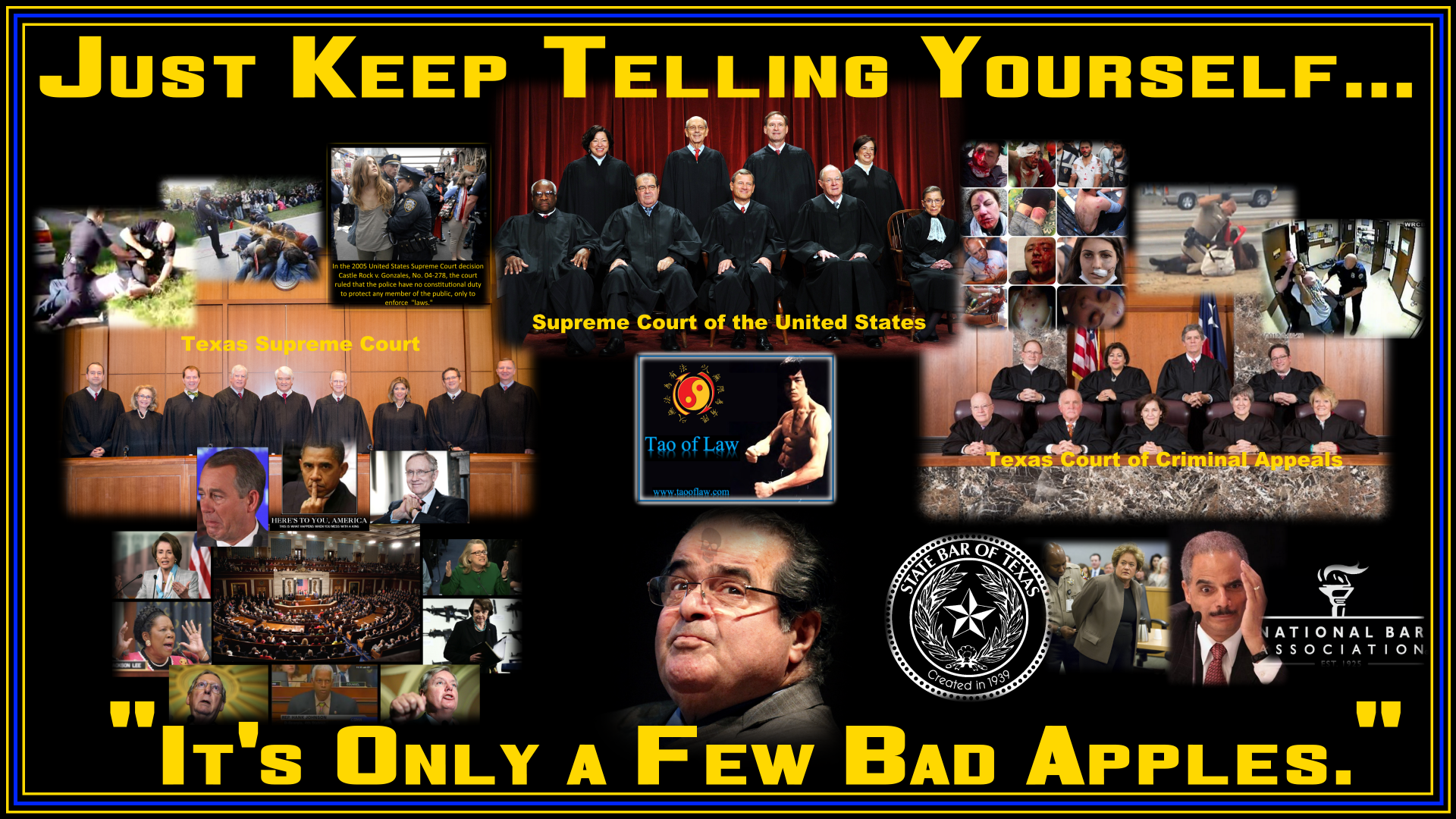
“It’s Only a Few Bad Apples…”

As you all should be aware of by now if you listen to the radio show at all, I have been working on a felony “Evading Arrest or Detention” case for the last several weeks. And if you have been listening for the last few years, then you are also aware that many of the facts and arguments I make on certain subjects have never been litigated or argued in the State of Texas Courts in a manner that addresses all of the in pari materia statutes on the particular subject. Which means that there is little to no “case law” relating to the specific argument.

The document that is posted here is a Motion to Quash Indictment that has been filed in the 63rd Judicial District Court in Terrell County Texas. I am posting it here with the full knowledge and consent of the individual that is being accused in the matter. I am also providing PDF documents for the four pleadings that I wrote for this case in links at the bottom. That way you won’t have to copy the web page and then try to massage it back into a formatted Word document if you find anything in it you might be able to use.

The Motion to Quash is quite long, but it had to be in order to cover all of the unconstitutional and illegal acts being perpetrated by the federal and local public officials in the matter so as to railroad this man into a prison sentence just to finally get rid of him. And if you can read this document and not get pissed off, then you are what is inherently wrong with America today, because it exposes the outright in-your-face corruption of the judicial process and system that runs all the way to the very top criminal court in Texas, the Texas Court of Criminal Appeals. And there is no one to blame for this sort of corruption but the self-serving attorneys themselves.

I am also going to link in copies of several of the Texas Court of Criminal Appeals own case opinions that proves that the Court has been and is actively engaging in and sanctioning statewide criminal violations of Texas law by every lower court and prosecutor in the entire state. And that the sanctioning of these violations is done with the specific intent of denying every individual accused of a crime in their right to substantive and procedural due process. In other words, I believe that I have proven the entire judicial department of the State of Texas to be engaging in organized criminal activity that goes above and beyond even that which we have known or suspected, and they were kind enough to provide the evidence against themselves in their own opinions.

This leaves us having to ask, just when is this bullshit going to be enough to make we the People stand up, charge, convict, and hang every damned attorney and judge in the entire country from the nearest horizontal object strong to hold them aloft until all of their kicking and squirming ceases? Think about the following statements really really hard; is there anything, and I mean anything, that has gone wrong with the course and history of this country, any incident, any disaster, any war, any terrorist governmental attack, unconstitutional law, or violation of individual rights, during its entire existence, that was not conceived, implemented, or justified by some attorney or attorney wanna’be?

Think about that. The founding fathers despised attorneys, even though many of them were attorneys. It was a bunch of Pharisee lawyers that had Jesus condemned to death. Then we had ‘Honest’ Abe Lincoln orchestrating the civil war. The prohibition era and the ‘legal’ alcohol poisoning murders of over 10,000 Americans was overseen by President Woodrow Wilson when the federal government laced all alcohol products with a poisonous recipe of chemicals that included “4 parts methanol (wood alcohol), 2.25 parts pyridine bases, 0.5 parts benzene to 100 parts ethyl alcohol” and, as TIME magazine noted, “Three ordinary drinks of this may cause blindness.” (In case you didn’t guess, the alternative phrasing “drinking that stuff will make you go blind” also isn’t just a figure of speech.). Harry S. Truman oversaw the dropping of the atomic bomb on Hiroshima and Nagasaki, and he went to law school to be an attorney, but never completed the degree after he won reelection as presiding county judge, even though he was informed by the state bar that he was already qualified to join the bar due to his prior court experience. Lyndon B. Johnson, the leading contender in the conspiracy to kill then President John F. Kennedy, went to law school, but never finished either — presumably because he could not have possibly passed the [pretend] ethics portion of the education. And that theme continues on through today with the Clintons and Obamas. This ‘profession’ is literally stealing everything from us, one step and piece at a time, and it must be stopped. But only we can do it. And we cannot do it by keeping our heads in the sand in the hope that the attorneys will simply pass us by because we choose to ignore their presence.

Remember, everything that Hitler did to the people of Europe and to our fighting men was ‘legal’ by the terms of the German-attorney made and enacted laws. And attorneys are doing the same things here, they have just set up a way to remove the middleman.

Like I said, the document is long, but it is an attempt to cover every possible exit and loophole that the corrupt individuals within the courts and judicial system might seek to squeeze their rat-like personages through so as to deprive an innocent man of not only his liberty, but also the few remaining months of his life with his family and friends.

So READ this, and don’t just think or wonder about it, DO something. SAY something. SCREAM something, at someone, anyone, everyone, that we are sick and tired of this kind of thing being done not only to us, but in our own name, by a bunch of corrupt self-serving communist-state loving sycophants!!

It is time to choose. Do you want FREEDOM, or freedumb?

[googleapps domain=”drive” dir=”file/d/0B1JlpaZykV3KOHNscmdwZ3BFc0k/preview” query=”” width=”100%” /]

[googleapps domain=”drive” dir=”file/d/0B1JlpaZykV3KNmtfNjN0YzAwams/preview” query=”” width=”100%” /]

[googleapps domain=”drive” dir=”file/d/0B1JlpaZykV3KcUNJS2Y2cElKOXc/preview” query=”” width=”100%” /]

[googleapps domain=”drive” dir=”file/d/0B1JlpaZykV3KbzNyZjI3MUExLWc/preview” query=”” width=”100%” /]

[googleapps domain=”drive” dir=”file/d/0B1JlpaZykV3KUkc2dWxpbHc1U2M/preview” query=”” width=”100%” /]

Court – We’ve Won Another One!

Okay, the documents from this win is IN ADDITION TO the previous win that I announced, although it IS relating to the same individual as the previous win.

The statutes don’t lie, unlike the cops, attorneys, and courts. And like any other board game, if they can control the rules, they can control the game. So DON’T let them control the rules.  OBJECT to ANY deviation from the prescribed rules of procedure, EVEN if they have “case law” that allegedly sanctions their actions.

When my pleadings for the felony case are completed, I will be posting them in their ENTIRETY for all to see and study, because they will tell you a LOT about the total corruption that IS the judicial and Bar system.

And by the time you are done reading them, it is my hope that no attorney or judge on the planet will ever again feel safe about showing his or her sorry corrupt face outside of their door or walking down the street, because I am going to be exposing them for the rotting scumbags they are.


beardsley-carl-001

beardsley-carl-002

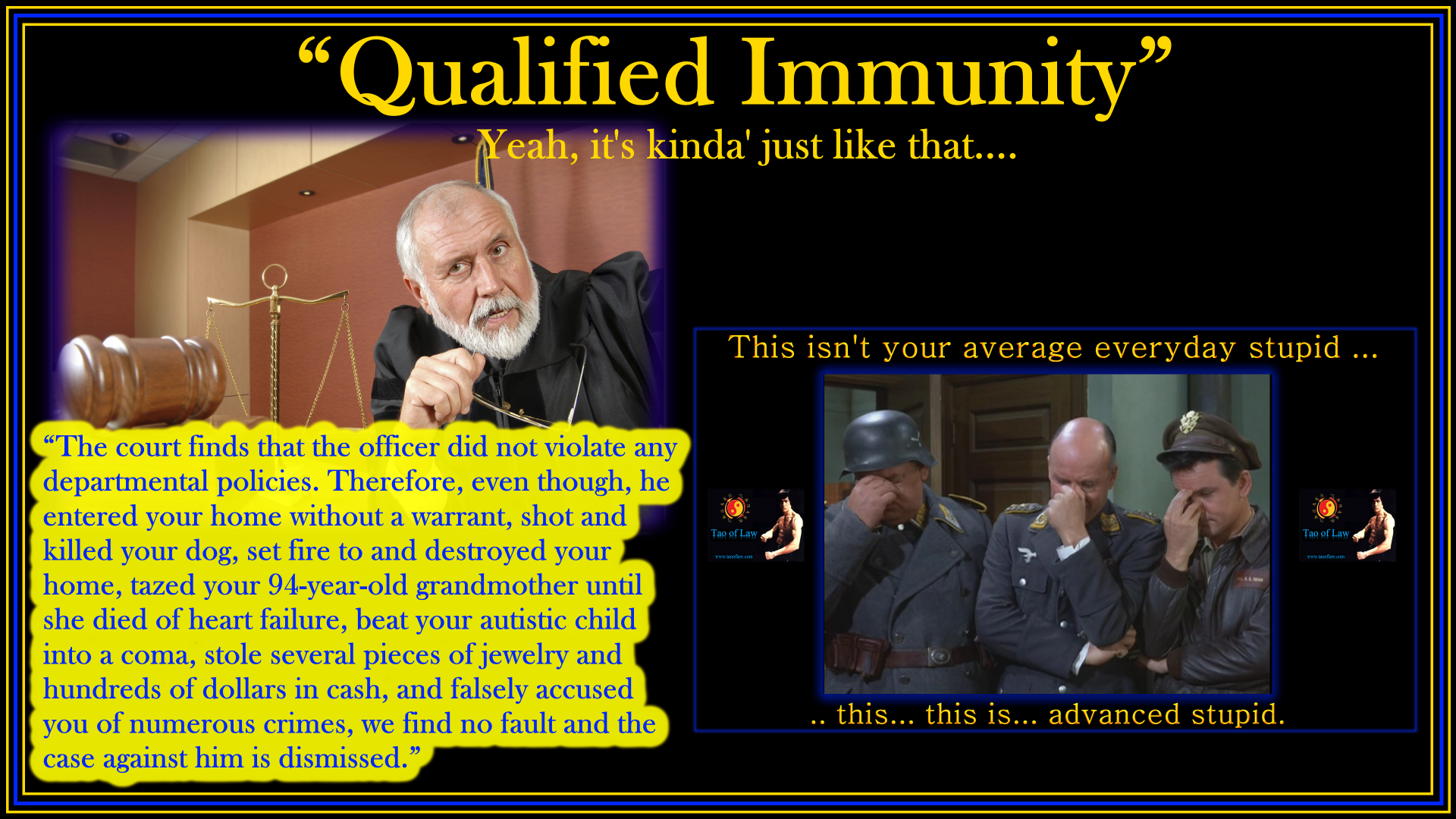
Attorneys – The Unqualified Stupidity of “Qualified” Immunity.

The very concept of “qualified immunity” for public officials borders on utter lunacy, especially when it involves “law enforcement” officers. Only another group of government officials, and all of them attorneys no less, could come up with the concept of “qualified immunity.” Seriously?

The true conceptualization for “qualified immunity” is fairly simple, being ignorant and stupid is an asset when serving in public office, therefore, establish a legal mechanism that does not exist in American history or written law, because it is created entirely out of thin air by the  modern judiciary, and whereby a public servant can claim susceptibility to either condition when they screw up, and then be free from the otherwise serious consequences and accountability for their actions, in contradistinction of that course of action to which we the peons from whom they steal their paychecks and pensions are subjected.

The general idea behind the concept is that, a public officer or employee cannot be held accountable for any wrongdoing if s/he allegedly acted in good faith reliance upon the orders or information s/he receives from a superior or a/n un/written policy manual.

I know, right? I can literally see and hear the confusion in your eyes and mind on this perspective point. “You mean, if a government employ, including a police/law enforcement officer, didn’t violate some policy that we don’t even know about, s/he isn’t actually guilty of any wrongdoing, even criminal wrongdoing, when they act to wrongfully injure someone or their private property?” Yep, that is exactly what I mean.

Which leads me to ask these related questions, even if it is for no one other than myself:

  • Is there any chance at all perhaps, that the damned policy itself is actually wrong and unconstitutional on its face?
  • And why aren’t these minion idiots required to understand and know when that policy is directing them to do something, anything, that is unconstitutional and unlawful, or even illegal?
  • Why is blatant stupidity and willful ignorance a defense for public servants while honest ignorance or outright innocence is no excuse at all for we the People?
  • Is there also a better than average chance that the psychotic idiots (that would be the attorneys running the courts that I mentioned before) that are responsible for the creation and continuance of this criminally insane doctrinal policy are actually wrong, and simply don’t give a crap about you, me, or our rights and property within the grand scheme of things, which is that they get richer and more powerful while we the People get poorer and more submissive?

What the hell happened to the requirement of having and using one’s own brain in order to do this or any other job? Isn’t a functioning brain somewhat of an asset, and actually a fundamental requirement for a person to be considered a viable productive and trustworthy individual and member of society, or, for that matter, to even be left alone and free to wander around on their own totally unsupervised? Since when did it become the norm to arm paranoid psychotics with handcuffs, body armor, a club, a portable electroshock therapy device, a loaded weapon, and permission to use any or all of it against anyone whenever they “feel threatened?” And the courts think that setting this sort of standard under the umbrella of “qualified immunity” is somehow a benefit and protection for society and the rights of individuals? Think about that for a second… and then repeat after me, “You seriously delusional mentally incompetent fucktards!”

Is it somehow even a remotely reasonable and credible concept that a public servant doesn’t really know, assuming the existence of an actually functioning brain, when s/he is doing something wrong to other persons or property without someone higher up in the chain of command having to tell him/her that they’ve done so? Aren’t they supposed to already be qualified to know and understand the concept of right and wrong before they got a job that put a shitload of abusable power and authority into their hands, not to mention a loaded weapon with real bullets? Really? They are actually incapable and don’t really understand when they are acting wrongfully against an individual in violation of their rights and property? WTF?

Isn’t there a couple of well-known psychological conditions that describe this particular type of behavior and mental disorder, the two being what we have come to know as the psychopath and sociopath? What characteristics do these disorders share in common, which is really the main concern in asking the question in the context of this writing? Well, it’s sorta’ like this:

The common features of a psychopath and sociopath lie in their shared diagnosis — antisocial personality disorder. The DSM-51 defines antisocial personality as someone have 3 or more of the following traits:

  1. Regularly breaks or flouts the law
  2. Constantly lies and deceives others
  3. Is impulsive and doesn’t plan ahead
  4. Can be prone to fighting and aggressiveness
  5. Has little regard for the safety of others
  6. Irresponsible, can’t meet financial obligations
  7. Doesn’t feel remorse or guilt

 In both cases, some signs or symptoms are nearly always present before age 15. By the time a person is an adult, they are well on their way to becoming a psychopath or sociopath.[1]

Does this list contain three or more traits that you can readily associate with any of the current-day governmental profession(s) existing in America?

So, I think a few fair and legitimate questions would be:

  • “Why the hell aren’t all public servants mentally evaluated with the intent of determining the existence of these traits, starting with their early childhood? Especially law enforcement officers, and any attorney. Any attorney occupying any job at all!
  • And if the individuals that seek employment in any of these fields already are being so evaluated, then why do we and should we trust psychology as a valid profession and practice for making such determinations, considering the number of morons within our public offices and the justice system that have obviously been overlooked or slipped by?
  • Just how frickin’ reliable can this so-called “science” and “profession” really be with this many mistakes and oversights to its credit?”

Can you imagine how the Nuremberg trials would have been handled if the doctrine of “qualified immunity” had been around and the panel of judges and the jury were all Nazis or Nazi sympathizers, just like the ones that we have today? “Zee dere! He vas jost following orders! Nein! Nein! We cannot let a man be sued, or convicted und punished or imprisoned for a crime vhen he vas simply following orders from his superiors now can we? Vhat? Ach du himmel, der Fuhrer actually had zee written policy? Zee Gestapo had zee policy too? Those policies said zhat all of zis vas uhndkay as long as zee soldiers did everyzing in accordance with zee policies? Wunderbar!! We cannot convict! Zee cases are dizmissed!!

What did you get me for Christmas this generation Santa? OH, wow! Just what I’ve always wanted, an American justice and governmental system that would make the character in “American Psycho” look normal and Adolph Hitler proud.


Footnotes:

[1] PsychCentral.com – World of Psychology article “Differences Between a Psychopath vs Sociopath.”

Rights – WTF Does the Constitutional Prohibition Against “Unreasonable” Even Mean Anymore?


Before you become embroiled with the details of this article, please take the time to ask yourself one very important question, and keep it at the forefront of your mind the whole time you are reading so you may contrast its implications with the totality of information herein; “why do you think it is that the entirety of the United States and state Constitutions, as well as the concepts and importance of every individual’s inherent and fundamental rights and liberty as ensconced within the history of our earliest American law, are not being taught to our children throughout their entire educational process?


For Whom the Bell Tolls

Our state and federal courts constantly extol the opinion that a warrantless arrest must be “reasonable” and not “unreasonable” without clarifying what the Founding Fathers and our history understood the terms “reasonable” and “unreasonable” to actually mean at the time of the Constitution’s writing, because they certainly seemed to dislike things they considered to be “unreasonable.”

When King George assented to the Tea Act on May 10, 1773, the colonists thought the King’s new revenue law levying an additional two cent tax (yes, 2¢) to be “unreasonable,” resulting in the “Boston Tea Party.” The “tea party” became a positive symbol and nationally recognized event glorifying the American ideal and zest for freedom and liberty in what was once our founding glory of challenging overzealous authority.

When King George’s magistrates were given the authority to create criminal laws and penalties for virtually any petty offense that they wished so as to intimidate and subjugate the colonists and raise revenue for the King, they immediately corrupted intent of the law by the practice of using it to line their own pockets and enrich themselves at the expense of the individual colonists. And when the grumblings of the colonists became too loud and forceful, the King’s magistrates and their minions sought his blessing to totally disarm the entire colonial population, except themselves of course (does this all sound familiar in relation to today’s attempts by government to enact gun control laws that would let them disarm the American people?).

But, the colonists themselves didn’t see any of these actions as being “reasonable,” and that triggered a war that founded a nation of freedom loving individuals that vowed and intended to never allow that kind of abusive and pervasive authority to ever exist over or among them again. A war that also culminated with the constitution of every sovereign republic containing a permanent prohibition outlawing any and all forms of Bills of Attainder, and by direct association, all Bills of Pains and Penalties. Every state constitution also forbade the enacting of ex-post facto laws as well. All of which our courts seem hell-bent-for-leather in allowing our legislative and executive departments to permanently reestablish as a part of the American way of life using even the flimsiest of legal logic and judicial reasoning.

The Concept of “Unreasonable” is Subject to Individual
Perception of the Parties, of Which Only the People’s
Legitimately Matters and is Controlling.

Therefore, the question must be asked; when it comes to resisting an unlawful arrest using a “reasonableness” standard, why are the opinions so blatantly against the rights of the People “to be free from unreasonable searches and seizures” when they resist unconstitutional, unlawful, and illegal acts by state officials? Are unlawful acts only unreasonable or illegal when perpetrated by someone outside of governmental authority? Are crimes only criminal when committed by non-state actors? This country was founded entirely upon the concept of the right to resist any presumption or exercise of authority that unjustly infringed upon or destroyed individual rights or property, regardless of the alleged source of the authority to commit such infringements.

For example: In the case of Class C fine-only misdemeanors, our Texas Courts have opined numerous times that it is perfectly “reasonable” for the courts themselves to violate the Texas Constitution’s Bill of Rights and its codified portions within the Code of Criminal Procedure by denying the most basic due process protections to an individual accused of this particular class of ‘crime’. Why and how you may ask? Simple, they justify these rights violations upon the grounds that, because the offense doesn’t involve incarceration as a part of the punishment, these rights are never invoked, and therefore, are not available to the Accused before or during trial on the allegation.

It would seem that our individual right to be free from any “unreasonable” situations that place us in potential danger where we might suffer bodily harm or death at the hands of some ‘roid-raging lunatic with a Mike-n-Ike-sized penis and seriously deficient social skills and an all-to-willing itchy trigger finger, are specifically relevant aspects of these situations that are being totally forgotten or ignored despite the duty upon the courts to preserve and protect every single one of those rights as well as the right of private property. By protection of private property in these situations, I mean to say that we have these rights so as to also protect our private property from being arbitrarily damaged or stolen through governmental whimsy and caprice, not just protection from jail time. Private property in this context refers to either our physical property, our money, or our time if sentenced to community service because we have no money for them to steal using trumped up charges on phantasmically intangible offenses.

The Courts Say That Certain Due Process Rights
Don’t Exist as Long as They Cannot Sentence
Us to Jail for the Offense.

Our courts routinely deny those accused of Class C fine-only offenses the right to counsel, the right to a probable cause hearing determining the validity of any warrantless seizure, detention, search, or arrest (called an examining trial in Texas), or even a probable cause hearing for the singular purpose of determining probable cause for any specific charge(s) being levied against them (also an examining trial), to have proper, sufficient, and timely notice of the allegations and proceedings against them, the right to be fully informed as to the nature of and the actual cause against them, to challenge the lack of evidence supporting the jurisdiction of the court itself, and innumerable violations of the Bill of Rights, Texas Code of Criminal Procedure, Judicial canons, professional ethics, Chapters 311 and 312 of the Texas Government Code, and finally, the knowing and willful misapplication of occupational regulatory codes against private individuals that were never engaged in the alleged occupation. In other words, that last one is nothing short of outright judicial and legal fraud on a massive scale. According to our various court’s own rulings and opinions, these unconstitutional, immoral, and seditious violations of the People’s sovereign rights and property are all considered to be “reasonable” in their eyes. Yet, in our history, both foreign and civil wars have erupted based upon far less egregious acts than these that those in authority at the time also considered to be “reasonable” and within their power to do.

Through this method of judicial sophistry, our Texas Courts routinely deny to individuals accused of Class C fine-only offenses the same standard of equal application and protection of the laws. And they do so based solely on the pretense that these rights only apply when some length of incarceration can be levied as a part of the punishment upon conviction for an alleged offense. They don’t even consider the loss of property, i.e. our money, our time off work, from family, etc., that is also involved in such cases. We have a vested interest and right to be protected from unjust loses of that property every bit as much as we have to be protected from unjust incarceration. It is as if the courts and prosecutors believe the term “all,” in relation to criminal proceedings, as is clearly found in the language of Art. 1, Sec. 10 of the Texas Constitution, either doesn’t exist there at all, or, at best, means something else entirely different than the terms “each” or “every.”

After all, it isn’t like they don’t know the actual meaning and intent of these terms, because they’ve already told us that they do:

All. Means the whole of – used with a singular noun or pronoun, and referring to amount, quantity, extent, duration, quality, or degree. The whole number or sum of-used collectively, with a plural noun or pronoun expressing an aggregate. Every member of individual component of; each one of-used with a plural noun. In this sense, all is used generically and distributively. “All” refers rather to the aggregate under which the individuals are subsumed than to the individuals themselves. State v. Hallenberg-Wagner Motor Co., 341 Mo. 771, 108 S.W.2d 398, 401. See Both.

Each. A distributive adjective pronoun, which denotes or refers to every one of the persons or things mentioned; every one of two or more persons or things, composing the whole, separately considered. The effect of this word, used in the covenants of a bond, is to create a several obligation. The word “any” is equivalent to “each.” Conerty v. Richtsteig, 308 IlLApp. 321, 31 N.E.2d 351. “Each” is synonymous with “all” and agrees in inclusiveness but differs in stress; “all” collects and “each” distributes. Knox Jewelry Co., Inc. v. Cincinnati Ins. Co., 130 Ga.App. 519, 203 S.E.2d 739, 740.

Every. Each one of all; all the separate individuals who constitute the whole, regarded one by one. The term is sometimes equivalent to “all”; and sometimes to “each”.

Source: Black’s Law Dictionary, 6th Edition 1996

Yet, the courts have never once addressed whether or not it is a violation of the United States and Texas Constitutions “unreasonable” clauses to statutorily authorize a warrantless seizure, arrest, and potential incarceration for a period of several hours to several days, or, as has occurred in many cases, even weeks, and all prior to any charges even being filed or a conviction had. And all for an alleged offense for which the Accused cannot be lawfully punished by any form of incarceration for even the tiniest fraction of a second even if convicted. Given the factual existence of exactly these processes, I personally believe and hold this entire possibility to be totally “unreasonable” in every respect. And yet, those charged with Class C fine-only offenses or other classes of misdemeanors are unjustly denied a chance at preserving any appealable error relating to the probable cause finding by being denied an examining trial in which to raise the issue in the first place.

Since When are the Illegal Acts of False
Imprisonment, Assault, and Kidnapping
Not ‘Excessive’ in and of Themselves?

This is especially true in light of our current atmosphere of police animosity and brutality toward the general public, as the encounter relating to any such alleged offense is very likely, and now almost expectedly, to turn dangerous or deadly to the civilian. All because an as-yet undiagnosed and out-of-control mental patient was given a gun and permission to use it as a matter of departmental policy to support their preexisting seriously bad attitude that obviously developed from carrying around a rather sizable chip on his or her shoulder, and then dressed all of that hot mess up in the uniform and ‘legal’ authority of a law enforcement officer. What is also especially true in such situations is the fact that these alleged offenses require no intent to commit any criminal act, or the intent to even commit the act itself, or to inflict harm or injury, and have no actual tangible and identifiable victim to claim and prove any such injury, to claim and prove palpable harm or injury of persons or property resulting from negligence, to claim and prove any felony acts, or to claim and prove a breach of the peace.

And once you have been accused, every aspect of the entire process moving against you is controlled entirely by agents of the same fictional entity, the “State.” The “State” is an entirely fictitious political designation that is claiming to have somehow been invisibly, insubstantially, and intangibly harmed by you. And the “State” is the only plaintiff claiming an alleged injury that is moving against you to allegedly seek redress for this intangible and unprovable harm, and yet, it has no way to demonstrate the injury, no victim to take the stand and testify, and no one to place under oath to testify to this harm as being a fact.  Were this you or I pursuing a suit in a court of law, we would be thrown out on our asses for failing to state a claim upon which relief can be granted and lack of standing. As we well should be, considering that we would be completely unable to demonstrate and prove any actual personal injury through any actual substantive admissible evidence.

‘Reasonable’? We are the State, We Don’t
Need No Stinking ‘Reasonable’?

In cases such as this, it is always one or more agents of that same legal entity that not only accused you of the offense that is the alleged source of this equally fictitious injury, but who will also be the entity’s star witness(es) against you. The “State’s” witness(es) will testify against you at the behest of a totally different agent whose only goal and purpose is prosecuting you. And that prosecution is taking place before yet another agent that controls the process and is responsible for the rulings and orders that ultimately “prove” that all of the actions being taken against you are ‘fair and impartial,’ ‘proper’ and ‘legal.’ Then, any appeals from the decision at the trial level will be submitted and held before more of the same. And lest we forget, each and every one of these agents of the “State” are direct or indirect financial beneficiaries of each and every guilty verdict found against the accused for the alleged offense(s).

At this point it should be abundantly clear that “reasonable” has left the building… all the while screaming in agony because these agents of the state doused it with gasoline and lit it on fire!!

How is it not unjust and “unreasonable” that the People, when not causing tangible harm to anyone or to the private property of another, can or should be subjected to the potential and wholly unacceptable risk of bodily injury or death during a warrantless seizure, detention, search, or arrest, for an alleged malum prohibitum offense that in and of itself, and without the prohibition, is neither morally or ethically wrong, and causes no harm to any individual, person or thing, nor is it a common law felony or breach of the peace, and the act being prohibited could not result in a single second of incarceration even if ‘convicted’ for it? When and how did we the People allegedly authorize our public servants to imperil our personal health and welfare, our property, and even our very lives, in this totally “unreasonable” manner?

Differing Perspectives and Desires of Governmental
Agents Does Not ‘Reasonable’ Make.

“The Blaze” is a web site that portends to carry current daily news, articles, and events from all aspects of the political and social realm. I’ve never thought too highly of it or the articles it publishes, as most seem to usually contain content and subjects that I find to be intellectually illiterate and, from the perspective of a freedom, liberty, and rights loving individual, highly offensive statist-centric liberal propagandist bullshit.

However, while doing some case research, I stumbled across one of the very few articles published there that I have ever considered to be actually looking at the “big picture” context of the situation surrounding the subject matter. This particular article was written by one Paul Markel, and is titled “Do You Have the Right to Resist an Unlawful Arrest?” Mr. Markel claims that he writes the article from the perspective of an ex-cop and, apparently, also as a constitutionalist, none of which I can offer any reason to doubt at this time. In his article, Markel writes:

In case after case, we see policemen who seem to view handcuffs as their first and only resort to a non-violent altercation. What is even more troubling to me are the scores of timid apologists who reason that any public display of anger or outrage is rightfully silenced by officers of the state.

This nation was born of dissent not acquiescence. Our founders fought for the rights of man. If Adams, Jefferson and Madison had listened to the voices of timidity and complicity their only path would have been the return to the life of comfortable tax slaves.

Rather than accept that they were sanctioning murder, we could view the legal opinions of the courts in both the Plummer and Bad Elk cases as a message sent by the Judicial Branch to the Executive. Firearms and handcuffs, while often legitimately called for in a crisis, should not be the default for every situation encountered. When the state seeks to rule by the sword, the peasants have a choice to make: submit or resist.

Imagine my surprise in finding an officer who not only “gets it,” but who is willing to make his understanding and beliefs known to the public even though both goes squarely against the “code of silence” and the “thin blue line.” But there is a truth to his words that cannot be ignored in our modern America. The police state isn’t looming on the horizon, it is in your cities, streets, and neighborhoods already, and God and the 2nd Amendment help us, it is already transgressing directly into our homes and in our faces. It is killing us without conscience or consequence. The unarmed and otherwise innocent civilian body count is rapidly mounting to prove it.

However, as equally unsurprising is an article and commentary on the same subject from a law enforcement oriented and focused site called “PoliceMag.com.” The majority of comments there appear to be coming from actual current law enforcement officers, as well as some possible imposters pretending to be law enforcement. Most all of whom make it abundantly clear that they are more than willing to kill you to perfect an arrest, regardless of how minor the alleged offense or that the only legally authorized punishment is a monetary fine. And regardless of the circumstances, the authorized punishment is most certainly not bodily injury or some other degree of injury so serious and life-threatening that it requires an ambulance or a coroner. From one commenter calling himself “Mike,” who claims to actually be a law enforcement officer, we see this attitude regarding his presumption of power and authority to arrest you or to kill you while trying; “When your resist you become mike brown or Eric garner and could potentially die. You have no right ever under any state law in the United states to resist any arrest legal or illegal hence why we have a justice system. If you don’t like the system vote to change it or move. You won’t be missed.

(NOTE: All grammar, spelling, capitalization, and punctuation errors in original, after all, he’s just a cop, not necessarily a high school grad or otherwise literate individual).

The comments from others who say they are or appear to be active in law enforcement go on and on about how no one has a right to resist even an illegal arrest, not even if it is known at the time to be illegal by both the person to be arrested and the arresting officer. And it appears to be their firm understanding and belief that the order of the day in virtually every state of the union is that an officer may continue to escalate the use of force, even during a knowingly illegal arrest, until such time as they can either perfect the arrest, the subject escapes, or the subject is dead and no longer resisting.

Therefore, we can all assume that the current standard for “reasonable” probable cause to inflict serious bodily injury or death upon another living fellow human is:

  • because that fellow human is in possession of a 2×3 inch piece of plastic with a really ugly photograph and a date that is one day past their last birthday, or a printed sheet of paper with the wrong date or incorrect insurance information on it, or a species of plant produced entirely by nature and having enormous medicinal, textile, and manufacturing value to mankind;
  • because that fellow human dared exit his or her car and demand that the officer point out the allegedly defective taillight the officer claimed was the basis for stopping them on a busy highway;
  • a police officer shooting that fellow human in the head and killing him or her during a totally bogus traffic stop and arrest, allegedly because there was no rectangular-shaped piece of alpha-numerically decorated metal on the front of the human’s car to match the one s/he had on the back, and, thus, was an incomprehensibly dangerous and unacceptable threat to the public’s safety and welfare warranting their immediate execution;[1]
  • a police officer assaulting and then threatening to taze or shoot an entire family of fellow humans because of a similar rectangular-shaped alpha-numerically decorated piece of metal that was allegedly ‘expired’ and, therefore, either no longer fit to eat or have bolted to one’s car, and, thus, was an incomprehensibly dangerous and unacceptable threat to the public’s safety and welfare potentially warranting the entire human families immediate execution;[2]
  • a Texas DPS Trooper tazing, brutally assaulting, and then arresting a fellow human because s/he refused to put out a cigarette s/he was smoking inside his/her own car after the officer had concluded his traffic stop for allegedly failing to use a turn signal to make a right-hand turn, and, thus, was an incomprehensibly dangerous and unacceptable threat to the public’s safety and welfare warranting his/her immediate beating, tazing, and incarceration on falsified charges of resisting and assault upon a police officer, and without a proper commitment order signed by a neutral and detached magistrate after a finding of probable cause for the warrantless seizure and arrest via a proper examining trial. NOTE: The human, a woman named Sandra Bland, died three days later in her jail cell while in the custody of the county Sheriff’s office where the DPS Officer illegally incarcerated her.[3]

Is it just me, or does anyone else notice a trend that indicates our police forces are getting inundated with far more morons than they used to be and that are way too thin-skinned and egocentric on top of being a bunch of pussified estrogen-rich pea-brained hot-headed steroid junkies? Why else would a 220 lb. man claim to have feared for his life from nothing more than the incessant barking of a family’s 2 lb. Chihuahua to such a degree that the dog had to be shot and killed to protect himself if not because he is actually the world’s biggest male pussy?

With that said, take notice of the fact that each of these encounters with law enforcement began with nothing more than a police officer trying to incorrectly and wrongfully apply and enforce a Class C fine-only or other low-level misdemeanor regulatory offense or infraction under their particular State’s “transportation/motor vehicle” regulatory code. An offense that, as a matter of law, applies only to those “persons” engaged in the commercial occupation of “transportation.” We can show this is absolutely true for Texas using some simple statutory algebra.

Statutory Algebra Formulas for “Transportation.”

Carrier” = A legal designation and capacity describing someone who engages in the business of moving any persons, goods, or property by land from one place to another for compensation or hire (see “transportation”).[4]

Commercial/ Motor/ Vehicle” = A legal designation assigned to a motor-driven device used by a “carrier,” “driver,” or “operator” who is actively engaged in “transportation” upon the land.

Driver/Operator” (or any grammatical variation thereof) = A legal designation and capacity describing someone who is actively engaged in acts of “transportation” upon the land.

Person” = A general legal designation and capacity generally describing someone who is acting in one or more of the other legal capacities defined as “Carrier,” “Driver,” or “Operator.”

Transportation” = the legally defined business profession or occupation relating to the moving of persons, goods, or property by land from one place to another via a “commercial/ motor/ vehicle” for compensation or hire as either a “carrier,” “driver,” “operator,” or any combination thereof.

Now we write equation in the form of a computer program function:

Define Person as Boolean

Person = IsPerson(False, False, False, False)

Function IsPerson(Transportation as Boolean, _
                   Carrier as Boolean, _
                   Driver as Boolean, _
                   Operator as Boolean) _
          as Boolean

  If Transportation = False then

        IsPerson = False

  Else

    If Carrier = False and  _
       Driver = False and _
       Operator = False then

          IsPerson = False

    Else

          IsPerson = True

    End IF
  End If
End Function


In each of these cases, the officers involved were unlawfully and illegally using that State’s occupational regulatory code and its related offense(s) against a private individual who was acting solely in their private common law capacity to engage in their private business or pleasure activities as a matter of right, in which case such codes never applied to those individuals in the first place. Which means, in reality, that every single detention, arrest, injury, and death memorialized in the linked in news articles and stories were all 100% unconstitutional and illegal, and, therefore, inherently “unreasonable” by constitutional standards and prohibitions. But, of even more import and concern, is the fact that each one was also 100% fully sanctioned by the courts and prosecutors through knowing and willful misrepresentations and abuses of the amorphous legal semantics intentionally written into the laws and statutes so as to perpetrate and perpetuate this long standing fraud upon the American People within every state of the union.

In Sandra Bland’s particular case, she was falsely charged and locked up by the DPS officer on the trumped-up charges of resisting arrest and assault on a police officer, not for the “transportation” offense she could not have possibly committed in the first place considering that she was not acting under any form of legal capacity for the purpose of engaging in any “transportation” related activity when the DPS Trooper initiated the illegal stop. However, those fraudulent, vindictive and malicious charges by the DPS Trooper would have never been able to even be applied to Bland if not for the fact that our courts had unconstitutionally and unlawfully ruled that it was totally “reasonable” for her to be knowingly and willfully deceived by her public servants so as to be fraudulently subjected to an profession/occupation related regulatory code that had absolutely nothing to do with her private activities could not be legitimately applied to her in any way. And this list of decades-old governmental atrocities and frauds grows daily by leaps and bounds.

The Times They Are a Changin’.

As found in the article linked below from TheFreeThoughtProject.com, the “The new death penalty standards in America” footnote states, “At a time when police can do no wrong—at least in the eyes of the courts, police unions and politicians dependent on their votes—and a “fear” for officer safety is used to justify all manner of police misconduct, “we the people” are at a severe disadvantage.” And so slips into the abyss of hopelessness and helplessness the hopes and dreams of every individual that once believed true freedom and liberty was to be found within the territories of the sovereign union of states known as America.

Those feelings of helplessness and hopelessness stem from the appearance and practice that “unreasonable” is now whatever the asylum inmates (our public non-servants at this point) actually desire it to be in order to fit their broken-brained view of a total authoritarian oligarchical police state where they are no longer limited as servants of the People, but rather, where they’re the new masters, and capable of wielding limitless power and authority to re-mold America and the world into their own private for-profit and pay-to-play labor pool.

Why does this thought evoke flashbacks of childhood cartoons and movies? You know, the ones where the evil man, always dressed in black and with a thinly curled mustache, would cackle insanely and tell the hero how he was planning to steal someone’s home and property through some perfectly ‘legal’ means of foreclosure or forced marriage if the poor person or lovely young widow woman was one minute late in paying the mortgage, or how the evil villain mastermind proclaimed his or her plan to possess and control the entire world through some nefarious and highly destructive means if it wouldn’t submit willingly.

Constitutionally, logically, morally and ethically, it is rather myopic, moronic, and downright insane to say that these specific types of malum prohibitum offenses correctly pretend to validate any such warrantless arrests as being constitutionally lawful simply because they are ‘legally’ authorized by a group of self-serving criminals only pretending to work for our benefit. Much less that such enactments truly serve any real purpose of better protecting the public from harm. Which one can only assume at this point means harm caused strictly by other non-state actors, but certainly not any harm inflicted upon the public by the agents of the state themselves.

Meanwhile, every single day, there are literally tens of hundreds of thousands of people whose rights are violated,[5] and many who are seriously injured or killed, by an overzealous and overly-aggressive police officer, often with support and assistance from fellow members of his legalized criminal street gang. Most of whom are also demonstrably more than willing to enforce the collection of a potential $200 fine or avenge some perceived slight or affront to their ego or authority through use of brute or deadly force and violence against virtually any member of the public that dares to exercise their right to ask questions about or challenge the officer’s actions. And far too often, regardless of the age, race, or sex of the officer’s brutality victim(s). What could possibly be justifiably “unreasonable” about any of that?

If the only test and determination for “unreasonableness” for a warrantless arrest is whether or not the United States Congress or a state Legislature has passed a “special statute” authorizing it for any sort of malum prohibitum thing that they don’t like, then, under a constitutional standard, the terms “unreasonable” and “reasonable” now mean less than an announcement that your local pub has just started serving fresh elk piss on tap for a dollar a quart, as any legislative body is now totally free to declare any statutory form of warrantless seizure or arrest as “special” and necessary, and therefore, “reasonable” for any purpose that may be governmentally desired. They could then forevermore do whatever they wanted by simply enacting a “special statute” saying that they could, regardless of any other constitutional, common law, and/or sovereign individual rights prohibitions against it. You are watching the wholly unconstitutional and unlawful reinstatement of the very sort of Bills of Attainder and Bills of Pains and Penalties that are expressly prohibited by the Bill of Rights in every state constitution as well as within the federal constitution itself.

Calling it a “special statute” does nothing to change the unconstitutionality and “unreasonableness” of such enactments, not to mention the seriously detrimental repercussions to our individual rights, as well as the totally unnecessary and wholly unacceptable levels of risk it places on our personal safety, health and welfare. Which the People have every right to presume and expect to be fully protected by the courts against such intrusions by using the Bill of Rights within the federal and state constitutions. These protections would rightfully and necessarily include the recognition and proclamation of our individual and collective right to defend ourselves and others against such abusive authoritarian actions with any level of force that is necessary to do so, all the way from evasion and escape up to deadly force, if and when the need arises.

Alas, Poor Liberty, I Knew Him Well.

This abrogation and derogation of our individual rights and property by incremental degrees simply must stop. And it is the duty and responsibility of our courts to make it stop, as they are supposed to be a buttress between the People and such prohibited and abusive acts by the agents of government. Not simply a rubber stamp committee for anything the legislature and the executive departments deem necessary so they may do things in any damn way they please. And if the courts won’t perform their duties faithfully and in full compliance with the Bill of Rights and the express will of the People, then they should be abolished or transferred over to the control of People who understand these issues and will enforce the constitution over the statutes. While those who are responsible for making such actions necessary are stripped of all wealth and possessions accumulated with the fraudulently obtained proceeds from their elected offices before being sentenced to prison for an appropriate length of time. I would recommend that length of time be at least until Hell itself becomes the preferred venue for hosting the Winter Olympics.

It is a fallacy of epic proportions to put forth the false authoritarian doctrine that a free people have not only no right to resist an unlawful arrest or assault by our public servants, but that we must actually obsequiously submit to such criminal acts peacefully and without any defensive or offensive resistance, no matter how violent and injurious or fatal the assault might be due to our failure or legal inability to defend and resist. And then, if you survive the initial assault, your only recourse is to take your case before a higher level of the same authoritarian system that authorized the initial abuses in the first place, and where you now plead the case for violations of your rights and to be vindicated and provided restitution, which we all know borders on the insanely difficult and expensive and the “yeah, like hell” process of collecting the judgment even if you win. This process is so much more expensive than the cost of the bullet(s) necessary to end the criminal actions of the officer(s) before they could escalate into a need for you to needlessly and wrongfully suffer on the off-chance that you might survive so as to later be afforded the aforementioned and almost certainly useless and losing, but wholly system-approved, course of action. Which anyone with any brains can tell you is just an added feature of the overall function and design of the system that is intended to serve and protect only those that are its true masters or who serve as their faithful servants and lackeys.

I find it rather comical that those in our government offices have the temerity to actually believe, vociferate, and act as if the power and authority that they received from us, can be used to create laws and consequences meant to destroy our ability to maintain control of or take back the very power and authority that we delegated to them. Think about it, they actually believe that they somehow have this “divine right of kings” to try and use we the People’s own delegated authority to violate every right that we have, to use that delegated power and authority to forcibly resist and prevent us from taking back that power and making any changes and corrections that we the People deem proper and necessary to prevent their abuses and hold them accountable, and that we must simply accept the injuries and consequences of their actions until they determine whether or not we have any right or privilege to make a claim challenging the validity of those actions in the first place. And only then can we hope for the opportunity to beg for recompense for our perceived slights at the hands of the agents that work for our own servants.

And you wonder why I refer to these idiots as asylum inmates and escaped mental patients? If ever there was a “fuck you” Kodak moment, it would be during my almost certainly epic response to some petty bureaucrat trying to sell me on this smelly bag of faux-magic horseshit as a societal cure-all in a public forum. I would lay waste to them with a wave of verbal heat and destruction that could melt the cores of a nuclear reactor from a mile away.

Those controlling our system of government from behind the scenes and from its positions of power live solely by the morality of their only creed, “if it’s necessary to make us more powerful and rich, and gains us further control over the masses populating the planet, then it shall be done at all costs.

Our governmental actors and their puppet masters behind the scenes need to remember one very important aspect of “the law of necessity,” it is both a two-way street and a double-edged sword.

Footnotes:

[1] Officer Ray Tensing murders Sam DuBose in Cincinnati.

[2] The new death penalty standards in America.

[3] The false arrest and subsequent wrongful death of Sandra Bland.

[4] NOTE: It is entirely possible for the same individual to be a “carrier” and a “driver.

[5] Source: http://www.statisticbrain.com/driving-citation-statistics/
NOTE:  The data from “Statistic Brain” reflects only “speeding” citations, not an overall cumulative total of all types of traffic citations, which could be reasonably assumed to be a great deal higher in total numbers.

Attorneys – Truth and Consequences

This post (all typos and such in original) was made in my “Tao of Law” legal discussion group on Fecalbook (not a typo):

About the Law called Right to travel where it’s saying on here you do not have to have drivers license and tags insurance and registration.Well ive talked to five attorneys this week and they laughed about that.With that being said why do everybody have license and tags on there cars if it was easy to get dismissed in a court.My guess is you can’t get it dismissed in court.Can anybody enlighten me on how I can beat it?? Thanks


My Response went thusly…

“Let me try to understand your logic:

You asked a series of known habitual liars about an area and matter of law from which they stand to hugely profit under the status quo, about a non-legal solution to that same issue that would serve to deprive them of that profit, and you expected the answers you got to be truthful and correct by being in actual compliance with the actual law, as well as respectful of the constitutionally protected rights of the individual and generally in the best interest of the public?

Have you actually LIVED on Earth long? lol

Your post reminds me of the old riddle of the fork in the road;
==================================

You stand at a fork in the road. Next to each of the two forks, there stands a guard. You know only the following things in order to choose the correct path and continue forward, as you cannot go back the way you came:

1) one path leads to Paradise, the other leads to Death;

2) you cannot distinguish any references or differences between the two paths to help you choose;

3) you also know that one of the two guards (“TRUTH”) always tells the truth and the other guard (“LIAR”) always lies (guess which one that is in your question…), but you don’t know which is which anymore than you know the correct path at this point;

4) you are allowed to ask only one of the guards one question to try and discover which path leads to Paradise;

5) once you choose and start down whichever path, there is no turning back or changing your mind.

So, the riddle is “what is the one question you can ask either of the two guards in order to properly apply the answer and guarantee that you choose the correct path to Paradise?”

Answer: The correct question AND application of the answer is:

Question: Ask either guard “What path will the other guard say is the path to Paradise?”

Application of answer: Take the OPPOSITE path from that which the guard pointed to.

ANALYSIS:

Now, IF TRUTH ALWAYS tells the truth, and LIAR ALWAYS lies, then the logic is:

If you asked TRUTH which path LIAR will say is the path to Paradise, then TRUTH will point to the path to Death, because TRUTH is telling the truth about what LIAR will say.

If you asked LIAR which path TRUTH will say is the path to Paradise, then LIAR will point to the path to Death, because LIAR is lying about what TRUTH will say.

Therefore, no matter WHICH guard you ask the question to, you ALWAYS take the opposite path from the one that is pointed to. This also illustrates the point of asking the question the CORRECT way, as you can quickly learn by simply changing the question from asking one of the guards about the road to Paradise to asking instead about the road to Death and then doing the same analysis.

Enjoy Paradise!”


The moral of the story is, generally speaking, attorneys are notorious liars and thieves that control our society with their own private criminal cabal utilizing a system of legalized slavery and theft through regulatory codes that are wholly unconstitutional when applied to the People in their private lives and activities, and, who are, in my humble opinion, totally worthless and a ruinous festering rot upon a truly civilized and moral society. They do this by utilizing knowing and willful misrepresentations of not only the law, but also of legal facts, evidence, and general principles relating to individual rights, truth, and moral and ethical justice.

The rule of law is nonexistent wherever and whenever it may by twisted and perverted by attorneys more interested in a victory or a fee more than in right, wrong, and justice.

And even though I would not expect an attorney to theoretically have enough moral substance and actual guts to even physically slow down or stop a bullet, I am sure that there would be many who would be more than willing to stack them ten deep and conduct such experiments with a variety of weapons and calibers to determine the validity of that theory for as long as is necessary to fully exhaust the supply of attorneys required to conduct such a study and reach a final conclusion.

NOTE: Please watch your local newspapers for applications to become an associate member of the research team.  😉

Trial – Undermining the State’s Unsubstantiated Legal Presumptions and Conclusions.

What do you do when you are attempting to cross-examining the officer on the stand about the actual facts and evidence the officer relied upon that allegedly support the legal presumptions and conclusions that s/he made in the field during your initial encounter with them at the “transportation” stop, and the Prosecution objects to your questioning of the witness about such things?

Let’s look at what usually happens at trial in such cases.

Prosecutor:    Officer, what was Mr. Craig doing when you had reason to take notice of him?

Officer:           Mr. Craig was “operating” his “motor vehicle” on I-35 at 70MPH in a zone marked for a maximum speed of 60MPH, which was “not reasonable and prudent” at the time “under the circumstances and conditions then existing.”

In his/her testimony, the officer has testified to five specific and totally erroneous legal determinations and conclusions, i.e. “operating,” “motor vehicle,” “not reasonable and prudent,” “under the circumstances and conditions then existing,” and the belief that the posted speed signs apply to anything other than a commercial motor vehicle under the provisions of Sec. 201.904 of the “Transportation” Code. These unsubstantiated claims by the officer during testimony constitutes the making of legal determinations and conclusions because, 1) these are terms defined by statute with specific legal, contextual, and subject matter meanings, and 2) the officer is not legally qualified or capable of making or testifying to a legal determination of law, and, therefore, cannot legally declare whether or not the statutory definition actually does apply to the Accused under the circumstances and conditions as they are currently known and existing.

However, without fail, when you begin to cross-examine the officer as to how s/he came to make such legal determinations and conclusions, the Prosecutor will usually jump up and begin making a rather interesting objection, considering the circumstances under which it is being made. It will usually go something like this:

Objection! The officer isn’t required to know those things and isn’t competent to testify as to any legal determinations or conclusions that s/he is being asked to make or testify to at this or any other time.”

(Yes, this is literally an objection that I personally witnessed one Prosecutor make almost verbatim in a trial. Most others have usually been fairly similar in their own individual objections).

Now, in volleyball parlance, this is what is known as a “set at the net,” and it is supposed to be the golden opportunity for a member of the team controlling the ball to “set it up” so that another teammate can be the first to get close to the net, jump really high, and spike the ball in the face of the opposing team to score a point. However, the problem with this set up becomes very apparent when the setting team member realizes that they accidentally set the ball too close to the net and within reach of the opposing team’s own high-jumping blocker/spiker who is already at the net, and who now has the opportunity to spike the ball back and gain his/her team control of the serve.

And this is what that spike looks like once the other team has inadvertently set you up on cross-examination with an objection worded fairly similarly to the one above so as to allow you the opportunity to spike it right back in their face:

Judge, I would like to make this point-by-point response to the prosecution’s objection. During this entire trial the witness for the Prosecution has done absolutely nothing but testify to their own arbitrary legal presumptions and conclusions made at the time of the initial encounter, despite the adamant objections of the Accused. And now, the prosecution wants the court to sustain an objection from them in which they claim that not only is the state’s accuser and only witness not required to actually read and understand the laws and statutes at issue before even attempting to make legal presumptions and conclusions claiming  that the Accused allegedly violated them, but also that that same witness is suddenly legally incompetent to testify when asked by the Accused to explain the specific facts and evidence the officer relied upon to reach those legal presumptions and conclusions at the time of the encounter. The very same legal presumptions and conclusions that the witness has already been allowed to testify to on behalf of the State over the strenuous objections of the Accused. Objections that have all been overruled by this very court despite there being no basis in law for doing so.

Therefore, if the court intends to sustain the Prosecution’s objection that the witness lacks legal competency to testify to the specific facts and evidence allegedly supporting those very same legal presumptions and conclusions made by the witness in this matter, then I move the court to declare the witness legally incompetent and unqualified to testify for all purposes, including, but not limited to, those relating to any such legal determinations and conclusions remaining or already testified to thus far, and that his/her entire testimony be stricken from the record.

Now, if the judge actually grants this motion to strike the witness’s testimony, which the law requires under any normal circumstances that involve real justice and due process, then the next step is to demand a dismissal of the case with prejudice, as the State has no substantive facts or evidence that an eyewitnesses could use to testify against you.

Congratulations, you have now spiked the ball so hard in face of the Prosecution that it permanently tattoos “Voit” across their forehead, and your team now controls the serve.

Jury – Texans, Are You Actually Being Denied Your Right to a Jury of Your Peers?

This discussion might prove useful in facilitating the legal theory and argument that the STATE OF TEXAS, i.e. “this state,” has knowingly, willfully, and completely unconstitutionally disqualified the entirety of the People of Texas from ever serving upon our Texas juries. Thus expressly denying our fellow Texans that have been accused of any crime from having their due process right to a fair and impartial trial before a jury comprised of one’s peers. And it is all due to the statutory exclusion of anyone that is not a “citizen of the United States” from qualifying for jury duty.

The term “citizen of the United States” is statutorily defined in a manner that expressly excludes any one or more of the People permanently domiciled within the Republic of Texas from participating on any jury, unless that individual falsely declares themselves to be a “citizen of the United States”  and a mere “resident” of “this state.”

This is what is contained in the Texas Jury Summons and Questionnaire form relating to qualifications for serving on a jury:

QUALIFICATIONS FOR JURY SERVICE
(Texas Government Code, Section 62.102)

To be qualified to serve as a juror you must:

1. be at least 18 years of age;

2. be a citizen of the United States;

3. be a resident of this state and a resident of the county in which you are to serve as a juror;

4. be qualified under the Constitution and laws to vote in the county in which you are to serve as a juror (Note: You do not have to be registered to vote to be qualified to vote);

5. be of sound mind and good moral character;

6. be able to read and write;

7. not have served as a juror for six days during the preceding three months in the county court or during the preceding six months in the district court; and

8. not have been convicted of, or be under indictment or other legal accusation for, misdemeanor theft or a felony.

I certify that I am exempt or disqualified from jury service for the reasons circled above.

Thus, it is not clear if the intended definition for this purpose is one defined according to a geographical use and characterization or political use and characterization.

However, as the term “citizen” is one most commonly recognized as a POLITICAL affiliation and NOT a geographic affiliation, it cannot be readily presumed that the latter is the objective meaning of “citizen of the United States.”  United States Supreme Court case opinions reflect the affiliation of a “citizen” as one of a political nature:

Citizen. One who, under the Constitution and laws of the United States, or of a particular state, is a member of the political community, owing allegiance and being entitled to the enjoyment of full civil rights. All persons born or naturalized in the United States, and subject to the jurisdiction thereof, are citizens of the United States and of the state wherein they reside. U.S.Const., 14th Amend. See Citizenship.

“Citizens” are members of a political community who, in their associated capacity, have established or submitted themselves to the dominion of a government for the promotion of their general welfare and the protection of their individual as well as collective rights. Herriott v. City of Seattle, 81 Wash.2d 48, 500 P.2d 101, 109.

The term may include or apply to children of alien parents born in United States, Von Schwerdtner v. Piper, D.C.Md., 23 F.2d 862,863; U. S. v. Minoru Yasui D.C.Or., 48 F.Supp. 40, 54; children of American citizens born outside United States, Haaland v. Attorney General of United States, D.C.Md., 42 F.Supp. 13,22; Indians, United States v. Hester, C.C.A.Okl., 137 F.2d 145, 147; National Banks, American Surety Co. v. Bank of California, C.C.A.Or., 133 F.2d 160, 162; nonresident who has qualified as administratrix of estate of deceased resident, Hunt v. Noll, C.C.A.Tenn., 112 F.2d 288, 289. However, neither the United States nor a state is a citizen for purposes of diversity jurisdiction. Jizemerjian v. Dept. of Air Force, 457 F.Supp. 820. On the other hand, municipalities and other local governments are deemed to be citizens. Rieser v. District of Columbia, 563 F.2d 462. A corporation is not a citizen for purposes of privileges and immunities clause of the Fourteenth Amendment. D. D. B. Realty Corp. v. Merrill, 232 F.Supp. 629, 637.

Under the diversity statute, which mirrors U.S. Const. Article Ill’s diversity clause, a person is a “citizen of a state” if he or she is a citizen of the United States and a domiciliary of a state of the United States. Gibbons v. Udaras na Gaeltachta, D.C.N.Y., 549 F.Supp. 1094, 1116.

Therefore, it is arguable that the term “citizen of the United States” is actually being used in its common and correct political context

Texas statutes don’t define the singular term “citizen’ at all, but they DO define “United States” in the following codes and ways:

FINANCE CODE
TITLE 3. FINANCIAL INSTITUTIONS AND BUSINESSES
SUBTITLE G. BANK HOLDING COMPANIES;  INTERSTATE BANK OPERATIONS
CHAPTER 201. GENERAL PROVISIONS
SUBCHAPTER A. GENERAL PROVISIONS

(45)  “United States” means:

(A)  when used in a geographical sense, the several states, the District of Columbia, Puerto Rico, Guam, American Samoa, the American Virgin Islands, the Trust Territory of the Pacific Islands, and other territories of the United States;  and

(B)  when used in a political sense, the federal government of the United States.

Now, other than a definition in the Water Code that is limited specifically to the statutory provisions of the Pecos River Compact, this is the only other definition in all of Texas law or statute that defines the singular term “United States.”  Which leaves us with more questions than answers as to how the particular classification and status  of “citizen of the United States” is to be applied when determining one’s qualifications for jury duty in “this state,” not to mention what waivers, immunities, rights or other protections may be prejudiced or non-existent because of same.

If we also take into consideration the legal meaning of “residence” and “resident” as being a temporary dwelling place versus the legal meaning of “domiciled” as being a permanent home, we can see that any and all of our fellow Texans and peers that are permanently domiciled within the Republic of Texas are being unconstitutionally excluded from serving on our juries. Which I consider to be a VERY big problem. See for yourself why the real legal meanings of these terms needs to be examined into and carefully studied:


Residence. Place where one actually lives o r has his home; a person’s dwelling place or place of habitation; an abode; house where one’s home is; a dwelling house. Perez v. Health and Social Services, 91 N.M. 334, 573 P.2d 689, 692. Personal presence at some place of abode with no present intention of definite and early removal and with purpose to remain for undetermined period, not infrequently, but not necessarily combined with design to stay permanently. T.P. Laboratories, Inc. v. Huge, D.C.Md., 197 F.Supp. 860, 865.

Residence implies something more than mere physical presence and something less than domicile. Petition of Castrinakis, D.C.Md., 179 F.Supp. 444, 445. The terms “resident” and “residence” have no precise legal meaning; sometimes they mean domicile plus physical presence; sometimes they mean domicile; and sometimes they mean something less than domicile. Willenbrock v. Rogers, C.A.Pa., 255 F.2d 236, 237. See also Abode; Domicile; Legal residence; Principal residence.

“Domicile” compared and distinguished. As “domicile” and “residence” are usually in the same place, they are frequently used as if they had the same meaning, but they are not identical terms, for a person may have two places of residence, as in the city and country, but only one domicile. Residence means living in a particular locality, but domicile means living in that locality with intent to make it a fixed and permanent home. Residence simply requires bodily presence as an inhabitant in a given place, while domicile requires bodily presence in that place and also an intention to make it one’s domicile. Fuller v. Hofferbert, C.A.Ohio, 204 F.2d 592, 597. “Residence” is not synonymous with “domicile,” though the two terms are closely related; a person may have only one legal domicile at one time, but he may have more than one residence. Fielding v. Casualty Reciprocal Exchange, La.App., 331 So.2d 186, 188.

In certain contexts the courts consider “residence” and “domicile” to be synonymous (e.g. divorce action, Cooper v. Cooper, 269 Cal.App.2d 6, 74 Cal.Rptr. 439, 441); while in others the two terms are distinguished (e.g. venue, Fromkin v. Loehmann’s Hewlett, Inc., 16 Misc.2d 1 17, 184 N.Y.S.2d 63, 65).

Immigration law. The place of general abode; the place of general abode of a person means his or her principal, actual dwelling place in fact, without regard to intent. 8 V.S.C.A. § 1 101. Legal residence. See that title.


Resident. Any person who occupies a dwelling within the State, has a present intent to remain within the State for a period of time, and manifests the genuineness of that intent by establishing an ongoing physical presence within the State together with indicia that his presence within the State is something other than merely transitory in nature. The word “resident” when used as a noun, means a dweller, habitant or occupant; one who resides or dwells in a place for a period of more, or less, duration; it signifies one having a residence, or one who resides or abides. Hanson v. P. A. Peterson Home Ass’n, 35 Ill.App.2d 134, 182 N.E.2d 237, 240. Word “resident” has many meanings in law, largely determined by statutory context in which it is used. KeIrn v. Carlson, C.A.Ohio, 473 F.2d 1267, 1271. See also Residence.


 Domicile. A person’s legal home. That place where a man has his true, fixed, and permanent home and principal establishment, and to which whenever he is absent he has the intention of returning. Smith v. Smith, 206 Pa.Super. 310, 213 A.2d 94. Generally, physical presence within a state and the intention to make it one’s home are the requisites of establishing a “domicile” therein. Montoya v. Collier, 85 N.M. 356, 512 P.2d 684, 686. The permanent residence of a person or the place to which he intends to return even though he may actually reside elsewhere. A person may have more than one residence but only one domicile. The legal domicile of a person is important since it, rather than the actual residence, often controls the jurisdiction of the taxing authorities and determines where a person may exercise the privilege of voting and other legal rights and privileges. The established, fixed, permanent, or ordinary dwelling place or place of residence of a person, as distinguished from his temporary and transient, though actual, place of residence. It is his legal residence, as distinguished from his temporary place of abode; or his home, as distinguished from a place to which business or pleasure may temporarily call him. See also Abode; Residence.

“Citizenship,” “habitancy,” and “residence” are severally words which in particular cases may mean precisely the same as “domicile,” while in other uses may have different meanings.

Residencesignifies living in particular locality while “domicilemeans living in that locality with intent to make it a fixed and permanent home. Schreiner v. Schreiner, Tex.Civ.App., 502 S.W.2d 840, 843.

For purpose of federal diversity jurisdiction, “citizenship” and “domicile” are synonymous. Hendry v. Masonite Corp., C.A.Miss., 455 F.2d 955.


Are you able to see and understand yet just exactly why this is a very big deal and problem?  You cannot legally serve on a jury in Texas if you are a Texas national who is not a “citizen of the United States” and are permanently domiciled in the Republic of Texas, i.e. you must be a “citizen of the United States” and a temporary resident of “this state,” which is NOT the same as being permanently domiciled in the geographic location known as the Republic of Texas.

Which truly begs the question, just exactly who in the hell is it that is being summoned to serve on our juries, because it most certainly doesn’t appear to be any of our fellow Texans and peers?

So, are you actually getting your constitutionally guaranteed and protected right to a jury trial by your fellow Texans and peers, or are you getting a “rubber stamp” squad fully indentured and obligated to “this state” to find you guilty regardless of the law and the facts, or even the total lack thereof?

Jurisdiction -The Authority to Murder and Steal While Calling It ‘Legal’

Remember when the federal government obeyed the constitution and stayed out of our lives and affairs? Yeah, me neither. And that certainly isn’t going to change any time soon unless we put the evil Genie back into the bottle and shoot it into outer space. But we have to understand a few things in order to accomplish that goal in an expedient manner.

The federal government is conducting a massive land grab within the states of the union. They are literally using federal agencies and bureaucracies to do their dirty work for them in transferring these massive land holdings into the hands of the federal government in the interest of multi-million/billion dollar deals with private developers and investors to privately enrich those members of the United States government that are facilitating these land grabs with their unconstitutional federal laws and agencies. Case in point:

https://www.youtube.com/watch?v=IOqD19vsZEM

So, in relation to Mr. Joe Robertson’s case, we have to start by asking ourselves a question on the subject of land and control over that land. And that question is “What are the constitutional limits placed upon federal authority over land, especially land within the individual states of the union?” Well, let’s take a look:

First off, there is no such thing as “federal land” unless it is land ceded or purchased for the specific uses stated in the Constitution of the United States in Article 1, Section 8, Clause 17, which reads “To exercise exclusive Legislation in all Cases whatsoever, over such District (not exceeding ten Miles square) as may, by Cession of particular States, and the Acceptance of Congress, become the Seat of the Government of the United States, and to exercise like Authority over all Places purchased by the Consent of the Legislature of the State in which the Same shall be, for the Erection of Forts, Magazines, Arsenals, dock-Yards, and other needful Buildings;”

This tells us these specific things:

1) That the lands upon which D.C. is built as the “seat of government” is lands that are ceded or sold by the states to the “United States” for that particular use.

2) That ANY other land acquired and governed over by the “United States” MUST come to the “United States” by the same two mechanisms, cession by or purchase from the legislature of the particular state(s) in which the land is located.

3) That the only constitutionally valid uses of such land, other than that land used to create Washington D.C., is to be used for the express purposes of “which the Same shall be, for the Erection of Forts, Magazines, Arsenals, dock-Yards, and other needful Buildings.”

The language “which the Same” means “the land that was ceded or purchased from the state(s),” and the phrase “shall be” is a COMMAND that the use of that land is limited to those uses enumerated and described therein.

Outside of these enumerated uses, there are NO “federal lands” within the several states of the union, only state lands, and therefore, NO FEDERAL JURISDICTION over any such land. His attorney is the one that screwed him by never raising the lack of jurisdiction of the federal agencies and its courts to rule upon anything.

However, once he CONSENTED to be tried under federal law by failing to make such a challenge, THAT is what put the lid on the coffin. After that, any argument made as to what he did or did not do on the non-existent “federal land” was just another nail in the lid.